


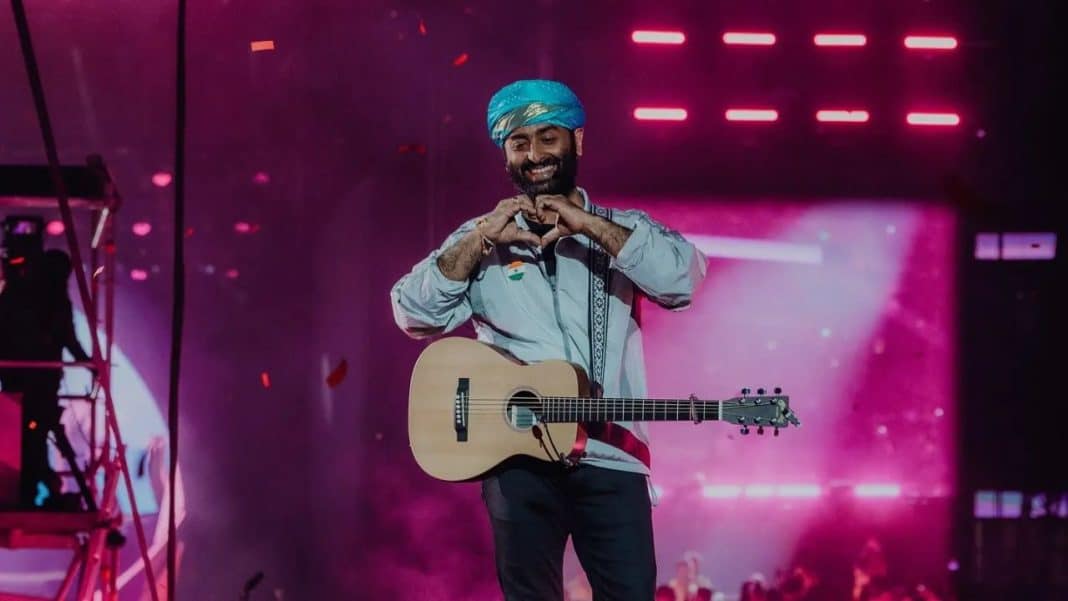

Arijit Singh Biography: At the peak of his career, when his voice dominated charts and emotions alike, Arijit Singh made an announcement that stunned the music industry. He is stepping away from playback singing.
“The decision left fans in disbelief and heartbreak, triggering a flood of questions on social media from those who had grown up with his songs as the soundtrack of their lives.”
Days after releasing “Maatrubhumi” for the Battle of Galwan alongside Shreya Ghoshal, Singh addressed his decision in a characteristically honest Instagram post. “I get bored pretty quick,” he wrote.
The blunt simplicity of the statement reflected an artist who had never fully conformed to the Bollywood mold, even while ruling it for over a decade.
From romantic hits to songs of longing, heartbreak, and quiet strength, Arijit’s soulful versatility made him feel less like a singer and more like a constant companion.
His exit at the peak wasn’t just unexpected, it marked a turning point that invites a deeper look into his journey, choices, and the voice that shaped a generation.
From Jiaganj to Stardom
Born on April 25, 1987, in Jiaganj, Murshidabad, West Bengal, Singh’s story begins far from the shining studios of Mumbai.
At just three years old, he began training under the Hazari brothers, learning Indian Classical music, tabla, and Rabindra Sangeet.
The training was so strict that young Arijit was not allowed to listen Modern Bollywood music- an irony not lost on those familiar with his career as the voice of modern romance.
His path to stardom was anything but straight. In 2005, an 18-year old Singh took part in the reality show “Fame Gurukul”, only to be eliminated in sixth place.
While the winners faded away, Singh entered an eight-year hibernation and working humbly as a music programmer, learning the craft from behind the scenes.
Everything changed in 2013 with “Tum Hi Ho” from Aashiqui 2. The soulful ballad changed the sound of modern romance in Indian cinema, transforming him from studio technician to the most wanted voice in the country almost overnight, winning his first Filmfare Award for Best Male Playback Singer.
A Decade of Dominance
What followed was an amazing run of success. From the heart-wrenching “Channa Mereya” in Ae Dil Hai Mushkil (2016) to the delicate “Agar Tum Saath Ho” from Tamasha (2015), a duet with Alka Yagnik composed by AR Rahman, Singh showed an emotional range that touched people across generations.
His versatility extended to high-energy tracks like “Nashe Si Chadh Gayi” from Befikre (2016) and romantic hits like “Raabta” from Agent Vinod (2012).
Songs like “Apna Bana Le,” “Tera Yaar Hoon Main,” “Tujhe Kitna Chahne Lage,” and “Kesariya” became the soundtrack of everyday life.
The numbers tell their own story , for seven straight years as India’s Top Artist on Spotify with over 7.1 billion streams, eight Filmfare Awards matching Kishore Kumar’s record, two National Film Awards, and the Padma Shri in 2025.
The Struggles Behind the Success
Singh’s journey wasn’t without struggles. His first marriage ended in a quiet divorce in 2013, during what he described as a period of significant emotional challenges.
The most public setback was a decade-long fight with superstar Salman Khan. After a joking comment at an awards show in 2014, his songs were reportedly removed from major films like Sultan and Bajrangi Bhaijaan.
Despite a desperate Facebook apology in 2016, the apparent ban lasted until late 2023, when the two finally made peace for Tiger 3.
More recently, critics pointed to Arijit’s fatigue the feeling that his presence as the voice of nearly every Bollywood hero had led to creative repetition, a problem that clearly weighed on an artist who valued artistic exploration over commercial formula.
The Humble Superstar
Singh’s personality is as different as his voice. He famously recorded “Phir Le Aaya Dil” from Barfi in just 20 minutes because he had a cycle rickshaw waiting outside.
Despite being India’s most-streamed artist, he has often said, I hate being a celebrity. He considers himself a music programmer by trade, a singer by fluke.
His life outside the studio shows these values. He enrolled his sons in a local school in Jiaganj rather than an expensive private institution, and he’s often spotted standing in line with other parents.
He travels by public transport, scooters, and auto-rickshaws, preferring trains and cycle rickshaws in West Bengal over private cars.
Through his NGO “Let There Be Light” and the Tatwamasi Foundation, Singh quietly supports healthcare programs, blood donation camps, and provides clothes and books to children from poor backgrounds in Murshidabad.
The Artist’s Voice
Singh’s musical style is defined by his “natural” and “nasal” voice raw, grainy, yet remarkably flexible.
He performs across genres with equal ease, from club tracks to Punjabi folk, from Sufi qawwali to ghazals.
A multi-instrumentalist skilled on harmonium, tabla, guitar, and piano, he often produces his own tracks, playing multiple instruments to achieve the exact emotional feel he wants.
In an era ruled by digital pitch correction, Singh is known for his dislike of heavy autotune, believing that the cracks and breaths in a voice make a song truly emotional.
Even at the height of his commercial success, he continued studying Hindustani Classical music, traveling across India to meet elderly masters, viewing himself as a forever student.
He credits lyricists like Irshad Kamil, Sayeed Quadri, and Amitabh Bhattacharya for shaping his interpretations, and his guru Rajendra Prasad Hazari for teaching him to balance classical discipline with modern expression.
An Exit as Soulful as His Songs
Arijit Singh’s decision to retire from playback singing at the peak of his career is perhaps the most genuine expression of who he has always been.
In an industry built on visibility, he chose privacy. In a moment of maximum commercial potential, he chose personal fulfillment.
His legacy is secure not just in the billions of streams or the awards, but in the way his voice became the language through which a generation learned to express longing, loss, and love.
In the quiet moments of heartbreak, in the celebration of connection, in the complexity of human emotion, Arijit Singh’s voice has been there, a companion in the most important moments of life.
As he steps away from the microphone, what remains is not silence but a collection of songs that will continue to speak for those who cannot find the right words themselves.
Arijit has made it clear that he is quitting playback singing, not music itself.
He wants to begin again from the very beginning, returning to Indian classical music and learning it with fresh focus. Expressing gratitude for his journey so far, he shared that God has been very kind to him.
He says he remains a true fan of music and, in the future, wants to keep learning and creating on his own slowly, quietly, and honestly as a small artist rediscovering his roots.
Also read: Shreyas Iyer Biography: Cricketer on Ground, Magician in Dressing Room