


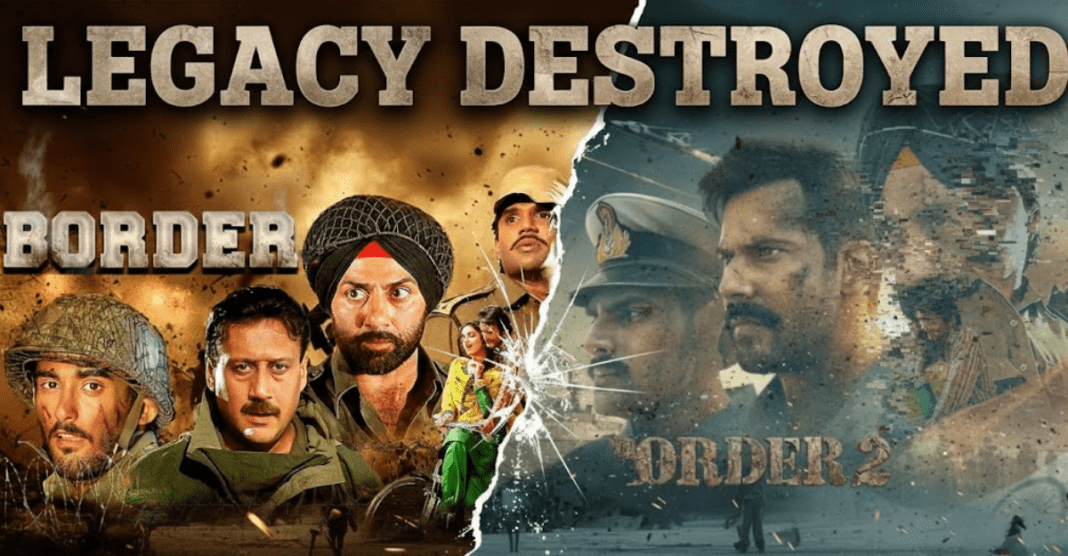

Border Raped By Border 2: Some films don’t just entertain, they become memories. Border (1997) was one such film. It wasn’t watched, it was felt.
Nearly three decades later, Border 2 arrives carrying that memory on its shoulders, and collapses under its weight.
Border Raped By Border 2: This isn’t the story of a bad film. This is the story of a film that tried hard, looked grand, and still couldn’t live up to what Border once meant. When a title becomes a legacy, effort alone isn’t enough. And that is where Border 2 falters. From the story to the dialogues, the writing is so weak that watching the film feels like a brutal violation of Border’s legacy
Story: Sincerity Without Soul
Border 2 is not careless. It is sincere, ambitious, and mounted on a massive scale. Yet sincerity cannot replace emotional connection.
JP Dutta’s Border was not just about war, it was about fear in the trenches, friendships formed in silence, and sacrifices that lingered long after the final shot.
The sequel attempts to cover four major confrontations from the 1971 India-Pakistan war: Operation Changez Khan, the Battle of Munawar Tawi, the Battle of Basantar, and the INS Khukri naval battle.
Each chapter carries immense historical weight. But the film rushes through them, never allowing the emotions to breathe.
The result is admiration without attachment, spectacle without intimacy.
Border 1 vs Border 2: Scale Over Substance
Border Raped By Border 2: The original Border thrived on its ensemble. Every soldier mattered. Every face stayed with you. The battlefield felt close, personal, almost claustrophobic.
In Border 2, Sunny Deol remains the strongest bridge between past and present. Even at 68, his presence is commanding and instinctive. He carries the film with authority — but often, he carries it alone.
Diljit Dosanjh brings restraint and sincerity, while Varun Dhawan and Ahan Shetty remain competent but unremarkable. In a film so defined by memory, “good enough” performances feel insufficient. Where Border felt like a united force, Border 2 feels fragmented, technically impressive, emotionally distant.
Dialogues and Music: Borrowed Emotion
Border Raped By Border 2: If there is one area where Border 2 truly exposes its weakness, it is music. The new soundtrack fails to leave a mark. Emotional recall comes almost entirely from the original album, Sandese Aate Hain, Toh Chaloon, songs already etched into collective memory.
Instead of the music emerging naturally, scenes feel constructed around these classics.
Nostalgia does the heavy lifting. Dialogues too rely on callbacks, “Awaaz kahan tak jaani chahiye,” echoes of “mujhe shakti do maa.”
These references are meant to stir emotion, but they also underline the gap between homage and originality.
Direction: When Legacy Becomes a Burden
Border 2 consciously chooses scale over depth. The battles are larger, the canvas wider, the production more polished.
Yet despite a runtime exceeding three hours, the war sequences feel fleeting.
The original Border allowed viewers to live inside the battlefield. Border 2 merely shows it.
Some stories deserved more space, particularly Diljit Dosanjh’s Flying Officer Nirmal Jit Singh Sekhon, whose Param Vir Chakra-winning bravery is barely explored, and Ahan Shetty’s Lt. Cdr. MS Rawat, whose emotional arc arrives and ends too abruptly.
Had this film arrived without the weight of its title, it might have been judged more kindly. But legacy does not allow neutrality.
Border 2 is not poorly made. The intent is honest, the effort undeniable, and the scale impressive. It will find its audience.
But for those who grew up with Border, who remember crying through its silences and holding onto its songs, this sequel feels like a reminder that some films are not meant to be revisited.