

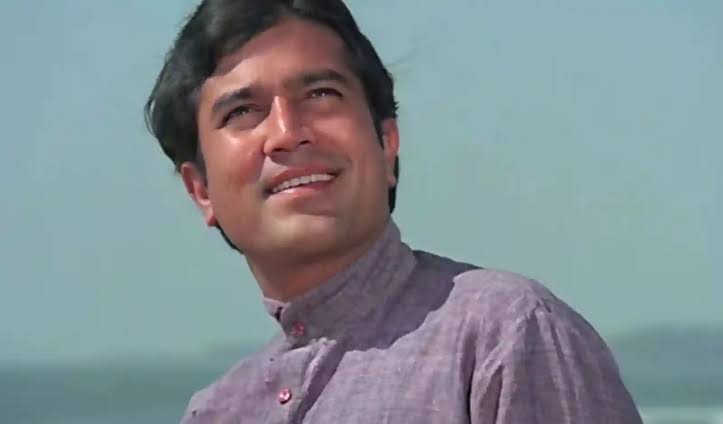

Rajesh Khanna Biography
In the late 1960s and early 1970s, India witnessed something the film industry had never experienced before. Cinema halls were no longer just places where people watched movies, they became sites of celebration, devotion, and near-religious admiration. Outside theaters, crowds gathered in thousands, waiting for hours and sometimes days just to catch a glimpse of the man who had captured the nation’s imagination.
Tickets were sold out weeks in advance, and when his films released, long queues wrapped around entire city blocks.
Fans expressed their admiration in ways that had never been seen in Indian cinema before. Young women sent him love letters written in their own blood, some reportedly married his photographs in private ceremonies, and many fainted merely at the sight of him arriving at public events. His car often returned home covered with lipstick marks from admirers who rushed to touch or kiss it.
Outside his famous bungalow in Mumbai, fans gathered daily, hoping for a momentary wave from their idol.
Inside the theaters, the excitement was equally electric. As soon as he appeared on the screen, audiences erupted into cheers and applause. Dialogues spoken by him were repeated loudly by fans, and songs picturized on him became instant sensations across the country.
Radio stations repeatedly played melodies associated with his films, turning them into national anthems of romance and emotion. For many viewers, watching his films was not just entertainment, it was an experience filled with passion, admiration, and emotional connection.
During this extraordinary phase, his movies achieved records rarely seen before. Several of his films celebrated silver jubilees (running 25 weeks) and golden jubilees (running 50 weeks) in theaters.
Producers, directors, and distributors planned their entire schedules around his availability because his presence alone could guarantee massive box office success. Film posters bearing his face were enough to ensure packed theaters.
At a time when the Hindi film industry had not yet defined or fully understood the concept of a “superstar,” audiences had already created one through their love, loyalty, and obsession. His popularity was not merely fame, it was a cultural phenomenon that reshaped the way stardom was perceived in Indian cinema.
That man was Rajesh Khanna widely regarded as the first true superstar of Indian cinema.
Personal Overview
| Full Name | Jatin Khanna |
| Screen Name | Rajesh Khanna |
| Nickname | “Kaka” |
| Date of Birth | 29 December 1942 |
| Birthplace | Amritsar, Punjab, India |
| Profession | Actor, Producer, Politician |
| Years Active | 1966–2012 |
| Debut | Aakhri Khat |
| Political Party | Indian National Congress |
| Spouse | Dimple Kapadia |
| Children | Twinkle Khanna, Rinke Khanna |
| Net Worth | $65 million |
| Nationality | Indian |
| Religon | Hinduism |
Early Roots and Family Background
Rajesh Khanna was born as Jatin Khanna on 29 December 1942 in Amritsar, into a middle-class Punjabi Khatri family. His biological parents were Lala Hiranand Khanna and Chand Rani Khanna.
At a very young age, he was adopted by his wealthy relatives, Chunnilal Khanna and Leelawati Khanna, who lived in Mumbai. After his adoption, he moved to Mumbai and grew up in a financially stable environment.
His adoptive father worked as a railway contractor, which allowed the family to provide him with good education and a comfortable upbringing.
He was raised in Girgaum, a culturally vibrant area of Mumbai known for its theatre and artistic atmosphere. Growing up close to cinema halls and stage performances gradually developed his interest in acting, planting the early seeds of the dream that would later turn him into one of the most celebrated stars of Indian cinema.
Education
While he was destined for the arc lights, his foundation was laid in some of the most prestigious institutions of India. His academic years were not just about degrees; they were the training grounds where he first discovered his love for the stage.
Schooling: The Roots of a Lifelong Friendship
He attended St. Sebastian’s Goan High School in Girgaon, South Mumbai. It was here that he met his lifelong friend, Ravi Kapoor (Jeetendra). Even in school, he was deeply involved in theater, often winning prizes for his performances in inter-school drama competitions.
Higher Education: Transitioning to the Arts
His college years saw him moving between Pune and Mumbai, balancing his studies with his growing passion for acting:
Nowrosjee Wadia College (Pune): From 1959 to 1961, he studied for his first two years of a Bachelor of Arts (B.A.).
Kishinchand Chellaram (K.C.) College (Mumbai): He completed his graduation at K.C. College. It was during this period that his participation in inter-college drama reached a fever pitch.
Career Beginning
The Audacious Beginning (1965–1968)
In the early 1960s, the film industry saw a strange sight: a newcomer arriving for auditions in a sleek MG sports car. While others waited at bus stops, he drove himself to the gates of studios, already carrying the aura of a star.
The “United Producers” Breakthrough
In 1965, he participated in the All India Talent Contest organized by United Producers and Filmfare.
The Competition: Out of more than 10,000 contestants, he was selected as one of the eight finalists.
The Victory: He won the contest, beating other future notables like Vinod Mehra and Subhash Ghai.
The Prize: The win came with a contract for films with the industry’s biggest banners, including G.P. Sippy and Nasir Hussain. It was here that Jatin Khanna officially became Rajesh Khanna.
The Debut: Aakhri Khat (1966)
His first film was Chetan Anand’s Aakhri Khat.
The Role: He played a young sculptor, but the real “star” of the film was a 15-month-old toddler wandering the streets of Mumbai.
Historical Significance: Though the film was a box-office failure at the time, it was a critical masterpiece and became India’s first official entry for the Best Foreign Language Film at the 40th Academy Awards (Oscars) in 1967.
The Leading Break: Raaz (1967)
While Aakhri Khat was his first release, he considered Raaz (1967) his first major break as a leading man. Starring opposite the popular actress Babita, the film was a suspense thriller.
Despite his confidence, he later admitted to being “shy” in front of the camera during these early days, often needing guidance on his body language and the now-famous “Khanna walk.”
The Turning Point: 1969
Between 1967 and 1968, he appeared in films like Baharon Ke Sapne and Aurat, which received modest attention. However, 1969 acted as a catalyst that would change Indian cinema forever.
Aradhana (1969): The dual role of father and son made him an overnight sensation. The song “Mere Sapno Ki Rani” became the anthem of a generation.
Do Raaste (1969): Released shortly after, this family drama solidified his status.
These two films were the spark that ignited the “Rajesh Khanna Phenomenon,” leading into his world-record streak of 15 consecutive solo hits (1969–1971), including classics like Anand, Kati Patang, and Amar Prem.
Career Timeline
1960s – Entry into Films
1965: Won the All-India talent contest organized by Filmfare and United Producers.
1966: Made his debut with Aakhri Khat, directed by Chetan Anand.
1967–1968: Appeared in films such as Raaz and Baharon Ke Sapne, slowly gaining recognition.
1969 – The Breakthrough Year
1969: Starred in Aradhana, which became a massive hit.
The film established him as a romantic hero and brought him nationwide fame.
1969–1975 – Era of Superstardom
Became the first superstar of Indian cinema with a historic run of consecutive hits.
Major successful films included:
-Anand
-Kati Patang
-Haathi Mere Saathi
-Amar Prem
-Daag
During this period he delivered 15 consecutive solo hit films, an extraordinary record.
Late 1970s – Changing Trends
The rise of action films and stars like Amitabh Bachchan changed audience preferences.
Rajesh Khanna’s dominance at the box office began to decline.
1980s – Comeback Attempts
Continued acting and delivered notable performances in films such as:
-Avtaar
-Souten
Remained a respected senior actor in the industry.
1990s – Politics and Select Films
Joined the Indian National Congress.
1992: Elected as Member of Parliament from New Delhi.
Reduced his film appearances during this period.
2000s – Later Appearances
Made occasional appearances in films and advertisements.
Remained active in public events and film-related activities.
2010–2012 – Final Years
Appeared in a few public projects and interviews.
2012: Passed away in Mumbai, leaving behind a legendary cinematic legacy.
Superstardom Era (1969–1975)
The period from 1969 to 1975 is often described as the golden age of Rajesh Khanna’s career. After the success of Aradhana, he became the most sought-after actor in Hindi cinema. Producers, directors, and distributors believed that simply having him in a film almost guaranteed success.
During this era he delivered 15 consecutive solo hit films, a record that remained unmatched for decades. His romantic image, emotional dialogue delivery, and charming personality connected deeply with audiences.
Some of his most celebrated films from this period include:
-Anand
-Kati Patang
-Haathi Mere Saathi
-Amar Prem
-Daag
His collaborations with singer Kishore Kumar created timeless songs that became classics of Indian cinema.
The “Kishore-Rajesh-RD” Musical Revolution
This trio didn’t just make music; they created a psychological connection with the listener.
The Voice: Kishore Kumar became the “official” voice of Khanna. Their voices were so perfectly synchronized that listeners often felt they were one person. Before this, Mohammad Rafi was the dominant playback singer, but the Khanna-Kishore wave shifted the industry’s entire sound.
The Sound: R.D. Burman brought Western arrangements, jazz influences, and Latin beats into Indian melodies. Songs like “Yeh Jo Mohabbat Hai” and “Pyaar Deewana Hota Hai” remain timeless.
The Result: Even today, a Rajesh Khanna film is synonymous with its soundtrack. The music acted as a marketing force that ensured a film was a hit before it even hit the screens.
Rajesh Khanna vs Amitabh Bachchan Rivalry
In the early 1970s, the Hindi film industry witnessed the rise of another powerful star — Amitabh Bachchan.
While Rajesh Khanna represented the romantic hero, Amitabh Bachchan introduced the “angry young man” image, reflecting the frustrations of India’s youth during that era.
Their most famous collaboration was:
-Namak Haraam
Over time, audience preferences shifted toward action-oriented films, and Amitabh Bachchan became the dominant star of the late 1970s and 1980s. This shift contributed to the gradual decline of Rajesh Khanna’s box-office dominance.
The Record-Breaking “15” (1969–1971)
| # | Film | Year | Key Highlight |
| 1 | Aradhana | 1969 | The birth of the Phenomenon. |
| 2 | Do Raaste | 1969 | Solidified him as the darling of Indian families. |
| 3 | Bandhan | 1969 | A rural drama that proved his range. |
| 4 | Doli | 1969 | A sensitive portrayal of romance and sacrifice. |
| 5 | Ittefaq | 1969 | A song-less thriller; proved he didn’t need music to succeed. |
| 6 | Kati Patang | 1970 | “Gave the world the “”Madhav”” persona and immortal music.” |
| 7 | The Train | 1970 | A stylish mystery thriller. |
| 8 | Sachaa Jhutha | 1970 | Won him his first Filmfare Best Actor Award. |
| 9 | Safar | 1970 | A tragic masterpiece about life and death. |
| 10 | Aan Milo Sajna | 1970 | Massive musical success with Asha Parekh. |
| 11 | Anand | 1971 | “His most iconic role; the “”mortal”” hero who lives forever.” |
| 12 | Maryada | 1971 | A high-octane drama alongside Raaj Kumar. |
| 13 | Haathi Mere Saathi | 1971 | The biggest hit of the year; made him a hero to children. |
| 14 | Amar Prem | 1971 | “Defined the “”soulful”” romantic hero (“”Pushpa, I hate tears””).” |
| 15 | Andaz | 1971 | “Featuring the motorbike anthem “”Zindagi Ek Safar Hai Suhana””.” |
Controversies
The “Napoleon” Ego: He was notorious for arriving 4–5 hours late to sets. He believed the industry revolved around him, famously telling producers, “The superstar has arrived,” even if he was half a day late.
The Slap Heard ‘Round the Set: Legend has it that the great comedian Mehmood once slapped Khanna during the filming of Janta Hawaldar because he was fed up with the star’s tardiness and arrogance.
The Bachchan Rivalry: He had a bitter cold war with Amitabh Bachchan. He reportedly felt threatened by Amitabh’s rise and once mocked him on a film set, leading to a long-standing rift.
Spiteful Heartbreak: When he broke up with Anju Mahendru to marry Dimple Kapadia, he intentionally diverted his wedding procession (baraat) to pass right under Anju’s balcony just to show off.
The Live-in Partner Scandal: After his death, Anita Advani claimed she was his live-in partner at his bungalow, Aashirwad, leading to a messy legal battle over his ₹600 crore estate and his “missing” will.
Domestic Friction: His marriage to a 16-year-old Dimple Kapadia was plagued by reports of him being controlling, allegedly forbidding her from acting, which eventually led to their 30-year separation.
Awards and Recognition
| Award Name | Year | Category/Reason |
| Filmfare Award | 1971 | Best Actor (Sachaa Jhutha) |
| Filmfare Award | 1972 | Best Actor (Anand) |
| BFJA Award | 1972 | Best Actor (Anand) |
| BFJA Award | 1973 | Best Actor (Bawarchi) |
| BFJA Award | 1974 | Best Actor (Namak Haraam) |
| Filmfare Award | 1984 | Best Actor (Avtaar) |
| BFJA Award | 1987 | Best Actor (Amrit) |
| Filmfare Award | 1991 | Special Award (25 Years in Industry) |
| Filmfare Award | 2005 | Lifetime Achievement Award |
| IIFA Award | 2009 | Lifetime Achievement Award |
| Padma Bhushan | 2013 | Third-Highest Civilian Honor (Posthumous) |
| Dadasaheb Phalke Academy Award | 2013 | First Superstar of Indian Cinema (Posthumous) |
Acting Style: The “Kaka” Grammar
Khanna’s acting was less about dialogue and more about punctuation.
The Head Tilt: A slight sideways tilt of the head during romantic dialogues that drove fans into a frenzy.
The Eyes: He had a way of crinkling his eyes while smiling that suggested a deep, soulful intimacy.
The Hands: He used his hands expressively, often touching his forehead or chest to emphasize heartbreak or joy.
The “Death” Scene: He was the undisputed king of dying on screen. From Anand to Safar, his “death” scenes were so moving that theaters often echoed with the sound of sobbing audiences.
The Iconic Screen Lines
“Babumoshai, zindagi badi honi chahiye, lambi nahi.” (Anand)
“Pushpa, I hate tears.” (Amar Prem)
“Main marne se pehle marna nahi chahta.” (Safar)
“Bada aadmi toh woh hota hai jo doosron ko chota nahi samajhta.” (Avtaar)
Politics and Business
In 1992, he entered a new arena.
The MP: He was elected as a Member of Parliament for the Indian National Congress from the New Delhi constituency (1992–1996), famously defeating Shatrughan Sinha.
Business: He was involved in film production and had various real estate interests, including his legendary bungalow, Aashirwad.
The Dispute and the Demolition
After his death in 2012, Aashirwad became the center of a bitter legal battle.
The Contender: Anita Advani, who claimed to be his live-in partner, challenged his will, which left the property to his daughters, Twinkle and Rinke.
The Sale: In 2014, the family sold the iconic bungalow to businessman Shashi Kiran Shetty for a staggering ₹85 Crore.
The End of an Era: In 2016, the bungalow was demolished to make way for a multi-story residential building. Fans across the globe mourned, as the last physical monument of the “Rajesh Khanna Era” was turned to dust.
Connection with Peers
The Rival (Amitabh Bachchan): A classic “clash of titans.” Khanna initially mentored him in Anand, but as Amitabh’s “Angry Young Man” took over, a cold war began. They remained professional rivals for decades, though Amitabh visited him during his final days to pay his respects.
The Brother (Jeetendra): His most genuine bond. They were childhood friends from the same school. Khanna even coached Jeetendra for his very first film audition. They stayed close throughout their lives.
The Soulmates (Kishore Kumar & R.D. Burman): These three were a “Holy Trinity.” They weren’t just colleagues; they were best friends who spent nights composing music together. When Kishore died, Khanna famously said, “I have lost my voice.”
The Favorite (Mumtaz): His most successful co-star. They shared a deep, platonic comfort. When she retired to get married, Khanna reportedly felt a deep sense of loneliness on set.
The “Coterie”: Unlike other stars, Khanna preferred a “court” of hangers-on and minor actors. He paid for their lavish lifestyles, and in return, they provided the constant praise and company his ego required.
Industry Appreciation: How Peers Saw Him
The “First” Superstar: The term “Superstar” was specifically coined by the Indian press to describe the madness surrounding him—it didn’t exist for anyone before him.
Hrishikesh Mukherjee: The legendary director once said that while other actors acted, Rajesh Khanna “lived” the role of the dying man in Anand.
Manoj Kumar: He famously remarked, “Rajesh Khanna was the soul of the film industry for a decade.”
The Final Act: Illness and Death
In 2011, his health began to decline. He was diagnosed with cancer. On July 18, 2012, he passed away at his home, Aashirwad.
His funeral was attended by nearly 900,000 people—the largest for any actor in Indian history—proving that while the star had faded, the love remained.
The Vision and Legacy
Rajesh Khanna’s vision was simple: To be loved eternally. He didn’t want to be just an actor; he wanted to be an emotion.
Impact: He changed the “Hero” from a distant figure to a “friend” (Anand) or a “soulmate” (Amar Prem).
Public Image: He was the first actor to experience “mass hysteria.” Before him, fans were polite; after him, they were obsessive.
Lesser Known Facts
The Oscar Entry: His very first film, Aakhri Khat, was India’s official entry to the Oscars in 1967.
The “Miracle” Belief: Fans used to bring sick children to his house, believing his “blessing” could cure them—such was the level of his “God-like” status.
The Most Successful Producer: His film Haathi Mere Saathi was the highest-grossing film of 1971 and saved the famous Devar Films studio from bankruptcy.
The “Wait” was Worth it: He was the highest-paid Indian actor from 1970 to 1987.