


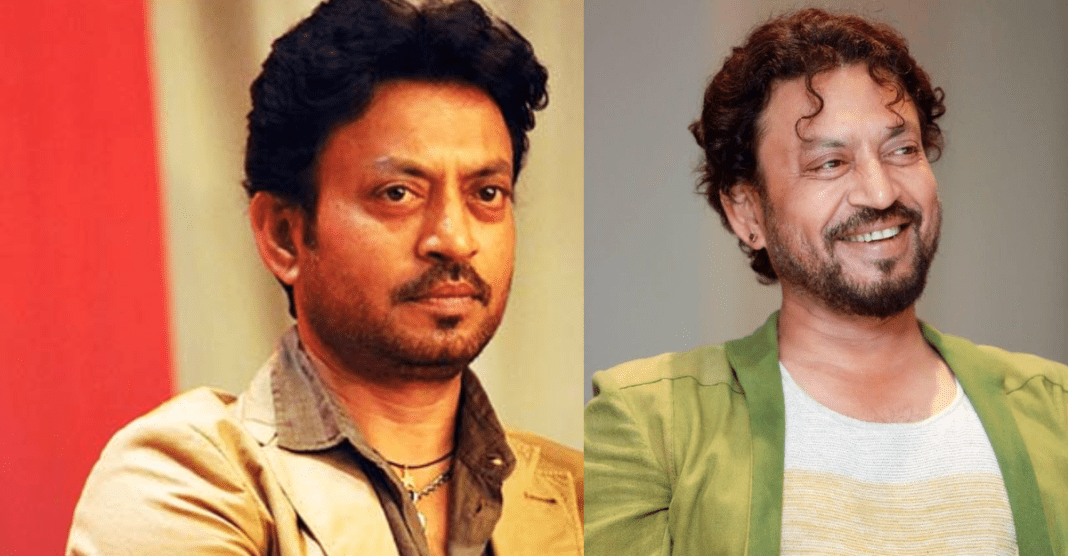

Irrfan Khan Biography: He was the boy from the deserts of Rajasthan who was told his face was “too unconventional,” his eyes “too heavy,” and his demeanor “too quiet” for the loud, technicolor world of Indian cinema.
In an industry obsessed with muscular fairness and melodic lip-syncing, he was an anomaly a man who didn’t fit the mold, so he decided to break it entirely.
For over a decade, he remained a ghost in the machine, grinding through the repetitive shadows of 90s television, appearing in living rooms across India while his soul hungered for something more than soap opera scripts.
He was the “struggling actor” who was almost erased from his own debut, yet he possessed a patience that was as cinematic as his performances.
Then, the world shifted.
Irrfan Khan Biography: He became the man who made Hollywood’s biggest titans from Tom Hanks to Steven Spielberg stand in awe of his silence.
Hanks famously called him “the coolest guy in the room,” while critics worldwide struggled to find adjectives that could keep up with his range.
He didn’t just “act” a part; he inhabited it so deeply that the script became a mere suggestion.
Whether he was a lonely widower in a Mumbai office, a rebel in the ravines of Chambal, or a billionaire overseeing a park of dinosaurs, he brought a haunting vulnerability to the screen that made dialogue feel secondary to the profound, melancholic truth residing in his eyes.
Irrfan Khan Biography: He didn’t seek fame; fame eventually found him because it had nowhere else to go. He bridged the impossible gap between the “masala” of Bollywood and the “method” of the West, proving that a Pathan from Jaipur could become the heartbeat of global cinema.
This is the odyssey of Sahabzade Irrfan Ali Khan. This is the story of a man who taught us that sometimes, the loudest way to speak is to stay perfectly still.
Personal Overview
| Full Name | Sahabzade Irfan Ali Khan |
| Popular Name | Irrfan Khan (later officially spelled Irrfan) |
| Date of Birth | 7 January 1967 |
| Place of Birth | Jaipur, Rajasthan, India |
| Age (at death) | 53 years |
| Date of Death | 29 April 2020 |
| Profession | Actor, Producer |
| Active Years | 1985 – 2020 |
| Net Worth | Approximately ₹350–400 crore |
| Mother | Saeeda Begum |
| Father | Yaseen Ali Khan |
| Spouse | Sutapa Sikdar |
| Children | Babil Khan, Ayaan Khan |
| Nationality | Indian |
The Foundations: Roots and Noble Lineage
Before the lights of Hollywood, there was the heat of Jaipur.
Irrfan was born into a family that carried the weight of history.
Family Background: Born on January 7, 1967, to Sahabzade Yaseen Ali Khan and Sayeeda Begum.
His father was a wealthy businessman dealing in tires, and his mother belonged to the Tonk Hakim family.
The “Brahmin” Pathan: In a household of hunters and meat-eaters, Irfan was the oddity a vegetarian who recoiled at the sight of blood.
His father often teased him, saying he was “a Brahmin born in a Pathan family.”
The Cricket Heartbreak: His first love wasn’t the camera; it was the leather ball. A gifted all-rounder, he was selected for the CK Nayudu Trophy.
However, the lack of 600 rupees for travel expenses ended his sporting career before it began a failure that pushed him toward the National School of Drama (NSD).
Education
Schooling & College: He grew up in Jaipur, completing his early education and later a Bachelor’s degree from Rajasthan College.
The Master’s Pivot: He was actually pursuing his M.A. (Master of Arts) in Jaipur when the acting bug bit hard. He decided to drop the traditional path to chase a scholarship at the prestigious National School of Drama (NSD) in New Delhi.
The Big Break (1984-1987): He graduated from NSD in 1987. This wasn’t just where he learned his craft; it’s where he met his wife, Sutapa Sikdar, and refined the “minimalist” style that would later stun Hollywood.
The “Necessary Lie”: To get into NSD, he reportedly lied about having prior theater experience because his passion was greater than his resume at the time.
The Career Dawn: A Heartbreaking Start
Irrfan’s entry into cinema wasn’t a red-carpet walk; it was a brutal lesson in rejection.
The Salaam Bombay! Tragedy (1988): While still at NSD, legendary director Mira Nair spotted him. She cast him as one of the lead street children in her iconic film.
Irrfan trained with street kids for weeks, losing weight to look the part. However, two days before filming, Mira told him he was too tall and didn’t look “malnourished” enough compared to the other kids.
He was reduced to a tiny, blink-and-miss-it role as a letter writer. He reportedly cried for hours after hearing the news.
The “Television Trap”: With no film offers, he moved to Mumbai. For the next 10 to 12 years, he became a “TV actor.” While he was brilliant in shows like Chanakya, Bharat Ek Khoj, and Banegi Apni Baat, he felt his soul withering. He was earning money, but he wasn’t “creating.”
The Villain Tag: In the early 2000s, Bollywood only saw him as a “character actor” or a “villain.”
His breakthrough in Haasil (2003) as the menacing Ranvijay Singh made him a star, but it threatened to pigeonhole him into “bad guy” roles forever.
The International “Accident”
The world only truly discovered Irrfan because of a British filmmaker named Asif Kapadia.
The Warrior (2001): Kapadia cast him in this minimalist, samurai-style film shot in Rajasthan.
It won the BAFTA for Best British Film. Suddenly, international critics were asking, “Who is this man who acts with his eyes?”
*The Irony: It took a British film to make India realize they had a diamond sitting in their backyard.
Career Timeline & Iconic Milestones
| Year | Film | Significance |
|---|---|---|
| 1988 | Salaam Bombay! | His “non-debut” that fueled his hunger. |
| 2003 | Haasil | Established him as a powerhouse in Bollywood. |
| 2004 | Maqbool | Proved he could handle Shakespearean complexity. |
| 2006 | The Namesake | His first major Hollywood leading role (with Mira Nair). |
| 2012 | Paan Singh Tomar | Won him the National Award; the peak of his craft. |
| 2013 | The Lunchbox | Became a global sensation; a masterclass in romance. |
| 2017 | Hindi Medium | His biggest commercial solo hit. |
Challenges & Struggles
The “Look” Barrier: Casting directors told him he didn’t look like a “Hero.” He didn’t have the dancing skills or the “chocolate boy” face.
He fought against the “fair and handsome” stereotype for two decades.
Financial Grind: During his TV days, there were times he struggled to pay rent. He once joked that he did so many TV episodes just to keep his kitchen running.
Identity Crisis: In Hollywood, he fought against being cast as the “stereotypical Indian.” He refused roles that mocked his heritage, insisting on characters with depth (like a scientist in The Amazing Spider-Man or a CEO in Jurassic World).
The Rise to Stardom: Bollywood & Beyond
The international success of The Warrior finally forced Bollywood to take notice.
Bollywood Breakthroughs:
Haasil (2003): His role as the devious student leader Ranvijay Singh earned him his first Filmfare Award (Best Villain) and cult status.
Maqbool (2004): His portrayal of a modern-day Macbeth proved he could carry the weight of a complex lead.
Life in a… Metro (2007): Showcased his impeccable comic timing and romantic vulnerability.
Paan Singh Tomar (2011): The definitive performance of his career, which won him the National Film Award for Best Actor.
The Global Icon (Hollywood)
Irrfan became India’s most successful export to the West, not as a “caricature,” but as a powerhouse performer in:
| Film | Year |
|---|---|
| The Namesake | 2006 |
| Slumdog Millionaire | 2008 |
| The Amazing Spider-Man | 2012 |
| Life of Pi | 2012 |
| Jurassic World | 2015 |
| Inferno | 2016 |
Acting Style: The Art of the “Unsaid”
Irrfan’s style was characterized by minimalism. He famously said, “I don’t want to act; I want to be.”
His peers often noted that while other actors used their bodies and voices, Irrfan used his eyes.
He had a rare ability to blend into a character so completely that the “star” vanished.
“Irrfan’s eyes speak louder than his words.” Critical consensus on his performance in Rog.
Controversies
The Religion Row (2016): Irfan sparked a massive storm when he questioned the traditional meaning of Qurbani (sacrifice), saying it should be about giving up something dear to you, not just buying a goat.
Clerics were furious, but Irrfan famously replied: “I don’t live in a country governed by religious contractors.”
The US Airport Drama: Despite being a global star, he was detained twice at US airports (2008 & 2009) due to his last name. He handled it with his signature wit, saying it kept him “humble.”
The “Nawaz” Cold War: Rumors of a massive ego clash with Nawazuddin Siddiqui on the sets of The Lunchbox followed him for years.
While the media painted them as rivals, they both later dismissed it as professional space rather than personal hate.
Awards
| Award / Organization | Film / Contribution | Year |
|---|---|---|
| Padma Shri | Contribution to Arts | 2011 |
| National Film Award (Best Actor) | Paan Singh Tomar | 2013 |
| Screen Actors Guild (SAG) Award | Slumdog Millionaire | 2009 |
| Asian Film Award (Best Actor) | The Lunchbox | 2014 |
| Filmfare (Best Villain) | Haasil | 2004 |
| Filmfare (Best Supporting Actor) | Life in a… Metro | 2008 |
| Filmfare (Best Actor – Critics) | Paan Singh Tomar | 2013 |
| Filmfare (Best Actor) | Hindi Medium | 2018 |
| Filmfare (Best Actor – Posthumous) | Angrezi Medium | 2021 |
| Filmfare Lifetime Achievement | Career Contribution | 2021 |
| Dubai International Film Festival (Best Actor) | The Lunchbox | 2013 |
| Oscar & BAFTA (In Memoriam) | Global Impact | 2021 |
Key Highlights of his Recognition
The Oscar Connection: While he never won a solo Oscar, he was a key part of four Academy Award-nominated/winning films, Salaam Bombay!, Slumdog Millionaire, Life of Pi, and The Namesake.
The “Khan” Exception: In an era dominated by the “Big Three” (SRK, Salman, Aamir), Irrfan was the only actor to win Best Actor awards purely on the strength of “character-driven” cinema.
The Universal Actor: He is one of the very few Indian actors to have been nominated for an Independent Spirit Award (USA) for The Namesake.
Connection with Peers
The Hollywood “Fan Club”: Tom Hanks famously called him “the coolest guy in the room” and sent him handwritten notes of admiration.
Ang Lee and Danny Boyle viewed him as a “wizard” who could fix any scene with a single look.
The Tabu Connection: His most profound bond was with Tabu. They were creative soulmates who could communicate through silence.
She often said that her best work only happened when she was looking into his eyes.
The “Khan” Brotherhood: While the media tried to create a rivalry, Shah Rukh Khan once handed Irrfan the keys to his London home during his illness, proving the deep, quiet bond they shared behind the scenes.
The Mentor: For younger actors like Deepika Padukone and Vicky Kaushal, he was the “Gentle Giant.”
He was known for being incredibly generous, often calling junior actors out of the blue to praise a single scene they did well.
His Reputation in the Industry
- Hollywood “Seen as a Global Master (not just an “Indian actor”).”
- Bollywood “The Bridge between “Mass” and “Class” cinema.”
- Juniors “An Inspiration who proved talent wins over “”nepotism.”
Net Worth
At the time of his passing, his net worth was estimated to be around $50 million (₹320+ Crores), including luxury properties in Mumbai and a collection of high-end cars.
The Final Battle
In March 2018, the world came to a standstill when Irrfan tweeted a cryptic but brave message about a “rare disease.” He was diagnosed with a Neuroendocrine Tumour.
The Grace of the Struggle: Instead of disappearing into bitterness, Irrfan turned his illness into a final piece of performance art.
He wrote letters from his hospital bed in London, speaking about the “uncertainty” of life and the beauty of the “now.”
The Final Gift: Despite being frail and in immense pain, he returned to India to shoot Angrezi Medium (2020).
He wanted to leave one last smile for his fans. He couldn’t even promote the film, leaving a heart-wrenching voice note instead: “Wait for me.”
The Departure: On April 29, 2020, the “Warrior” finally rested. He passed away in Mumbai, leaving a void in global cinema that remains unfilled.
Famous Lines & Speeches
His voice had a rhythmic, conversational quality that made even the most scripted lines feel like a secret shared between friends.
From Life of Pi: “I suppose in the end, the whole of life becomes an act of letting go, but what always hurts the most is not taking a moment to say goodbye.”
From The Lunchbox: “I think we forget things if there is nobody to tell them to.”
From Paan Singh Tomar: “Beehad mein baaghi hote hain, dacait milte hain Parliament mein.” (Rebels are found in the ravines; dacoits are found in Parliament.)
His Speech Philosophy: He once said, “To be famous is a disease… I want to be known for my work, not for my face on a hoarding.”
The Vision & Impact
The Anti-Bollywood Hero: He hated the term “Bollywood” (feeling it was a copy of Hollywood). He wanted Indian cinema to have its own unique, world-class identity.
Public Image: He was the “Un-Star.” He didn’t have a massive entourage or a PR-driven life. He was a man of the soil who just happened to be a genius.
Lesser-Known Facts
The “Other” Career: He was a master at repairing air conditioners and once worked as an AC technician in Mumbai while waiting for his big break. One of the houses he visited to fix an AC belonged to legend Dilip Kumar.
The “R” Fact: He added the extra ‘r’ to his name (Irrfan) not for luck, but because he liked the way it vibrated when spoken.
The Hollywood Reject: He famously turned down a role in Christopher Nolan’s Interstellar because he wanted to stay in India for the release of The Lunchbox and D-Day.
Biography By: Snigdha