


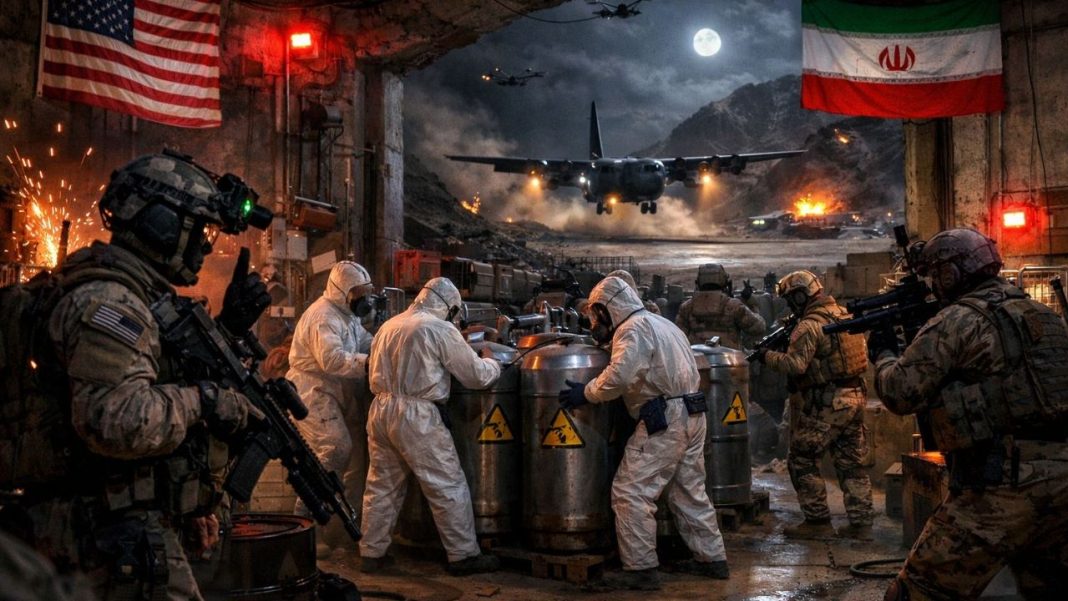

The 440kg Gamble: As of March 30, 2026, the global landscape stands at a knife’s edge, caught between the echoes of a month-long air campaign and the looming shadow of a historic ground invasion.
What began on February 28 a series of targeted strikes to dismantle the Iranian military machine has officially entered its most perilous phase yet.
Following the failure of last year’s Operation Midnight Hammer to fully neutralize Tehran’s deepest bunkers, reports are surfacing that the Trump administration is preparing for an unprecedented “snatch-and-grab” mission.
The target is as specific as it is dangerous: 440 kilograms of 60% enriched uranium, hidden within the near-impregnable tunnels of Pickaxe Mountain and Isfahan.
While President Trump continues to signal a preference for a “Big Deal” through sudden diplomacy, the high-alert status of U.S.
Army Rangers suggests that the “440kg Gamble” is the administration’s ultimate insurance policy a plan to physically “repo” Iran’s nuclear future if the talking stops.
The Problem Bombs Could Not Solve
For weeks, American and allied aircraft have pounded Iranian nuclear sites. But the most dangerous material has remained out of reach.
Stored behind metres of reinforced concrete and solid mountain rock, the uranium stockpile survived a previous air campaign reportedly called Operation Midnight Hammer without being touched.
At 60 percent enrichment, Iran’s 440-kilogram stockpile sits just short of weapons-grade, which stands at 90 percent.
The gap, however, is narrow enough that nuclear specialists have described the current stockpile as a “red line” a point from which a fully functional nuclear weapon is only a short technical step away.
With destruction from the air having proved insufficient, senior officials in Washington have reportedly concluded that the only remaining option is to go in and take it.
A Mission Unlike Any Other
This would be no quick raid, analysts say. Nuclear experts familiar with such operations note that uranium stored as pressurised gas in heavy sealed cylinders cannot simply be loaded onto a truck.
The process requires engineers with specialist equipment working under tightly controlled conditions a procedure that could take several days.
That timeline carries enormous military implications. Reports claim the 75th Ranger Regiment is on high alert for this mission.
The unit would need to capture a facility, establish a secure perimeter, hold off any Iranian counterattack, and protect technical teams carrying out the extraction all simultaneously, deep inside enemy territory.
Perhaps the most perilous element of the reported plan is the exit strategy. To fly the uranium canisters out, reports indicate the U.S. military would need to establish a temporary airstrip inside Iran capable of landing heavy MC-130J cargo aircraft.
Military planners describe this manoeuvre as among the most complex and risky in modern warfare.
Trump Keeps Two Options Open
While military preparations reportedly continue, President Trump is simultaneously pursuing a very different path.
On March 29, Trump indicated publicly that negotiations with Iranian intermediaries were progressing well, suggesting a comprehensive agreement could be within reach.
Reports claim the president described the diplomatic track as potentially leading to a “Big Deal” that could bring the conflict to an end.
The parallel approach appears deliberate. By keeping the ground operation visibly on the table, the administration is using the threat of Rangers at the gates of Iran’s most sensitive facilities as its most powerful bargaining chip.
The message to Tehran, analysts say, is clear: negotiate away your nuclear programme, or face the prospect of American soldiers coming to take it.
Whether that pressure brings Iran to the negotiating table or pushes it toward further confrontation remains, according to observers on both sides of the debate, the central unanswered question of the conflict.
Felt at the Pump Worldwide
For much of the world, the consequences of the standoff have arrived not as distant headlines but as rising fuel costs.
Since Iran shut down the Strait of Hormuz the narrow waterway through which approximately one-fifth of the world’s daily oil supply passes global crude prices have surged past 120 dollars per barrel.
The ripple effects have pushed up transport costs and consumer prices across multiple continents.
Reports claim the White House has argued that the entire campaign including the proposed ground mission is ultimately aimed at ending that economic disruption.
Remove Iran’s nuclear stockpile, the administration’s argument goes, and the justification for the war, and for keeping the Strait closed, disappears. Oil flows again, markets stabilise, and prices fall.
The Risks Are Severe
Military analysts and independent security experts are warning that the reported ground mission carries dangers that extend well beyond a conventional battlefield operation.
The bunkers at Isfahan and Natanz are believed to be heavily booby-trapped, according to security analysts.
A triggering of those explosives whether by accident or enemy action could release radioactive contamination affecting soldiers, engineers, and civilians in the surrounding region.
Iran, meanwhile, has issued calls for a mass mobilisation of its military and civilian population to defend nuclear sites.
Reports claim any ground incursion would face fierce, organised resistance, raising the prospect of significant casualties on both sides.
The broader geopolitical consequences are equally concerning, analysts warn. A full-scale ground incursion into Iran could draw in regional powers and the country’s international allies, potentially transforming what began as a targeted air campaign into something far wider and harder to contain.
A Race Against Time
The outcome of the coming days may depend less on military capability than on diplomatic timing.
Can a negotiated settlement be reached before orders are given to the soldiers waiting on standby?
Reports claim the Trump administration’s strategy rests on the belief that the credible threat of force is more effective than force that Tehran will move toward a deal before the Rangers are ordered to move.
Critics, however, warn that the same pressure could miscalculate, leaving both sides without a clear path to de-escalation.
What is beyond dispute, according to analysts across the political spectrum, is the scale of what is at stake.
A successful seizure of Iran’s nuclear stockpile would remove what many consider the most immediate nuclear proliferation threat in the world today.
A failed mission or one that triggers a broader conflict could reshape the global order in ways that are difficult to predict and harder still to reverse. The world, for now, is watching and waiting.
By – Namita Deora