


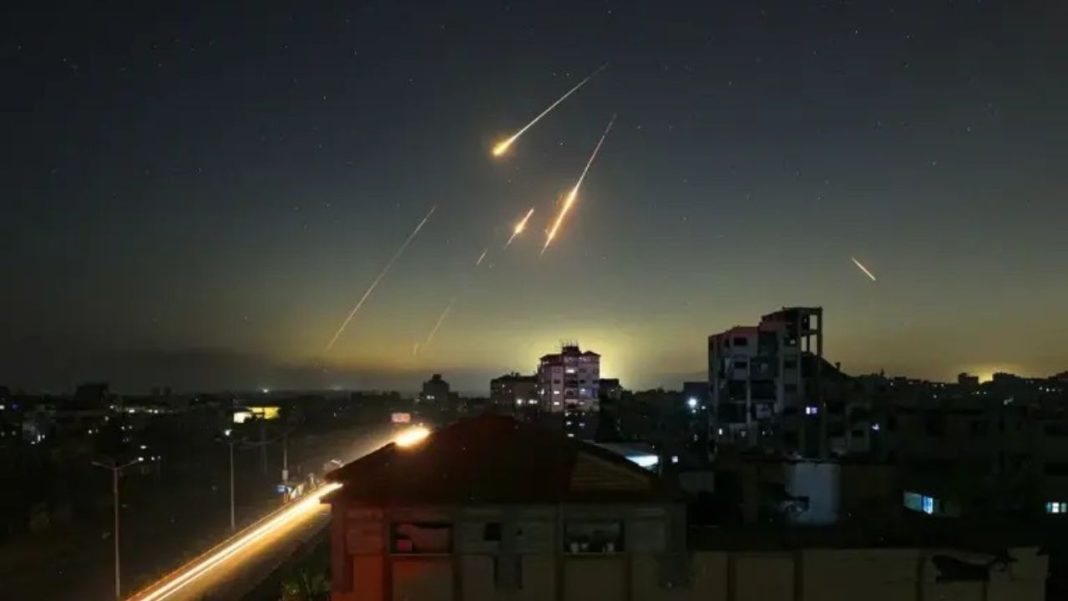

West Asia War: Every night for the past 30 days, somewhere above the Gulf, a missile worth between 3 and 4 million dollars has been fired into the sky to destroy a drone that cost less than 20,000 dollars to build.
That exchange has happened over 3,700 times since February 28, 2026. The shield has held. The cities are standing.
But inside the defense establishments of the UAE, Kuwait, Bahrain, and Saudi Arabia, a very serious conversation is happening behind closed doors.
The interceptor missiles are running out. The spare parts are being consumed faster than they can be replaced.
And the systems doing the shooting were built for short, sharp conflicts not a month-long, near-continuous barrage with no end in sight.
This is the story of how the Gulf’s missile defense network works, how hard it is being pushed, and how much longer it can last.
How the Shield Works: Three Layers Between a City and a Missile
To understand the problem, you first need to understand the system.
The air defense network protecting Gulf cities is not a single weapon. It is three separate layers, each designed to catch a different kind of threat at a different height.
Layer One: THAAD – The Top of the Roof
THAAD stands for Terminal High Altitude Area Defense. It is the highest layer of protection and deals with ballistic missiles the large, fast-moving rockets that travel up into the upper atmosphere before coming back down toward a target.
When a ballistic missile is detected, THAAD tracks it using a powerful radar system called the AN/TPY-2.
This radar can see objects hundreds of kilometers away and calculate exactly where a missile is going to land. THAAD then fires its own interceptor missile, which does not carry an explosive warhead.
Instead, it destroys the incoming missile purely by hitting it at very high speed a concept the military calls “hit to kill.” The impact at that velocity is enough to destroy the threat completely.
The UAE operates THAAD batteries, making it one of only a handful of countries outside the United States with this capability. In the current conflict, THAAD has been the first line of defense against the larger ballistic missiles being fired from across the Gulf.
Layer Two: Patriot PAC-3 – The Middle of the Roof
Below THAAD sits the Patriot system, specifically the PAC-3 MSE variant currently deployed across the UAE, Kuwait, Saudi Arabia, and Bahrain.
The Patriot handles medium-range ballistic missiles and cruise missiles threats that fly lower and faster than THAAD is optimized to catch.
The Patriot works differently from THAAD. Its interceptor carries a small explosive charge that detonates near the incoming threat, destroying it with a combination of blast and fragments.
A single Patriot battery consists of a radar unit, a control station, and multiple launchers, each holding several interceptor missiles ready to fire.
In the current conflict, the Patriot has been doing the heaviest work. The UAE alone has fired Patriot interceptors 425 times against ballistic missiles this month.
Kuwait has fired 245 times. These are extraordinary numbers. In normal training conditions, a Patriot battery might fire a handful of interceptors in an entire year.
Layer Three: Electronic Warfare – The Invisible Net
The lowest layer of defense does not fire missiles at all. Electronic warfare units positioned around the perimeters of Dubai, Kuwait City, and other population centers use high-powered radio frequency jamming to attack the guidance systems of incoming drones.
Most of the drones being used in this conflict the Shahed-type suicide drones navigate using GPS signals or pre-programmed flight paths.
Jamming units flood the area with interference that confuses or overrides those signals, causing the drone to lose its direction and crash before it reaches its target.
This layer has been particularly important for dealing with the sheer volume of drone attacks.
Firing an expensive Patriot missile at a drone that costs 20,000 dollars makes no financial sense.
Jamming it to the ground costs almost nothing by comparison. Electronic warfare has quietly become one of the most important tools in the Gulf’s defensive arsenal this month.
The Numbers Behind the Shield
Together, these three layers have achieved a combined interception rate of approximately 93% across all four countries. In military terms, that is a remarkable result.
The UAE has intercepted 425 ballistic missiles and 1,941 drones. Kuwait has destroyed 245 missiles and over 460 drones.
Bahrain’s defense force has taken down 182 missiles and 398 drones. Saudi Arabia has intercepted at least 55 missiles and more than 600 drones.
But 93% against more than 3,700 incoming threats still means roughly 260 things getting through.
And at this volume, even a small percentage of failures has serious consequences — a fuel farm fire in Kuwait that burned 2.1 million gallons of jet fuel, damage to the Bapco refinery in Bahrain, strikes near Dubai International Airport, and damage to ports and power lines across the region.
The Core Problem: A System Being Pushed Beyond Its Design Limits
Here is what the impressive interception numbers do not show: the systems achieving them were never built to operate at this intensity for this long.
A standard Patriot battery carries a limited number of interceptor missiles in its launchers. Once those are fired, the battery must be reloaded. Reloading takes time, requires specialist equipment, and consumes the stockpile of spare interceptors held in reserve.
In a typical conflict scenario, military planners expect a Patriot battery to engage a small number of targets over days or weeks, with plenty of time to resupply between engagements.
What is happening in the Gulf right now is completely different. Batteries are firing multiple interceptors every single night, sometimes in rapid succession against large waves of incoming drones and missiles.
The reload cycle is being compressed to its absolute limit. Maintenance crews are working around the clock.
And the stockpiles are shrinking fast. Current estimates indicate that across all four nations, approximately 75% of pre-conflict Patriot and THAAD interceptor stocks have been consumed in 30 days.
That means these countries are now operating on roughly one quarter of the ammunition they started with.
The United States is working to resupply its Gulf partners. But Patriot interceptors are not simple objects to produce quickly.
Each one takes months to manufacture. The production lines in the United States are already running at full capacity. The waiting list is long.
The Cost Problem That Cannot Be Ignored
Beyond the physical shortage of ammunition, there is a financial reality that defense analysts are increasingly open about. Each Patriot PAC-3 MSE interceptor costs between 3 and 4 million dollars.
A THAAD interceptor costs significantly more approximately 11 million dollars per round. The drones these systems are destroying cost between 10,000 and 50,000 dollars each.
The ballistic missiles cost more, but are still far cheaper than the interceptors used against them.
Run the numbers across 30 days of continuous interceptions and the financial scale becomes clear.
The UAE alone has spent an estimated 1.5 to 2 billion dollars in interceptor costs this month.
Across all four nations, the total expenditure on interception is likely to exceed 4 billion dollars for March alone.
This is what military analysts call the cost-exchange problem. The side launching the attacks spends relatively little.
The side defending spends enormously. Over time, this gap can become a strategic weapon in itself — not by breaking through the shield, but by exhausting the economy behind it.
One senior defense official, speaking privately, described it plainly: “They do not need to beat the shield. They just need to make running the shield more painful than stopping the war.”
What Happens If the Ammunition Runs Out
This is the question that Gulf defense planners are working hardest to avoid answering publicly. If Patriot interceptor stocks fall below a critical threshold, battery commanders face impossible choices.
Do you save remaining interceptors for the most dangerous ballistic missile threats and allow smaller drones through?
Do you rely more heavily on electronic jamming, which is effective against some drones but useless against ballistic missiles?
Do you start prioritizing which parts of the city to protect? None of these are good options. All of them are being quietly discussed.
The electronic warfare layer can absorb more of the burden for drone defense, and there is some evidence that Gulf forces have already shifted in this direction over the past two weeks using jamming more aggressively to preserve Patriot stocks for higher-end threats.
But jamming has its own limits. Newer drone variants are being designed with more resistance to electronic interference, and there are signs that the attacking forces are already adapting their tactics in response.
The diplomatic track reopening the Strait of Hormuz, reaching a ceasefire, finding a political off-ramp is therefore not just a political goal. For the defense planners watching the ammunition counters fall, it is becoming an operational necessity.
Still Open, But the Clock Is Ticking
The missile shield over the Gulf is one of the most impressive pieces of military engineering ever put to a real test.
It has performed well beyond what many experts expected. The cities beneath it are still functioning.
But a shield that is 75% spent in 30 days, defending against attacks that show no sign of stopping, is a shield under serious strain.
The technology is holding. The stockpiles are not. And somewhere in the gap between those two facts lies the most important question of this conflict: how much longer can the math work in the Gulf’s favor?
The Defense Numbers: West Asia War, March 2026
Country System Used Missiles Intercepted Drones Intercepted Est. Interceptor Cost
UAE THAAD + Patriot PAC-3 425 1,941 $1.5 — 2 billion
Saudi Arabia Patriot PAC-3 55+ 600+ $200 — 400 million
Kuwait Patriot PAC-3 245+ 460+ $800 million — 1 billion
Bahrain Patriot PAC-3 182 398 $600 — 800 million
Still Open, But the Clock Is Ticking
The missile shield over the Gulf is one of the most impressive pieces of military engineering ever put to a real test.
It has performed well beyond what many experts expected. The cities beneath it are still functioning.
But a shield that is 75% spent in 30 days, defending against attacks that show no sign of stopping, is a shield under serious strain.
The technology is holding. The stockpiles are not. And somewhere in the gap between those two facts lies the most important question of this conflict: how much longer can the math work in the Gulf’s favor?
by- Namita Deora