


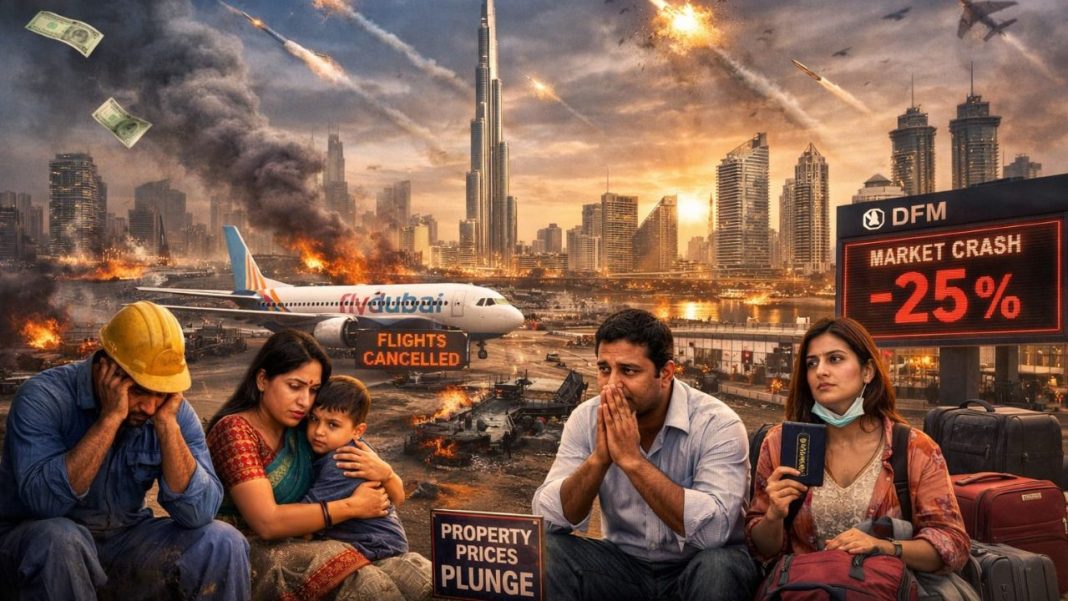

Dubai in Distress: Imagine a city built on the dreams of gold, glass, and global ambition suddenly falling silent under the hum of interceptor missiles.
For the 1.7 million Indians who call Dubai home, the “City of Dreams” has turned into a high-stakes waiting room.
With over ₹2 lakh crore in economic losses and 5 lakh Indians desperate to return home, the fallout of the Iran-Israel war isn’t just a Middle Eastern problem it’s a full-blown Indian emergency.
The $25 Billion Crack in the Desert Dream
Dubai has long been the “Global Financial Safety Net” for Indian billionaires and middle-class workers alike. However, the escalation between Iran and Israel has hit the emirate’s economy where it hurts most.
Aviation Paralysis: The closure of regional airspace has turned Dubai International (DXB) from the world’s busiest hub into a logistical nightmare. Emirates and flydubai are reportedly losing between $50 million to $70 million daily.
Real Estate Bloodbath: Property prices, which saw record highs in 2025, have plummeted by 20-25% in just 30 days. Investors who poured billions into the Dubai Marina and Palm Jumeirah are watching their “paper wealth” evaporate.
Infrastructure at Risk: While the iconic Burj Khalifa remains structurally sound, industrial zones have faced damage from drone shrapnel, with repair costs estimated in the billions of dirhams.
1.7 Million Indians: A Community Under Siege
India’s “unofficial 29th state” is currently in a state of paralysis. Out of the 1.7 million Indians in Dubai, nearly 3 to 5 lakh are urgently seeking repatriation.
Who are the people stuck?
Stranded Tourists: Thousands who arrived for luxury vacations are now living in hotel lobbies or temporary shelters as flight tickets have surged 5-10x in price.
Contract Workers: Blue-collar workers whose contracts ended in March are stuck in labor camps with no way to fly back and dwindling cash reserves.
The Professional Class: Thousands of Indian engineers and managers have been placed on ‘unpaid leave’ as companies invoke ‘Force Majeure’ clauses to survive the slump.
The ₹1 Lakh Crore Stake: Why India Can’t Afford a Dubai Downfall
The relationship between India and Dubai has transcended mere migration; it is now a story of massive capital ownership. According to 2025-26 fiscal data, Indian nationals have emerged as the #1 foreign buyers in the Dubai property market.
-The Residential Powerplay: In the last year alone, Indians have pumped between ₹85,000 to ₹95,000 crore ($10.5 – $11.5 Billion) into Dubai’s residential real estate.
From luxury penthouses in Palm Jumeirah to commercial hubs in Business Bay, nearly 23% of all foreign property transactions in the city bear an Indian name.
-Greenfield FDI Leadership: Beyond apartments, Indian entrepreneurs are the leading source of Greenfield FDI (new business projects).
In 2025, India contributed over $12 billion in new manufacturing and tech hubs, including massive projects like the $10 billion smart manufacturing center in Ras Al Khaimah.
-The SME Backbone: Nearly 40-50% of Dubai’s Small and Medium Enterprises (SMEs) are owned or operated by Indians.
The War Impact: This isn’t just “invested” money it’s “locked” money. With the Iran-Israel conflict escalating, these investors face a double-edged sword:
-The Liquidity Trap: They own assets worth billions, but with the “War Risk Premium” skyrocketing, there are no buyers. Their life savings are effectively frozen in concrete and glass.
The Rental Income Wipeout: Many Indians rely on Dubai’s high rental yields (6-9%) to fund their lives in India. With residents fleeing and tourism dead, that monthly income stream has evaporated overnight.
The DFM Bloodbath: ₹40,000 Crore of Indian Wealth Evaporated
While Dubai’s real estate is “frozen” capital, the Dubai Financial Market (DFM) is where the immediate financial carnage of the Iran-Israel war is visible. For Indian investors, the stock market has turned into a “red zone.”
The 25% Market Crash
Since the conflict escalated in February 2026, the DFM General Index has plummeted by nearly 25%. Panic selling has become the norm as investors flee to safer assets like Gold.
Huge Indian Exposure
Indians are not just spectators; they are major players in the Dubai economy.
Trading Volume: Indian High-Net-Worth Individuals (HNIs) and NRIs account for approximately 12% to 15% of the total foreign trading flow in the Dubai market.
The Loss Calculation: Estimates suggest a “Notional Loss” (paper loss) of over ₹40,000 crore ($4.8 Billion) for Indian investors in just 30 days.
Blue-Chip Stocks Hitting Rock Bottom
The companies that built Dubai are now the ones losing the most value:
Emaar Properties: The developer of the Burj Khalifa and a favorite among Indian investors, has seen its share price drop by over 20%.
Banking Giants: Shares of Emirates NBD and Dubai Islamic Bank have hit multi-year lows, wiping out the dividend income that many Indian families rely on.
Logistics & Aviation: With the Jebel Ali Port and Dubai Airport facing disruptions, stocks related to trade and transport have entered a “Free Fall” zone.
The Liquidity Trap
The biggest problem for Indians right now isn’t just the falling prices—it’s the lack of buyers.
Investors trying to exit their positions are forced to sell at a 30-40% discount because the market is extremely volatile.
Currency Impact: With the Indian Rupee (INR) fluctuating against the Dirham (AED) due to war-time instability, the actual “realizable value” of these investments has shrunk further.
Why Can’t They Just Leave?
If things are so bad, why hasn’t there been a mass exodus?
Airspace Danger: With missiles traversing the skies, only limited emergency corridors exist.
The Passport Problem: A significant number of workers still have their passports held by employers, making emergency movement difficult during a lockdown.
Scale of Operation: The Indian Government is preparing a massive evacuation (similar to Operation Ganga or Vande Bharat), but moving 5 lakh people simultaneously is a logistical mountain that cannot be climbed overnight.
The “Backbone” is Shaking: Why India is Worried
To understand the panic, one must look at how much India has invested in Dubai as of early 2026:
Sector Indian Investment (Est. 2025-26) Impact of War
Real Estate “₹95,000 Crore” 20% Value Wipeout
FDI/Business ₹1.05 Lakh Crore Projects Halted
Retail/Gold 60% Ownership by Indians Sales down by 70%
Indians aren’t just residents; they are the shareholders of Dubai. From the Golden Visa holders who invested ₹4.5 crore+ for residency to the small business owners in the Gold Souk, the Indian stake is unparalleled.
The Status of the Burj Khalifa
The world’s tallest building stands as a silent sentinel. While it hasn’t been hit, the atmosphere in Downtown Dubai is eerie.
The famous light shows have been dimmed to avoid making the tower a navigational landmark for drones at night.
Residents are reportedly living between their luxury apartments and reinforced basement shelters.
What Lies Ahead?
As of March 31, 2026, Dubai is in “Survival Mode.” The city that thrived on being a “Safe Haven” is facing a crisis of identity. If the conflict does not de-escalate within the next few weeks:
Massive Reverse Migration: India could see a sudden influx of lakhs of returnees, putting pressure on the Indian domestic job market.
Investment Shift: Future Indian capital may pivot toward Singapore or Mumbai, ending Dubai’s decade-long run as the preferred investment destination.
The Road Ahead: Is the Dream Over?
For decades, Dubai was the “Safe Room” for Indian wealth. But April 2026 has brought a reality check.
While the Burj Khalifa still gleams, the anxiety in the streets of Deira and Bur Dubai is palpable.
The Indian government faces its biggest challenge yet, not just to bring people back, but to protect the billions of dollars of Indian sweat and blood invested in the desert.
For the Indian community in Dubai, the prayer is no longer about “Rental Yields” or “Tax-free Income” it is simply about the opening of the skies and a safe flight back home.