


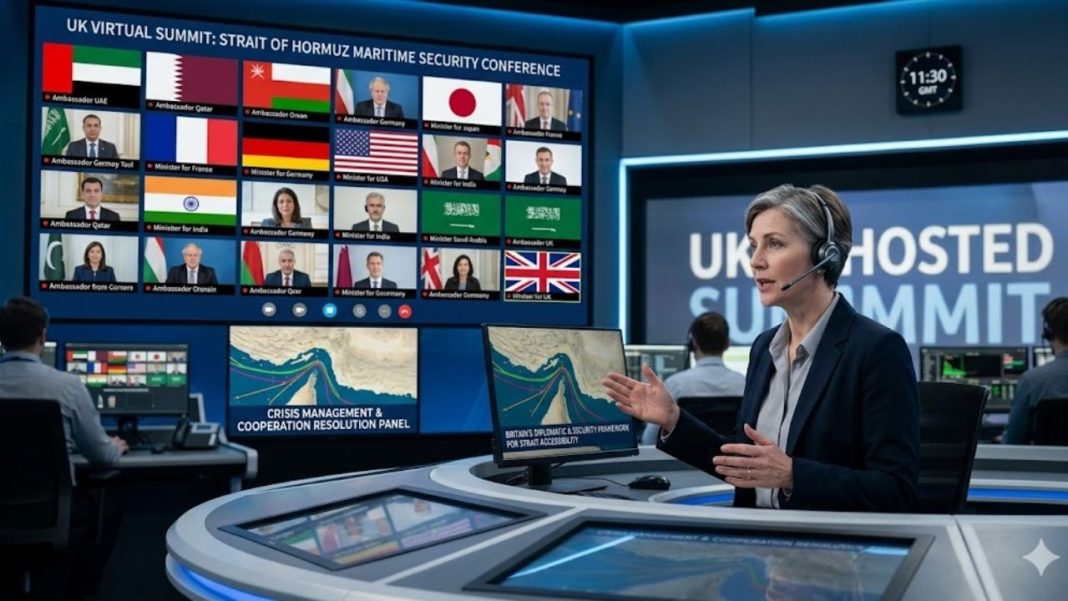

UK Virtual Summit 2026: Imagine a single, narrow strip of blue water, barely 21 miles wide at its tightest point.
Now, imagine that this tiny stretch of sea carries the lifeblood of the global economy, one-fifth of the world’s oil and nearly a third of its liquefied natural gas.
For the last month, that “lifeblood” has been clotting. The Strait of Hormuz is currently the most dangerous place on Earth, a maritime graveyard of abandoned tankers and silent engines.
As global energy prices skyrocket and the threat of a “dark winter” looms over Europe and Asia, the United Kingdom is stepping into the breach.
On Thursday, Foreign Secretary Yvette Cooper will convene a high-stakes virtual summit of 30 nations.
This is not just another diplomatic meet-and-greet; it is a desperate, last-ditch effort to find a “political key” to a military lock.
With the global economy on life support, the question isn’t just whether the Strait can be reopened, it’s whether it can be done before the sparks in West Asia ignite a global conflagration.
The Trump Victory Lap: “Mission Accomplished” or Smoke and Mirrors?
The backdrop to this summit is a series of jarringly confident proclamations from Washington.
President Donald Trump, speaking from a position of perceived strength, has declared that the United States is “nearing completion” of its strategic objectives in the conflict with Iran.
Under the banner of Operation Epic Fury, U.S. and Israeli forces have spent weeks conducting high-intensity strikes against Iranian infrastructure.
President Trump hailed American forces for scoring what he termed “overwhelming victories,” suggesting that the Iranian military machine has been effectively decimated.
“We have taken out their eyes, their ears, and their teeth,” Trump told reporters. “The regime is in a state of collapse, and they know it.”
In a move that added further fuel to the fire, the President asserted that Tehran had reached out through intermediaries to beg for a ceasefire.
It was a classic Trumpian “maximum pressure” narrative, portraying the adversary as defeated and desperate.
Tehran’s Defiant Retort: Barbed Words and Ballistic Barrages
However, the reality on the ground, and in the sky…tells a different story. Almost immediately after the President’s victory speech, the air raid sirens screamed across Tel Aviv and Haifa.
Iran launched a fresh barrage of missile strikes against Israel, a clear signal that despite the heavy bombardment of its launch sites, its “asymmetric” capabilities remain potent.
Tehran was also quick to shoot down the rumors of a white flag. Iranian officials firmly denied that any request for a ceasefire had been made.
Iranian President Masoud Pezeshkian took to the airwaves to project an image of calm, reasoned resistance.
In a speech aimed at Western audiences, he emphasized that Iran harbors “no hostility” toward the people of the United States, Europe, or its Middle Eastern neighbors.
“We are not the aggressors,” Pezeshkian stated. “We are the defenders of our sovereignty against a neo-colonial assault.”
Collateral Chaos: The Rising Price of a Regional Powder Keg :
While the leaders trade rhetoric, the civilian toll is mounting. Recent U.S.-Israeli operations targeting logistical hubs in Larestan and Mianeh reportedly killed nine people and caused significant damage to civilian airports and shipping piers.
The conflict is no longer contained within the borders of the primary combatants. The entire Gulf region has become a “hot zone”:
Kuwait and Bahrain have reported multiple interceptions of stray drones.
Saudi Arabia and the UAE have activated their advanced missile defense systems to neutralize projectiles veering off course from the main theater of war.
This regional spillover is exactly what the UK-led summit hopes to contain. The 30 nations attending—ranging from G7 members to regional powers like Japan and South Korea, are terrified that a “miscalculation” in the Strait could lead to a direct hit on a neutral vessel, triggering a much wider war.
Whitehall’s Hail Mary: Why London is Playing the Middleman
The UK is playing a delicate game. While a staunch ally of the U.S., London is acutely aware that the current military strategy has not achieved its primary economic goal: the free flow of oil.
By hosting this summit virtually, the UK is attempting to create a “neutral digital space” where countries that might be wary of Washington’s current aggression can still coordinate on maritime security.
The summit’s agenda is focused on three pillars:
- The Steel Shield: Establishing a UN-sanctioned, multi-national naval escort for merchant vessels.
- Sanctuaries of Silence: Creating “de-escalation zones” or safe harbors where tankers can wait without being targeted by shore-based missiles.
- The “Hormuz Protocol”: A proposed agreement to treat the Strait as a neutral zone, independent of the ongoing kinetic conflict on land.
The Final Countdown: A Shipping Truce or Global Shockwave?
The world is holding its breath. If the UK can broker even a temporary “shipping truce,” the global economy might begin to stabilize.
But if the summit ends in finger-pointing and platitudes, the Strait of Hormuz will remain a choked artery, and the “overwhelming victories” hailed in Washington may feel very hollow to a world shivering in the dark.
As the virtual meeting begins, one thing is certain: the era of “contained” regional conflict is over. In 2026, a spark in Larestan is a fire in London, and a missile in the Strait is a shock to the world.
Written By – Arushi Sharma