


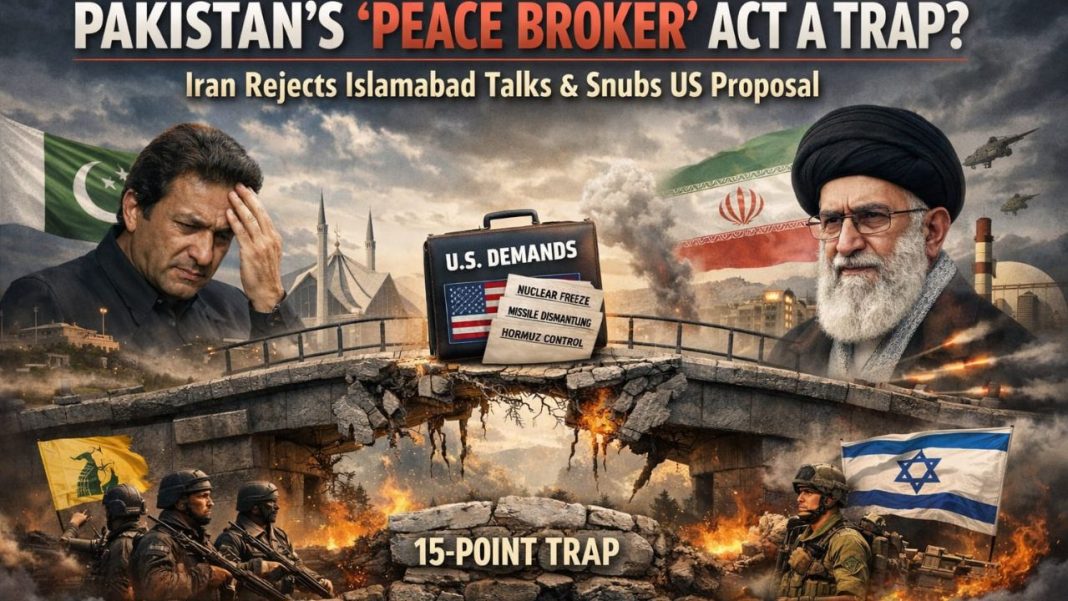

The diplomatic tightrope in the Middle East has just snapped. Pakistan’s ambitious attempt to play the “global peacemaker” between Iran and the United States has crashed before it could even take off.
Tehran hasn’t just said “no” to the talks, it has effectively signaled that it doesn’t trust Islamabad to hold the whistle.
For weeks, Pakistan has been positioning itself as the bridge between the West and the Islamic Republic of Iran.
However, latest reports suggest that Iran has officially pulled the plug on the proposed high-level meeting in Islamabad, leaving Pakistan’s diplomatic aspirations in tatters and raising a serious question: Was Pakistan acting as a neutral mediator, or was it a Trojan horse for American interests?
The “15-Point Trap”: Why Iran Walked Away
The collapse follows a significant multilateral meeting on March 29 in Islamabad, attended by the foreign ministers of Pakistan, Turkey, Egypt, and Saudi Arabia.
The goal was to de-escalate the explosive tensions involving Israel, the US, and Iran.
Pakistan presented a 15-point proposal from Washington to the Iranian leadership. The terms, however, were far from “neutral.” The US demanded:
A complete freeze on Iran’s nuclear program.
The dismantling of Iran’s long-range missile capabilities.
Total freedom of navigation in the Strait of Hormuz (a critical chokepoint Iran uses for leverage).
In exchange? A conditional ceasefire. For Tehran, this wasn’t a peace deal; it was a surrender document. Iran has labeled these terms “unacceptable” and refused to send its officials to Islamabad, viewing the proposal as a move to strip them of their defenses while giving nothing concrete in return.
The Trust Deficit: “Mediator” or “Messanger’?
The biggest hurdle in this diplomatic drama isn’t just the terms of the deal it’s the man in the middle. Iran’s skepticism toward Pakistan is reaching an all-time high.
Vali Nasr, a renowned Iran expert and professor at Johns Hopkins University, points out a chilling fear within the Iranian camp: The “Assassination” Anxiety. Following the high-profile killings of Iranian commanders in recent years, Tehran reportedly fears that a high-level summit in Islamabad could be a setup. There is a deep-seated suspicion that Pakistan is coordinating too closely with US intelligence, potentially putting Iranian officials in a vulnerable position.
“Iran suspects that Pakistan is not an independent actor here but is working hand-in-glove with the US. After Washington walked away from the 2015 Nuclear Deal (JCPOA), Tehran has zero faith in American promises and even less in those who carry them.” — Expert Analysis
A Pattern of Failed Neutrality
Pakistan’s attempt to play “Middle East Mediator” is a risky game. On one hand, Islamabad needs to stay in the good graces of the United States for economic survival and IMF bailouts.
On the other, it shares a volatile border with Iran, where security skirmishes and “tit-for-tat” missile strikes occurred as recently as early 2024.
By carrying a 15-point list of American demands that mirror the “Maximum Pressure” campaign of the past, Pakistan has inadvertently confirmed Iran’s fears.
Instead of being seen as a neutral neighbor, Islamabad is being viewed as Washington’s diplomatic courier.
The Broader Fallout: What This Means for the Region
The failure of the Islamabad talks leaves the Middle East in a dangerous vacuum. With Iran refusing to negotiate under the current framework:
Increased Proxy Tensions: Without a diplomatic outlet, the friction between Israel and Iran-backed groups is likely to intensify.
[2:20 pm, 4/4/2026] +91 63671 98173: The Nuclear Clock: Iran is signaling that it will continue its nuclear enrichment on its own terms, refusing to be bullied by “pre-conditions.”
Pakistan’s Diplomatic Isolation: This snub is a major blow to Pakistan’s image. It sought to prove its relevance on the global stage but has instead highlighted its lack of influence over Tehran.
The Verdict: A Bridge to Nowhere
Iran has made its stance clear: it wants a ceasefire, but only on its own terms. It refuses to trade its sovereign defense capabilities for a “peace” that can be retracted by the next US administration.
As for Pakistan, the dream of being the “Messiah of Peace” has hit a hard reality.
In the complex world of Middle Eastern geopolitics, you cannot be a neutral mediator if the other side thinks you are holding a net for the enemy.
For now, the “Islamabad Initiative” is dead in the water, and the drums of war in West Asia continue to beat louder than the whispers of diplomacy.
By: Snigdha