


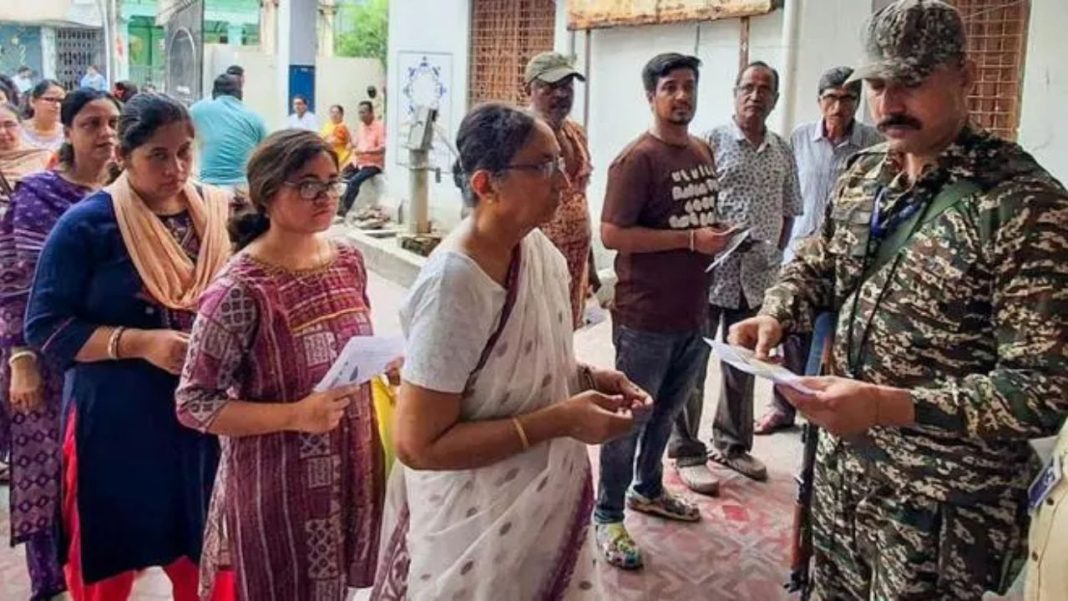

Bengal Elections Phase 2: The second and final phase of the West Bengal Assembly elections unfolded on Wednesday in a tense atmosphere, shaped by the ongoing debate over the voter list revision exercise ordered by the Election Commission of India.
The Special Intensive Revision (SIR), intended to remove duplicate and ineligible voters, has already sparked sharp political disagreements across parties
Violence Reported Across Multiple Districts
Incidents of unrest surfaced early in the day from several regions, including Chapra, Shantipur, and Bhangar. Reports suggested clashes between party workers, vandalism, and disruptions near polling booths.
In Chapra, allegations emerged that a polling agent linked to the Bharatiya Janata Party was attacked.
The injured individual was taken to a nearby hospital, claiming he was assaulted by a group allegedly associated with the All India Trinamool Congress.
Police have registered a case, though the ruling party has denied involvement.
Meanwhile, in Shantipur, property damage at a BJP camp heightened tensions, while in Bhangar, accusations surfaced that a polling agent from the Indian Secular Front was stopped from entering a booth.
Altercation Inside Polling Booths
Tensions were not limited to the streets. In Kolkata’s Entally constituency, BJP candidate Priyanka Tibrewal reportedly confronted polling officials after her agent was removed from a booth due to space constraints.
A representative from the Trinamool side also got involved, leading to both agents being asked to leave.
The incident reflects the charged environment inside polling stations, where even minor procedural decisions escalated into political confrontations.
EVM Malfunction Allegations Resurface
Fresh concerns over Electronic Voting Machines (EVMs) were raised after reports of malfunctioning devices in parts of Howrah.
EVM-related controversies have long been a contentious issue in Indian elections, with opposition parties frequently questioning their reliability.
Despite repeated assurances from the Election Commission regarding the security and accuracy of these machines, skepticism continues to persist in politically sensitive contests.
Serious Accusations Over Voting Process
Senior BJP leader Amit Malviya alleged that in certain booths, voters were unable to select his party due to tampering with the voting buttons.
He described it as a systematic tactic and demanded re-polling in affected areas.
The Trinamool Congress rejected these claims, calling them baseless and politically motivated.
Mamata Banerjee Targets Central Forces
Chief Minister Mamata Banerjee strongly criticized the role of central security forces, accusing them of bias and acting under political influence.
She claimed that the deployment of outside observers and forces was undermining the fairness of the election.
Her nephew and senior party leader Abhishek Banerjee echoed similar concerns, alleging that observers had overstepped their authority.
Bhabanipur: The Political Battleground
The Bhabanipur constituency remains one of the most closely watched seats in this election.
A stronghold of Mamata Banerjee in previous elections, it is now witnessing an intense contest, adding further political significance to the phase.
Voter Roll Revision Sparks Debate
At the heart of the controversy lies the Special Intensive Revision of electoral rolls.
The exercise reportedly removed over 90 lakh names, triggering allegations from the Trinamool Congress that genuine voters were unfairly excluded.
However, both the BJP and the Election Commission maintain that the revision was necessary to eliminate duplicate and invalid entries, ensuring cleaner electoral rolls.
Record Turnout in Phase One Sets the Tone
The first phase of polling, held on April 23, saw an impressive voter turnout of 92.88%, setting a high benchmark for electoral participation.
With counting scheduled for May 4, all eyes are now on the final outcome of this fiercely contested election.
The second phase of the West Bengal elections highlights the deep political divisions and high stakes involved.
From allegations of violence and electoral malpractice to disputes over administrative neutrality, the electoral process has come under intense scrutiny.
As the state awaits results, the focus remains on whether democratic institutions can withstand the pressure of such a charged political environment.