


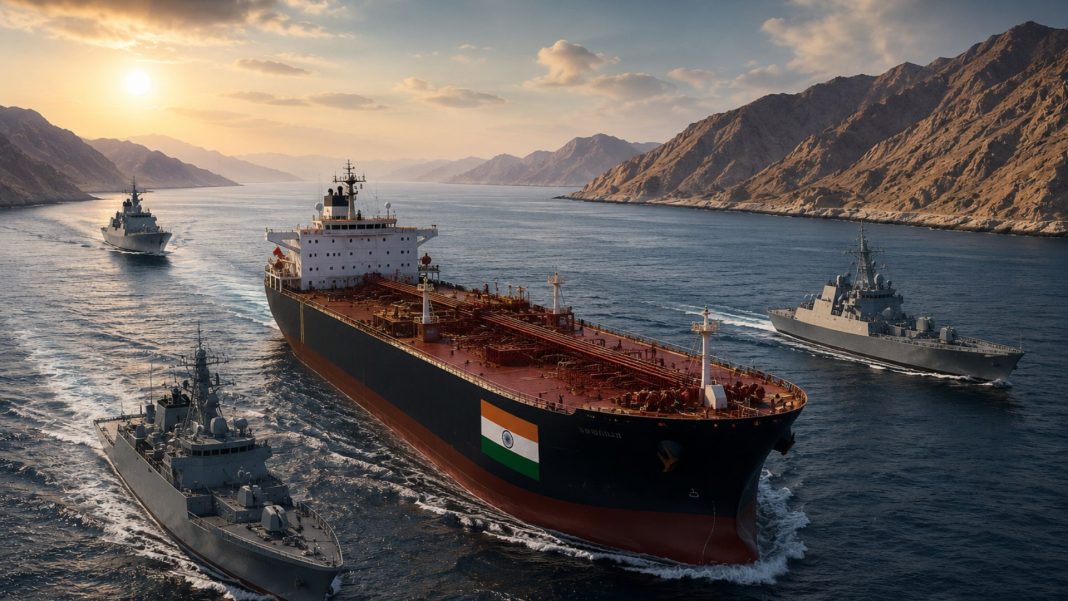

Safe Passage of Indian Tanker: The Marshall Islands-flagged ‘Nisos Keros’ clears the volatile Iranian-controlled chokepoint; expected to dock in Visakhapatnam by June 3.
In a major relief for India’s energy security, a massive crude oil tanker has successfully navigated through the highly volatile Strait of Hormuz. The vessel, ‘Nisos Keros’, cleared the tense maritime chokepoint safely and is currently heading toward the port of Visakhapatnam on India’s eastern coast.
Amid escalating geopolitical friction in Western Asia, this successful passage brings a huge sigh of relief for Indian policymakers and energy markets worried about potential supply disruptions.
Tracking the Journey: From Sharjah to India
Safe Passage of Indian Tanker: According to global maritime tracking websites, the vessel has already crossed the most dangerous zones of its route:
The Departure: The tanker set sail from Sharjah, UAE, on May 21.
Current Location: On Friday morning at 6:00 AM (IST), the ship was spotted in the Northern Arabian Sea, cruising safely near India’s western coast.
The Destination: The ship is expected to reach its final destination, Visakhapatnam, by June 3.
Vessel Specifications at a Glance:
Ship Name: Nisos Keros
Flag: Marshall Islands
Length: 333 meters (Supertanker class)
Owner: Arethusa Shipping Corporation
Operator: Cyclades Maritime Corporation
Data Source: Maritime tracking firm Aucvisor
Iran’s Tight Grip: 23 Ships Allowed in 24 Hours
Safe Passage of Indian Tanker: The passage comes at a time when Iran’s Islamic Revolutionary Guard Corps (IRGC) has tightened its grip on the Strait of Hormuz,
one of the world’s most critical oil transit chokepoints.
According to the Iranian state news agency, IRNA, the IRGC granted permission to 23 commercial vessels, including oil tankers and container ships, to pass through the strait within a 24-hour window.
However, this permission comes with a catch. The Iranian military confirmed that these movements were allowed only after “formal coordination and clearance” with IRGC officials.
The “Toll Tax” Controversy: Is Iran Charging for Safe Passage?
While the Nisos Keros made it through safely, a cloud of geopolitical uncertainty hangs over the terms of its passage. It remains unclear whether the Indian-bound vessel or the other 22 ships had to pay a financial toll to Iran.
Tehran’s New Maritime Authority
Earlier this month, Iran announced the creation of a new regulatory body called the ‘Persian Gulf Strait Authority’ to monitor and control maritime traffic. Tehran has explicitly hinted that it might start levying a transit toll on commercial ships using the strait.
The Global Backlash
Iran’s move to monetize or restrict the strait has triggered intense international pushback:
The United Nations (UN): Has strictly termed any collection of tolls or fees in international waterways as illegal.
The United States: Has strongly condemned the move, demanding that Iran immediately restore and respect the freedom of navigation in the global strait.
Why This Matters for India
India relies heavily on the Middle East for over 80% of its crude oil imports. Any prolonged blockade or disruption in the Strait of Hormuz can send domestic fuel prices skyrocketing and harm the economy.
The safe transit of Nisos Keros proves that despite the heavy militarization and bureaucratic hurdles set up by Iran, oil supply lines to the Indian subcontinent remain operational, at least for now.
Maritime experts will be watching closely to see if future Indian vessels face smoother sailing or stricter Iranian demands.
Also Read :US-Iran Ceasefire Agreement: 60-Day Truce Draft Ready, Trump’s Approval Awaited