


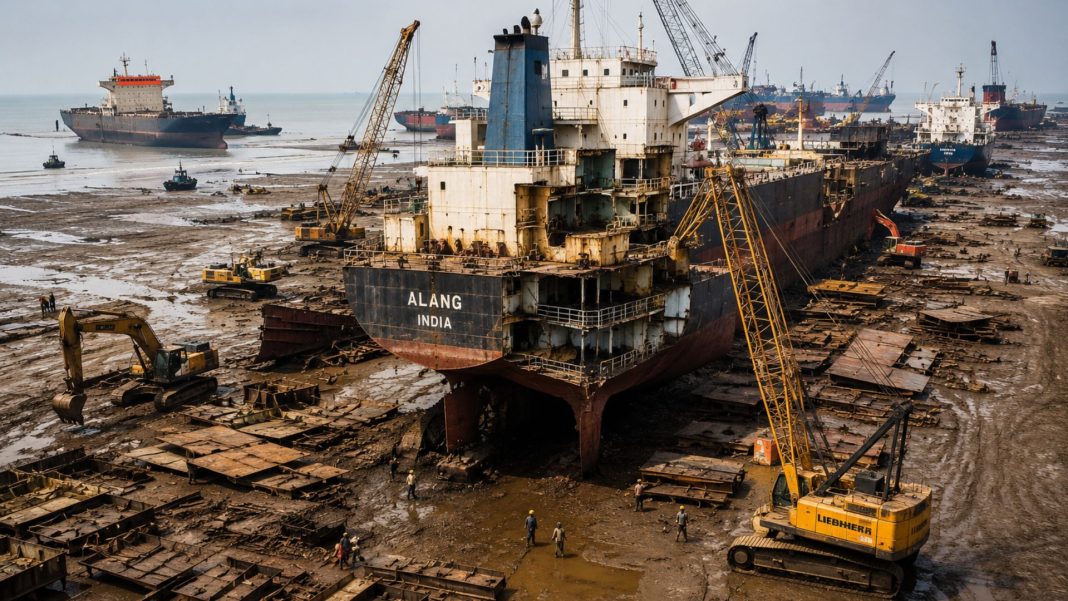

Global Ship Recycling Leader: In a monumental achievement for its maritime sector, India has officially established itself as the world’s Global Ship Recycling Leader.
This milestone marks the successful realization of a core objective outlined in the “Maritime India Vision (MIV) 2030” achieved an impressive five years ahead of the original target date.
According to the latest flagship data released by the United Nations Conference on Trade and Development (UNCTAD), India’s share of the global ship recycling market experienced a massive surge, climbing to a dominant 35.4 per cent, up from 30.1 per cent recorded in the previous year.
This rapid expansion is backed by a phenomenal 60 per cent year-on-year growth in dismantling volumes, with total tonnage rising from 1.86 million Gross Tons (GT) to 2.99 million GT.
Reacting to the development, Union Minister for Ports, Shipping and Waterways, Sarbananda Sonowal, stated that India’s rise to the top position reflects sustained policy reforms, strong industry participation, and strict adherence to international environmental and safety standards.
The Strategic Policy Framework Behind the Growth
Global Ship Recycling Leader: Industry experts point out that India’s rapid ascent to the number-one spot is rooted in aggressive, structural regulatory formalization rather than mere market luck.
A major catalyst was the enactment of the Recycling of Ships Act, 2019, which effectively codified the strict global standards of the Hong Kong International Convention (HKC) into domestic law.
To turn this legislative mandate into reality, the central government backed the sector with a Rs 53.5 crore modernization package.
As a direct result, 115 domestic ship recycling yards successfully upgraded their operations to achieve strict HKC environmental compliance.
This regulatory transformation has successfully attracted major global shipping liners who had previously avoided South Asian yards due to safety and ecological concerns.
Driving the Circular Economy: The Ship-Breaking Credit Note Scheme
Global Ship Recycling Leader: To stimulate domestic shipbuilders and seamlessly link the recycling and manufacturing ecosystems, the Ministry of Ports, Shipping and Waterways (MoPSW) introduced an innovative financial incentive.
Under the newly implemented Ship-breaking Credit Note Scheme, ship owners are offered a credit note worth 40 per cent of the scrap value of their recycled vessel.
According to official guidelines, this credit can be strategically utilized by ship owners to offset up to 5 per cent of the cost of building a brand-new vessel at any domestic Indian shipyard.
This dual-benefit framework effectively ensures that the scrap material recovered from older vessels directly feeds into the modernization of the country’s broader merchant fleet.
Alang-Sosiya: The Powerhouse of India’s Green Shipping Strategy
The undisputed backbone of this historic achievement remains the massive Alang-Sosiya ship-breaking cluster located in Gujarat.
Widely recognized as the largest stretch of ship recycling beaches on Earth, Alang has evolved from a conventional ship-breaking yard into a modern hub for green recycling.
To maintain momentum, the Ministry has engaged in continuous collaborative discussions with the Gujarat Maritime Board, the Ship Recycling Industries Association, international classification societies, and global cash buyers to constantly address operational bottlenecks and improve economic competitiveness.
Future Outlook: Targeting 9 Million LDT and EU Recognition
The government is actively building on this early 2030 victory. Under a comprehensive master plan drawn up by the Government of Gujarat, infrastructure expansions at Alang are underway to nearly double India’s baseline capacity to approximately 9 million Light Displacement Tons (LDT).
Concurrently, reports indicate that New Delhi is in active diplomatic talks to secure the inclusion of top-tier Indian yards in the European Union Ship Recycling Regulation (EUSRR) approved list.
Gaining access to this highly selective green list would unlock exclusive, premium European shipping markets, driving further high-value volume to Indian shores.
Capitalizing on the Global Green Transition
The timing of India’s capacity expansion aligns perfectly with structural shifts in global shipping.
Projections by the Baltic and International Maritime Council (Bimco) indicate that more than 16,000 vessels will require decommissioning and recycling worldwide over the next decade as global fleets undergo mandatory green transitions to meet lower emission standards.
Armed with its current 35.4 per cent market share, India is already well-positioned to safely dismantle 500 to 600 global vessels annually.
By positioning itself as a clean, compliant, and highly efficient destination for vessel retirement, India is set to play a decisive role in strengthening the global circular economy while enhancing its stature as an unshakeable maritime hub.
Also Read: Visakhapatnam Express Drug Seizure: RPF Recovers 29 Kg Contraband Worth Rs 14.5 Lakh in Aurangabad