


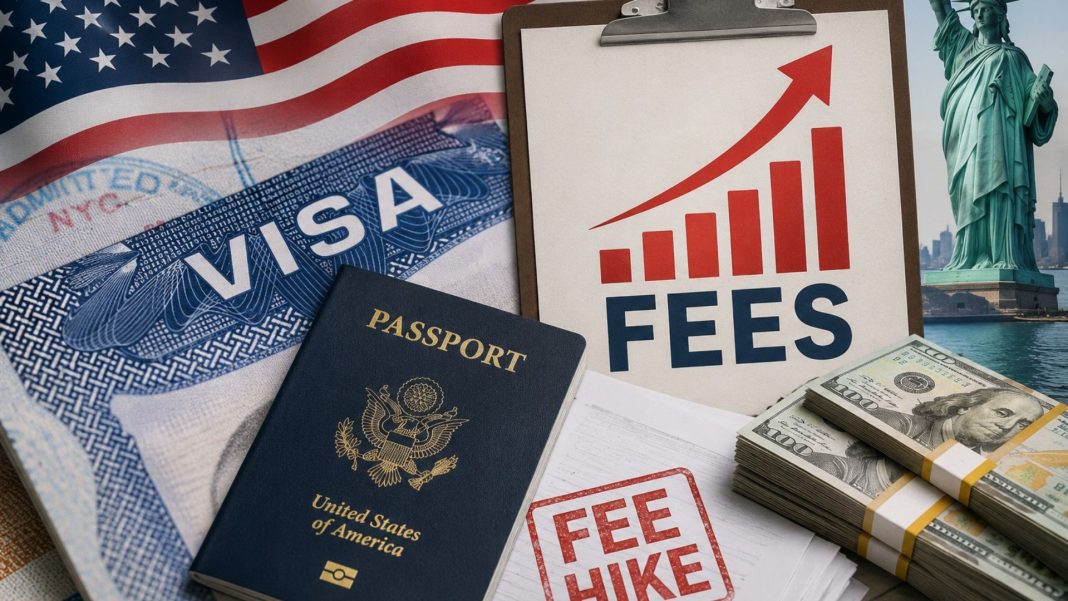

US Visa & Citizenship Fee Hike 2026: For millions of immigrants who spend decades chasing the American Dream, obtaining US citizenship is the ultimate finish line. It is the moment temporary existence transforms into permanent belonging. However, that final mile is about to become historically expensive.
The US Department of Homeland Security (DHS) has introduced a sweeping proposal that threatens to fundamentally alter the financial landscape of American immigration. Published via a Notice of Proposed Rulemaking (NPRM), the draft outlines
aggressive fee hikes aimed at making the immigration system self-sustaining. At the epicenter of this structural shift is Form N-400, the naturalization application used by Green Card holders to become US citizens.
With filing fees projected to surge by up to 80% and low-income safety nets facing complete elimination, this proposal introduces a daunting financial barrier. For the Indian diaspora, a community already bottlenecked by decades-long visa backlogs, this policy shift represents an immediate, multi-million-dollar tax on their pursuit of American citizenship.
The Dollars and Decades: Breaking Down the Proposed Fee Hikes
US Visa & Citizenship Fee Hike 2026: The core of the DHS proposal is a aggressive restructuring of how United States Citizenship and Immigration Services (USCIS) funds its operations. Historically, citizenship applications were subsidized to keep them accessible. The new model flips this philosophy completely, moving toward a rigid “full-cost, beneficiary-pays” system.
For individual applicants, the financial jump is severe. The proposed changes split applications into two categories: traditional paper filings and digital online submissions.
Under the current structure, paper applications cost $760, while online filings cost $710. The DHS proposal raises these rates significantly, pushing paper submissions to $1,330 (a 75% increase) and online submissions to $1,280 (an 80% increase). In both scenarios, applicants face an identical, flat-rate spike of $570.
The Cost of Rejection: Appealing the Decision
US Visa & Citizenship Fee Hike 2026: The financial penalties do not stop at the initial application. If an applicant is denied citizenship and wishes to challenge the verdict, they must file Form N-336 (Request for a Hearing on a Decision in Naturalization Proceedings). Under the new guidelines, defending one’s right to citizenship will see an equally steep spike:
Paper-filed N-336 appeals: Surging from $830 to $1,475
Online-filed N-336 appeals: Surging from $780 to $1,425
This restructuring represents one of the largest percentage increases in modern USCIS history, affecting not just citizenship but a broad spectrum of services including employment authorizations, status adjustments, and family reunifications.
The $165 Million Indian Predicament: Why the Diaspora Bears the Brunt
While these fee increases apply universally to all immigrants, they hit the Indian community with disproportionate force. India remains one of the top origin countries for new US citizens, driven by a massive pipeline of highly skilled professionals who enter the country on temporary work visas like the H-1B.
The Long, Costly Journey to the Finish Line
For an Indian tech or healthcare professional, the road to a Green Card is rarely straightforward. It is a grueling,
Because of strict per-country caps on Green Cards, Indian applicants face notorious, decades-long backlogs. By the time an Indian immigrant actually secures a Green Card and fulfills the five-year residency requirement to apply for citizenship, they have already spent tens of thousands of dollars on visa renewals, legal representation, travel documents, and administrative fees.
The Quantifiable Impact on Eligible Indians
Data cited by the Congressional Research Service (CRS) reveals that approximately 290,000 India-born lawful permanent residents are currently eligible to naturalize but have not yet done so.
An extra $165 million would be extracted from the Indian diaspora just to cross the final immigration finish line. While those who apply immediately can grandfather themselves under the current rates, those caught in the transition face a massive financial penalty.
The Exponential Family Burden: Multiplied Costs for Indian Households
The financial strain of this proposal multiplies exponentially when viewed through the lens of Indian cultural and immigration patterns. In the Indian diaspora, immigration is rarely an individual endeavor; it is almost always a collective family milestone.
The Geometric Progression of Family Filing Fees
Because spouses frequently navigate the visa tracking system together, they often become eligible for citizenship at the exact same time. Furthermore, many well-established Indian immigrants choose to sponsor their elderly parents, bringing them to the US to live out their retirement years.
When multiple family members apply simultaneously, the numbers quickly become restrictive for middle-class households:
The Working Couple: Under the current online filing system, a husband and wife pay a combined $1,420. Under the proposed rule, that same couple must shell out $2,560.
The Multigenerational Household: For an Indian household consisting of a couple and two elderly parents, the naturalization cost skyrockets from a manageable rate to a staggering $5,120 in government fees alone, excluding legal help.
Strategic Delaying: Facing a $5,000+ price tag, many Indian families will be forced to ration their citizenship. Instead of applying together, households will likely stagger their applications over several years, delaying the voting rights, security, and civic integration of family members simply to manage cash flow.
Shattering the Myth of the Uniformly Wealthy Indian American
There is a prevalent stereotype in American demographic discourse that Indian Americans are universally affluent, heavily concentrated in high-earning tech, corporate leadership, and specialized medicine.
While median income statistics are high, this narrative completely erases an economically vulnerable segment of the diaspora.
The Disappearing Safety Net
The most controversial element of the DHS proposal is not the baseline fee increase, but the complete elimination of affordable safeguards. Currently, applicants with household incomes below certain thresholds qualify for a reduced fee of $380.
The DHS wants to completely eliminate this reduced-fee option, alongside traditional fee waivers for low-income individuals.
If this safety net is dismantled, a lower-income immigrant who previously qualified for the $380 rate will see their application cost jump to $1,330, a brutal 250% price hike.
Who Falls Through the Cracks?
Within the Indian community, this policy will heavily impact:
Family-Sponsored Immigrants: Relatives who arrived via family preferences rather than corporate tech tracks.
Elderly Parents: Dependent parents who do not work and have no independent US income.
Small Business and Sector Workers: Indians working in hospitality, convenience stores, gas stations, and low-wage service sectors.
Advocacy groups like the Catholic Legal Immigration Network (CLINIC) have sounded the alarm, warning that restricting fee waivers and raising costs will create an wealth-based immigration system, locks out eligible, law-abiding residents simply because of their bank balances.
The Washington Rationale: Why the US Government Claims the Hikes are Mandatory
From the perspective of the US government, these drastic measures are not punitive, they are an operational necessity to save a sinking administrative ship.
The 96% Funding Crisis
Unlike the Department of Defense or federal law enforcement, which are funded directly by US taxpayers through congressional appropriations, USCIS operates almost entirely as a business. The DHS estimates that 96% of the USCIS operating budget is generated directly from applicant and petitioner fees.
According to DHS financial audits, the current fee structure is completely inadequate. The agency claims it is running an annual deficit of over $600 million specifically tied to processing naturalization applications.
The End of the Cross-Subsidy Model
For decades, the US government artificially suppressed the price of citizenship by practicing a cross-subsidy model. The deficit created by cheap citizenship applications was quietly balanced by charging premium fees on employment-based visas.
The new proposal abandons this philosophy. The administration argues that citizenship applicants must directly finance the exhaustive security screenings, biometric verifications, and background checks required to process their cases.
¼ Furthermore, this comes on the heels of other aggressive fee increases across the board. In 2026, DHS implemented higher premium-processing fees, pushing Form I-140 premium processing from $2,805 to $2,965, alongside discussions of high corporate registration fees for H-1B filings.
What Happens Next? The 60-Day Window for the Indian Community to Act
It is vital to understand that this proposal is not yet law. The June 22 announcement is a Notice of Proposed Rulemaking, meaning it is a draft open for public debate.
The Roadmap to Final Implementation
The Public Comment Phase: The publication triggers a strict 60-day public comment window in the Federal Register. During this time, any individual, immigration lawyer, corporate employer, or diaspora organization (such as Indian-American advocacy groups) can file formal objections or suggest alternatives.
The Review Phase: Once the 60 days close, USCIS is legally mandated to review, categorize, and respond to every unique public comment.
The Final Rule: After processing the feedback, the agency will issue a “Final Rule.” Historically, this evaluation and final rollout process takes anywhere from four to ten months.
The Final Verdict for Eligible Indian Green Card Holders
For the 290,000 Indian green card holders currently sitting on the fence, the clock is officially ticking. The proposed fee hikes are insulated by a multi-month administrative buffer, meaning the current rates remain active for now.
However, for families looking to avoid a multi-thousand-dollar premium on their American Dream, the window to act under the old fee structure is closing fast.
Also Read: Qatar Gas Plant Blast: 12 Indian Workers Among 13 Dead in Ras Laffan LNG Complex Explosion