


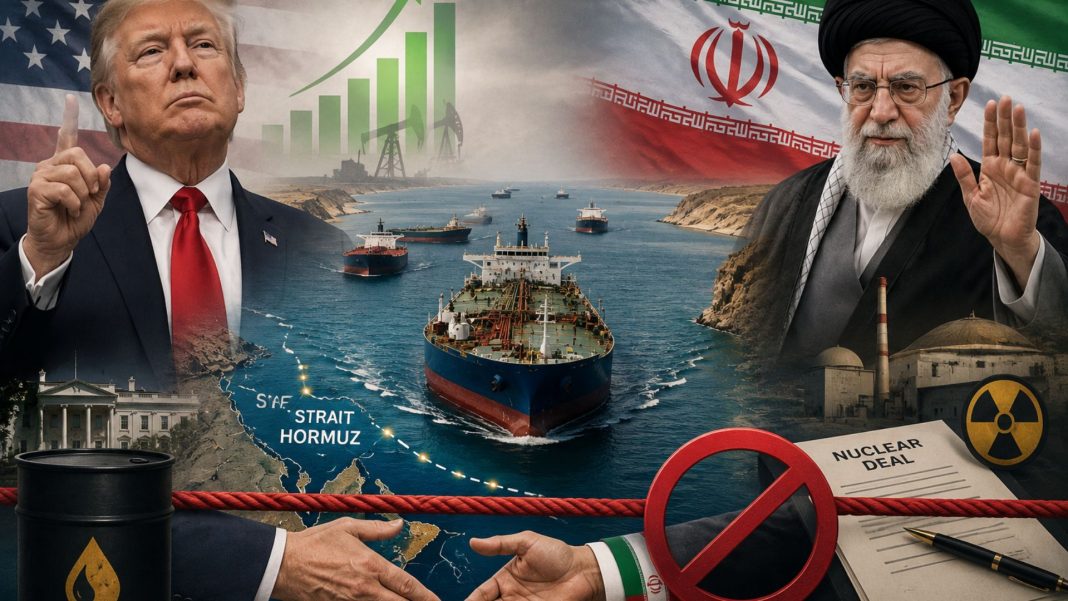

Trump Iran Agreement: The global energy market and Middle Eastern geopolitics are witnessing a massive shakeup. US President Donald Trump has claimed a historic breakthrough regarding the Strait of Hormuz and Iran’s nuclear monitoring. However, conflicting statements from Tehran suggest that while the oil is flowing, the diplomatic waters remain incredibly muddy.
The Oil Boom: 19 Million Barrels and Counting
Trump Iran Agreement: In a major announcement from Washington D.C., President Donald Trump claimed that the vital Strait of Hormuz is fully open and operating without disruptions.
The Record: Trump stated that a staggering 19 million barrels of oil were exported through the strait on Monday alone.
The Catalyst: According to the US administration, this massive surge in oil flow is the direct result of a new understanding or agreement reached with Iran, bringing much-needed relief to global fuel prices.
From an economic standpoint, this 19 million barrel figure is monumental. Nearly 20% of the world’s petroleum passes through this narrow strait. Following recent military tensions, the threat of a complete shutdown hung over the global economy, raising fears of hyperinflation.
By temporarily easing some US sanctions, Trump has allowed Iranian oil to flow rapidly back into the global market, mainly toward Asian buyers. This surge has successfully stabilized crashing market sentiments and lowered global crude prices.
The Nuclear Friction: Agreement or Illusion?
Trump Iran Agreement: While the US portrays the situation as a massive diplomatic win, the fine print of the “deal” is already causing heavy friction between the two nations.
The US Claim: Trump asserted that Iran has agreed to high-level, long-term monitoring of its nuclear infrastructure. Furthermore, he hinted that Iran has accepted stricter UN inspection regimes.
The Iranian Denial: Refuting these claims, Iranian Foreign Ministry Spokesperson Esmaeil Baghaei explicitly stated that Tehran has not accepted any new or detailed inspection conditions on its nuclear sites. Iran maintains that the talks are still in the preliminary stages and significant differences remain unresolved.
This public clash of statements reveals the immense domestic pressure both leaders face. President Trump needs to project a “maximum pressure” victory to the American public and Congress, showing he successfully tamed Iran’s nuclear ambitions.
On the flip side, Iran’s reformist government cannot afford to look weak or appear to be surrendering to Western demands in front of its own hardliners. While technical experts behind closed doors might be agreeing on basic monitoring parameters, the public denial shows that the road to a finalized, written treaty remains incredibly rocky.
The Missile Red Line: Pezeshkian’s Firm Stance
On his first foreign trip since the US talks began, Iranian President Masoud Pezeshkian arrived in Islamabad, Pakistan, where he co-hosted a press conference with Pakistani Prime Minister Shehbaz Sharif. He drew a hard line regarding Iran’s military sovereignty.
“Our missile program was not part of the agreement with the US, and it never will be.” Masoud Pezeshkian, President of Iran
Regional Diplomacy: Pezeshkian emphasized that honest dialogue and regional cooperation are the only ways to achieve lasting peace.
Pakistan’s Role: During a meeting with Pakistani President Asif Ali Zardari, it was highlighted that Pakistan, alongside nations like Qatar, played a constructive, mediating role in facilitating the US-Iran dialogues.
Pezeshkian’s statement is a crucial strategic reminder to the West. Iran views its conventional ballistic missile program as its ultimate deterrent against regional adversaries like Israel. While Tehran might negotiate on nuclear enrichment levels in exchange for economic sanctions relief, its missile defense is entirely non-negotiable.
Furthermore, this visit highlights a shifting regional dynamic; Pakistan is positioning itself as a vital diplomatic bridge. With sanctions potentially clearing up, Iran hopes to revive long-delayed cross-border energy projects like the Iran-Pakistan gas pipeline.
The Shadow of Conflict: Cross-Border Tensions Escalate
The diplomatic breakthrough is being severely tested by reality on the ground. In Southern Lebanon, two people were killed and two others injured due to firing by Israeli forces.
Hezbollah’s Reaction: Hezbollah labeled the Israeli attack as “treacherous” and openly announced that it is actively considering a retaliatory strike, threatening to disrupt the fragile peace.
This is the weakest link in the entire peace plan. High-level talks in Washington or Islamabad mean very little if proxy battlefields remain active. While the US-Iran framework mentions respecting Lebanese sovereignty, Israel has largely decoupled itself from these terms, asserting its right to strike Hezbollah threats independently.
Since Hezbollah is heavily funded and armed by Tehran, any massive escalation on the Israel-Lebanon border will instantly bleed into the US-Iran negotiations, giving Washington hardliners an excuse to tear up the fragile progress.
The Big Picture: What This Means for the World
The Economic Catch: The record-breaking oil supply gives the global economy a temporary breather. However, this stability is built on glass. As long as the Strait of Hormuz lacks a legally binding security treaty, shipping companies and global markets will remain on edge.
The Leverage Game: Trump is using a carrot-and-stick policy, offering sanctions relief while threatening harsher economic punishment if Iran steps out of line. Iran, conversely, is using its oil flow as leverage while keeping its core defense structures intact.
A Fragile Foundation: True peace requires all moving parts to align. Currently, we have a booming oil market and open diplomatic channels, but we also have deep-rooted US-Iran distrust and an active border conflict in Lebanon.
While the world can enjoy a temporary sigh of relief with stable fuel prices, this “Hormuz breakthrough” is currently resting on thin ice. Until the underlying issues of Iran’s missile sovereignty and Israel’s regional security are addressed, this peace can turn back into conflict at any moment.
Also Read : Indian Citizens in Iran: Indian Embassy in Tehran Issues Critical Safety Advisory For Citizens in Iran