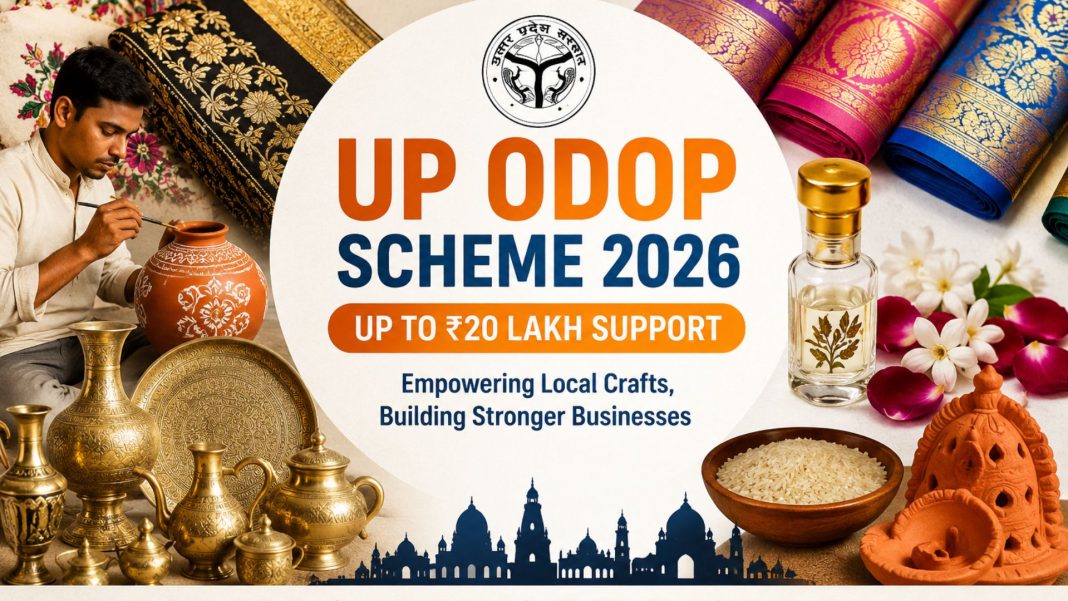

UP ODOP Scheme 2026: Starting a business in Uttar Pradesh has become significantly more accessible for local entrepreneurs, traditional artisans, and small-scale manufacturers.
Under the state’s flagship One District One Product (ODOP) Scheme 2026, the government of Uttar Pradesh is offering robust financial backing, comprehensive skill training, modern toolkits, and global marketing support to revitalize traditional local crafts and boost rural entrepreneurship.
By aligning with broader national initiatives such as MSME development, Skill India, and the Startup India ecosystem, this program aims to drive economic self-reliance and generate millions of local employment opportunities.
Understanding the Vision Behind UP’s ODOP Program
UP ODOP Scheme 2026: Launched on Uttar Pradesh’s Foundation Day on January 24, 2018, the ODOP scheme was designed to breathe new life into the unique, indigenous products that define each of the state’s 75 districts.
Rather than focusing on generic industrialization, the program selects one specialized, traditional product from each district and nurtures its entire value chain. By bridging the gap between local craftsmen and modern markets, the initiative aims to:
Promote and preserve ancient heritage crafts and regional handlooms.
Curb migration by generating sustainable livelihood opportunities in rural areas.
Enhance export quality to introduce UP’s unique products to international buyers.
Drive local manufacturing in line with the “Vocal for Local” and “Make in India” philosophies.
How the Financial Support Works: ODOP Margin Money Scheme
UP ODOP Scheme 2026: The cornerstone of the ODOP initiative is its highly structured credit-linked subsidy program, known as the ODOP Margin Money Scheme.
Under this framework, the state government provides varying levels of subsidy (margin money) depending on the overall size and cost of the proposed business project.
| Total Project Cost | Government Subsidy (Margin Money) |
|---|---|
| Up to ₹25 Lakh | 25% of the project cost (Maximum subsidy: ₹6.25 lakh) |
| ₹25 Lakh to ₹50 Lakh | 20% of the project cost or a guaranteed minimum subsidy of ₹6.25 lakh, whichever is higher |
| ₹50 Lakh to ₹1.5 Crore | 10% of the project cost or a guaranteed minimum subsidy of ₹10 lakh, whichever is higher |
| Above ₹1.5 Crore | 10% of the project cost (Maximum subsidy: ₹20 lakh) |
Free Skill Training and Modern Equipment Distribution
To ensure that traditional artisans can keep pace with modern industrial standards, the UP government pairs financial aid with hands-on skill development. Eligible candidates receive access to structural training programs that include:
A 10-day comprehensive training program fully funded by the state.
Free modern machine toolkits tailored to their specific craft to enhance production speed and product quality.
A daily stipend of ₹200 provided to trainees for the entire duration of the training program to offset wage losses.
Recognition of Prior Learning (RPL) certification, validating their traditional expertise and helping them secure formal banking credit.
Elevating Local Crafts to Global Markets
Recognizing that product quality must be matched by effective marketing, the UP administration actively helps micro-enterprises navigate modern retail channels. According to official guidelines, the government provides active support in several key commercial areas:
Professional Packaging & Branding: Designing premium, market-ready packaging to increase the shelf appeal of rural products.
Digital Commerce Integration: Helping local producers register on major e-commerce platforms and the Government e-Marketplace (GeM) portal for bulk government procurement.
Exhibitions & Trade Fairs: Sponsoring artisan stalls at national and international trade expos to put regional products directly in front of global buyers.
Signature Regional Products: What Each District Offers
Each district in Uttar Pradesh is mapped to a specific craft or culinary item under the program. Some of the most notable pairings include:
Lucknow: Exquisite Chikan embroidery and Zari-Zardozi work.
Varanasi: World-renowned Banarasi silk sarees.
Moradabad: Highly sought-after brassware and metal crafts.
Kannauj: Traditional organic perfumes (Attar).
Gorakhpur: Iconic terracotta clay art.
Siddharthnagar: The aromatic, indigenous Kalanamak rice.
Aligarh: High-security locks and brass hardware.
Eligibility Criteria & Required Documentation
To ensure the benefits reach genuine entrepreneurs and rural artisans, the UP administration has laid down clear eligibility parameters.
Who Can Apply?
The applicant must be a permanent resident of Uttar Pradesh.
The applicant must be at least 18 years of age at the time of application.
The proposed business venture must align with the specific ODOP product identified for their home district.
The applicant must not be a defaulted borrower with any nationalized bank or financial institution.
Only one member per family can claim the benefit of the free training and toolkit scheme. Additionally, the applicant must not have received similar state-sponsored toolkits in the preceding two fiscal years.
Essential Checklist of Documents:
A valid government-issued identification card (such as an Aadhaar card or voter ID)
Valid proof of residency (Domicile certificate)
Age proof document (Birth certificate or school leaving certificate)
Active bank passbook and account details
Passport-sized photographs
Category/Caste certificate (if applying under reserved categories)
Preliminary project report detailing the business plan
Step-by-Step Online Application Process
The application process is fully digitized to ensure transparency and prevent administrative delays. Aspiring entrepreneurs can apply by following these steps:
Visit the Official Portal: Navigate to the official website of the Directorate of Industries and Enterprise Promotion, Uttar Pradesh.
User Registration: Create a new user profile by entering basic contact information, followed by mobile number and email verification.
Fill out the Application Form: Select the “ODOP Margin Money Scheme” or “ODOP Training & Toolkit Scheme” and fill in the detailed form, including personal details, business location, and required loan amounts.
Upload Digital Documents: Upload scanned, clear copies of the required documents, including the business project report.
Verification & Approval: The submitted application undergoes verification by the District Industries Centre (DIC). Once verified, the proposal is forwarded to nationalized partner banks for final credit appraisal and loan disbursement.
Expanding Horizons: The ODOC Initiative
Building on the widespread success of the ODOP model, the Uttar Pradesh government has also introduced the One District One Cuisine (ODOC) initiative.
This program aims to map, standardize, and popularize unique local culinary delicacies from all 75 districts.
By supporting the regional food processing sector and local eatery systems, the government is creating a wider economic net that combines heritage tourism, food culture, and local agrarian trade.
Also Read: UP Kisan Karj Mafi Yojana 2026: Beneficiary Status, Eligibility, and Online List Check Guide