


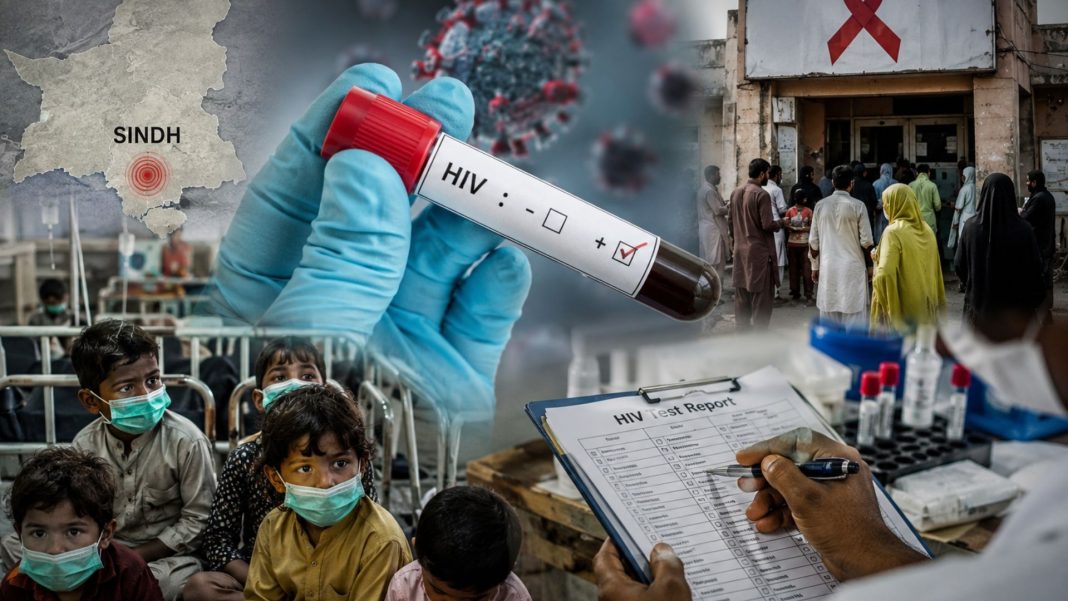

Inside Sindh’s HIV Outbreak: A severe healthcare emergency has erupted in Sindh, Pakistan, after more than 130 people, the vast majority being young children, tested positive for Human Immunodeficiency Virus (HIV).
The epicenter of the outbreak has been identified as the Kulsum Bai Valika (KBV) Hospital, a state-run healthcare facility operated by the Sindh Employees’ Social Security Institution (SESSI) in Karachi’s SITE industrial zone.
The alarm was first raised by local residents in November 2025 after an alarming cluster of HIV cases emerged among children receiving treatment at the hospital’s pediatric ward.
Subsequent mass screening drives conducted in and around KBV Hospital confirmed 120 positive cases, while additional screenings in Karachi’s Landhi area uncovered 10 more infections, bringing the confirmed official count to at least 130.
SHOCKING INVESTIGATION: WHAT CAUSED THE OUTBREAK?
Inside Sindh’s HIV Outbreak: Provincial inquiry reports submitted to Sindh Chief Minister Murad Ali Shah on July 14 have laid bare a catastrophic failure of infection control standards inside the government facility.
Investigators found that the outbreak was not a natural disaster, but the direct outcome of gross administrative failure and safety negligence.
Key Lapses Uncovered by Health Inspectors:
Improper Syringe Handling: Medical staff failed to follow basic safety protocols while handling single-use syringes. A regulatory inspection by the Sindh Healthcare Commission (SHCC) revealed that needles were routinely removed manually from syringes after use rather than being safely discarded in designated sharp-object containers.
Missing & Unverified Sterilization: The working condition of the hospital’s autoclave, the primary machine used to sterilize surgical instruments, could not be verified by visiting inspectors.
Absent Medical Staff: During critical duty hours, essential nursing and Operation Theatre (OT) personnel were frequently absent from their posts, making routine monitoring impossible.
Zero IPC Training: Hospital employees had never received formal training on Infection Prevention and Control (IPC) protocols.
Hazardous Waste Disposal: Medical waste was not segregated properly. The private contractor hired to collect biohazardous materials had no formal training in handling dangerous hospital waste.
GOVERNMENT ACTION: FREE TREATMENT, A ₹2 BILLION FUND, AND SHOW-CAUSE NOTICES
Inside Sindh’s HIV Outbreak: Facing intense public backlash and legal petitions in the Sindh High Court, state authorities have stepped in with emergency measures:
State-Funded Medical Care: All affected patients have been transferred to top-tier health centers, including Indus Hospital, Aga Khan University Hospital (AKUH), and Dow University of Health Sciences, where they are receiving free Anti-Retroviral Therapy (ART) paid for by the state.
₹2 Billion Endowment Fund: Sindh Labour Minister Saeed Ghani announced the establishment of a Rs 2 billion endowment fund aimed at providing long-term rehabilitation, monthly support, and specialized medical care for the infected children and their families.
Mass Crackdown & Suspensions: 37 doctors and hospital staff, including former administrators, nurses, and laboratory personnel, have been issued show-cause notices and suspended pending criminal investigations. Minister Ghani pledged that those found guilty of criminal negligence face FIRs, job dismissals, and prison time.
Nationwide Screening Order: Pakistan’s Federal Health Minister, Mustafa Kamal, has mandated that HIV screening must now be conducted before any surgical procedure across the country.
A LARGER EPIDEMIC: PAKISTAN’S HEALTHCARE AS A SPREADER OF DISEASE
Health experts warn that the disaster at KBV Hospital is merely the tip of a dangerous iceberg. According to WHO and UNAIDS, Pakistan is experiencing one of the fastest-growing HIV epidemics in the Eastern Mediterranean Region.
200% Surge: National HIV cases jumped from 16,000 in 2010 to nearly 48,000 in 2024.
Child Infections Spiking: Pediatric HIV cases rose dramatically from 530 in 2010 to over 1,800 in 2023.
Lack of Care: Only 38% of HIV-positive children in Pakistan currently have access to life-saving treatment.
Writing in The Lancet HIV, medical experts highlighted that Pakistan’s HIV epidemic is now being driven largely by the healthcare system itself due to widespread unsafe injection practices, unsterilized equipment, and a lack of oversight.
As public health watchdogs and the Sindh High Court demand complete accountability, families of the victims continue to push for criminal prosecution against all responsible officials, hoping this tragic wake-up call will finally force systemic reform across Pakistan’s medical infrastructure.