


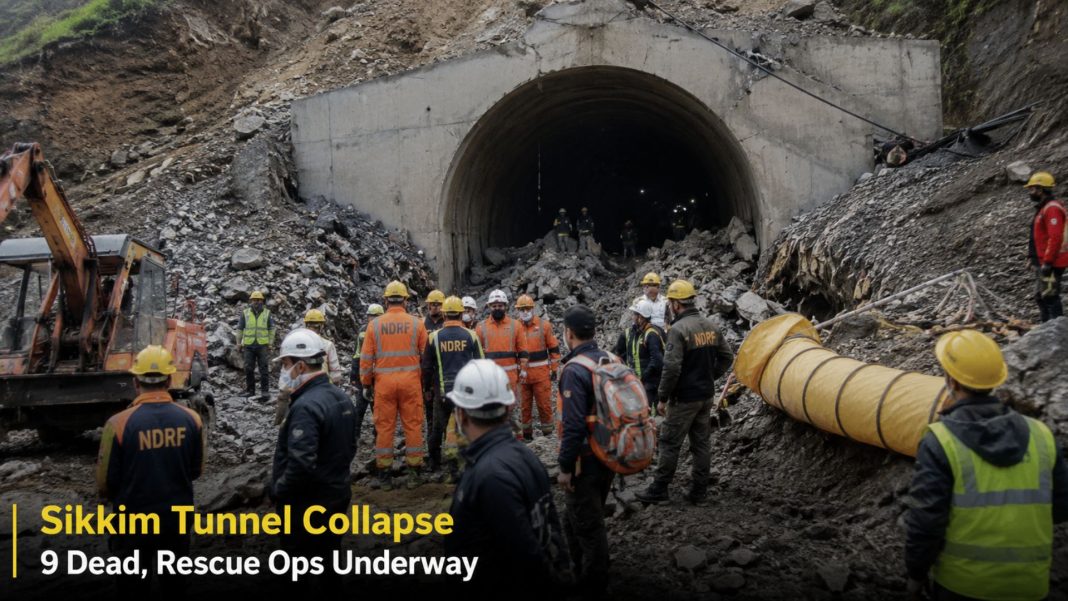

Sikkim Tunnel Collapse: A severe disaster struck South Sikkim’s Namchi district on Monday afternoon when a sudden landslide caused an under-construction tunnel to collapse at the NHPC Teesta Stage VI Hydroelectric Project.
According to media reports, the tragedy has claimed at least nine lives, while an estimated 27 workers remain trapped deep inside the structure as multi-agency rescue efforts continue under extremely hazardous conditions.
The incident occurred at approximately 3:09 PM at the Samardung, Jholungey site, where Patel Engineering was actively constructing a critical section of the hydropower unit.
Preliminary inputs indicate that a massive rock-and-earth movement blocked the main entry access, sealing off the interior passages and leaving the workforce stranded without a clear exit route.
Hazardous Methane Leak Hinders Initial Rescue Attempts
Sikkim Tunnel Collapse: The recovery process has faced immense challenges due to an underground gas emergency. As reported by media outlets, geological shifts triggered by the landslide led to a high-concentration methane gas leak spanning nearly 1.5 kilometers inside the tunnel.
The toxic environment, combined with severe oxygen depletion and absolute darkness, created a life-threatening situation for both the trapped workers and the emergency crews.
Namchi District Collector Anupa Tamling highlighted the immediate difficulty faced by first responders:
Initial Attempts: Fire and emergency services alongside local police attempted to enter the shaft twice shortly after the collapse.
Forced Retreat: Due to a lack of specialized protective gear and high toxicity levels, the teams were forced to turn back.
First Evacuations: The initial National Disaster Response Force (NDRF) unit that reached the site had to prioritize safely evacuating the first responders who were overwhelmed by the hazardous atmosphere.
Bodies recovered from the site were heavily covered in debris and earth, illustrating the violent force of the collapse.
The deceased have been transported to Singtam District Hospital, STNM Hospital in Gangtok, and Namchi District Hospital. As of now, official identifications for the victims have not been publicly confirmed.
Over 25 Personnel Believed Trapped Inside
Sikkim Tunnel Collapse: The exact number of individuals inside the structure remains provisional as rescue teams work to reach the core collapse zone.
According to local administration statements cited by the media, workers who managed to escape reported hearing a massive sound similar to a blast before rushing toward the exit.
The estimated breakdown of those currently trapped includes:
Initial Workforce: Around 19 site workers initially caught inside during the collapse.
Private Firm Personnel: Three employees from Patel Engineering entered the tunnel shortly after the event to initiate a rescue; two of them subsequently became trapped, bringing the company’s total to 21.
NHPC Staff: An additional 6 personnel from the National Hydroelectric Power Corporation (NHPC) are believed to be stuck.
This brings the total estimated number of trapped individuals to 27, though authorities caution the figure could fluctuate once full physical contact is established inside the shaft.
Multi-Agency Mobilization and Specialized Support
A massive joint rescue enterprise is currently active at the location. Operations are being coordinated by the Sikkim State Disaster Management Authority (SSDMA), supported by:
National Disaster Response Force (NDRF): Teams dispatched immediately from Pakyong and Siliguri (West Bengal).
State Disaster Response Force (SDRF): Local units providing immediate ground coordination.
Sikkim Police & Fire Services: Securing the perimeter, directing site efforts, and managing traffic flow across nearby routes to ensure smooth passage for emergency vehicles.
To counter the gas hazard, local authorities requested a specialized rescue team equipped with advanced gas-resistant apparatus from West Bengal. A second NDRF team equipped with heavy-duty breathing equipment has since entered the tunnel to push deeper into the blocked zones.
Understanding the Invisible Hazard: The Danger of Methane Gas
The primary barrier preventing teams from reaching the stranded workers is the extreme concentration of natural methane.
Scientifically, while methane itself is not intrinsically toxic, high levels in enclosed spaces act as a simple asphyxiant by displacing breathable oxygen. This leads rapidly to loss of consciousness and suffocation.
Furthermore, methane is highly volatile. In a confined environment like a blocked underground passage, even a tiny spark from moving equipment, friction, or electrical faults can trigger a major explosion, making every step of the rescue operation exceptionally delicate.
Priority Remains on Safe Evacuation
District Collector Anupa Tamling reiterated that the administration’s absolute priority is the safe extraction of every individual inside the tunnel.
However, until specialized teams clear the dangerous gas pockets and dig through the central obstruction, the condition of the remaining workers remains uncertain.
Operations will continue uninterrupted through the night as teams work to restore safe air supply lines and clear the blocked access point.
Also Read: Jammu Floods 2026: Death Toll Rises to 11, Amarnath and Vaishno Devi Yatras Suspended