


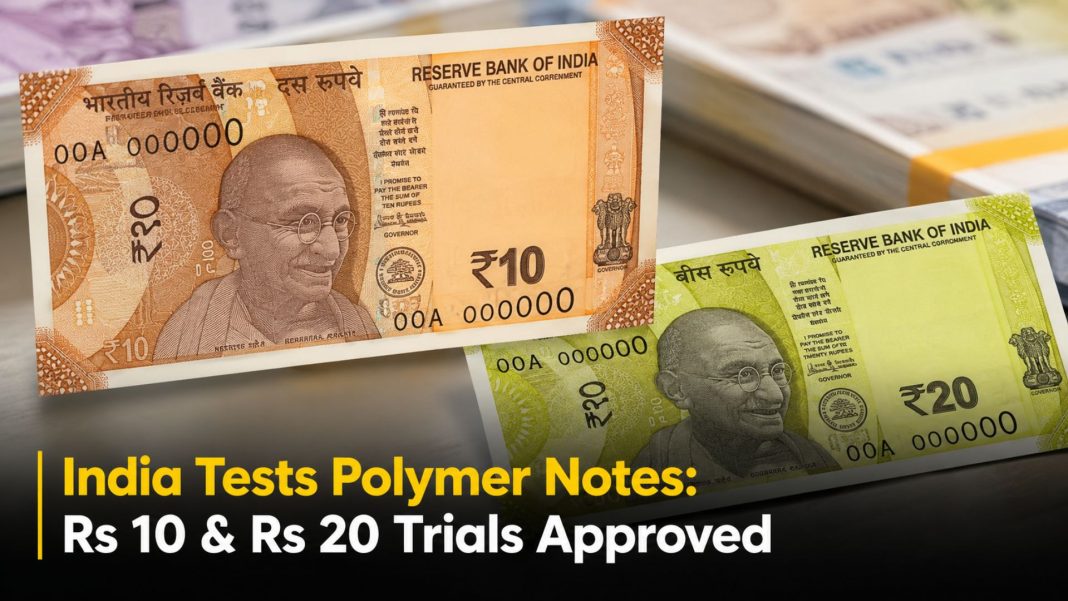

Polymer Currency Notes in India: India has taken a major step toward modernizing its physical currency system. The Central Government has officially approved a proposal by the Reserve Bank of India (RBI) to issue two billion polymer banknotes for field trials across the country.
According to media reports, the pilot phase will involve one billion pieces of Rs 10 notes and one billion pieces of Rs 20 notes to test their performance and durability under real-world Indian conditions.
According to media updates, official parliamentary disclosures confirmed that the proposal has received government authorization for pilot testing.
The Central Board of the RBI submitted the recommendation under Section 25 of the RBI Act, 1934, requesting permission to conduct field trials and subsequently begin regular issuance if the trials prove successful.
When Will Rs 10 and Rs 20 Polymer Notes Launch?
Polymer Currency Notes in India: While the government’s approval marks a major turning point, there is no fixed release date for the nationwide rollout. According to media reports, the introduction is currently in a preliminary testing phase.
Before issuing plastic currency to the general public on a full-scale basis, the RBI must complete rigorous field trials.
These tests will evaluate how polymer substrate banknotes withstand India’s diverse climatic conditions, heavy daily circulation, and varied handling habits.
As reported by media sources, a subsidiary of the central bank Bharatiya Reserve Bank Note Mudran Private Limited (BRBNMPL) has already initiated a global tender process to procure specialized polymer substrate sheets needed for printing.
Industry analysts suggest it could take several months to set up a secure, uninterrupted supply chain and complete the initial trial phase before any decision on regular issuance is made.
Paper Notes Will Coexist: No Plans for Replacement
The Ministry of Finance has clarified that polymer currency will not replace existing paper banknotes. Instead, both forms of currency will circulate alongside each other.
According to media reports, there is currently no proposal to phase out paper-substrate currency altogether.
The primary focus remains on using polymer material specifically for lower-denomination banknotes such as Rs 10 and Rs 20 which exchange hands far more frequently and suffer higher rates of physical degradation than higher-value notes.
Why Is the RBI Moving to Polymer Banknotes?
According to international studies cited by reports, polymer banknotes have a significantly longer lifespan compared to traditional cotton-paper notes.
Key reasons behind the RBI’s initiative include:
Superior Durability: Polymer notes resist moisture, dirt, and tearing, making them far more resilient in high-circulation environments.
Reduced Printing Costs: While the initial cost of producing polymer substrate notes is higher, their extended lifespan reduces the overall cost of reprinting and replacing soiled bills.
As per media reports, the RBI spent Rs 6,372.8 crore on currency printing in FY25, highlighting the financial burden of replacing worn-out cash.
Enhanced Security Features: Polymer material allows for advanced anti-counterfeiting elements, such as transparent windows and intricate security threads that are hard to replicate.
Impact on Digital Payments and Global Context
The government also addressed questions regarding whether introducing plastic notes could affect India’s digital payments ecosystem.
According to media reports, official sources clarified that physical banknotes and digital transaction platforms serve as complementary payment options for citizens.
Any measurable impact on digital payments can only be assessed once polymer notes achieve regular circulation following field trials.
The plan revives an initiative that was first considered over a decade ago when the central bank proposed pilot runs in selected cities.
Globally, over 60 countries including Australia, Canada, the United Kingdom, Singapore, and Vietnam already rely on polymer currency for its environmental and economic benefits.
The upcoming trials will determine whether India can successfully transition to longer-lasting plastic currency on a national scale.
Also Read: India-China Border Trade via Nathu La Pass Set to Resume from August 1 After Six-Year Suspension