


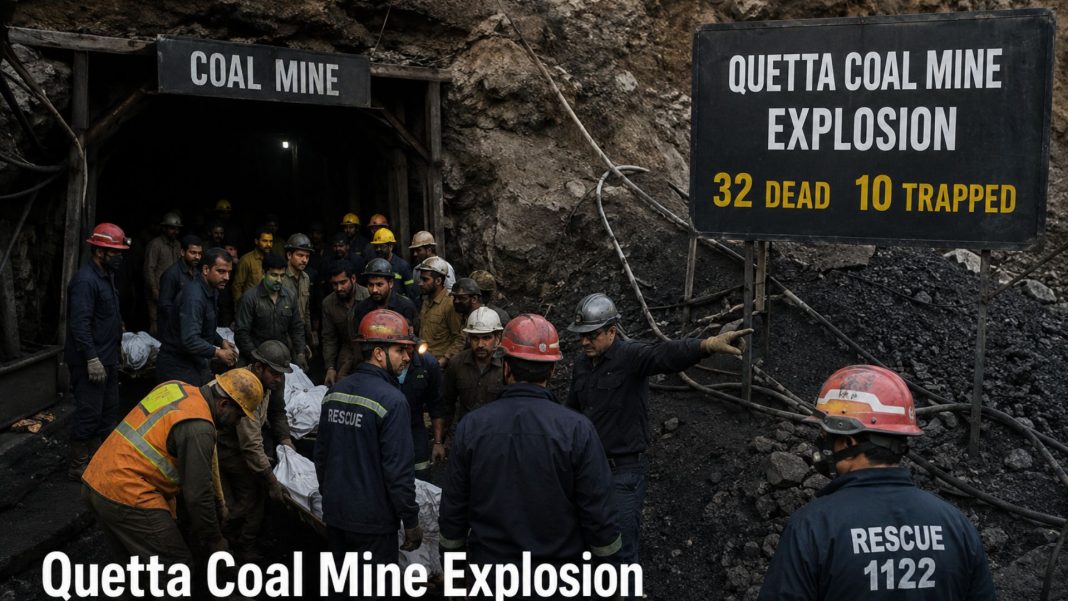

Pakistan Coal Mine Explosion: A devastating disaster has struck the mining sector in southwestern Pakistan. According to media reports, a massive explosion inside a coal mine on the outskirts of Quetta, the provincial capital of Baluchistan, has claimed the lives of at least 32 miners.
Emergency responders are currently locked in a high-stakes search and rescue operation to locate at least 10 workers who remain trapped hundreds of meters underground under perilous conditions.
The tragedy unfolded when a hazardous accumulation of flammable methane gas ignited deep within the shafts.
As per officials from the local disaster management authorities, the blast caused immediate collapses and filled the mine passages with toxic gas, leaving workers with little chance of escape.
Tracing the Incident: How the Underground Blast Unfolded
Pakistan Coal Mine Explosion: According to official reports provided by government mine inspector Ghani Baloch, the disaster occurred unexpectedly during routine mining operations.
Initial rescue efforts managed to extract seven bodies from the entrance shafts in the immediate hours following the detonation.
As specialized emergency teams penetrated deeper into the compromised tunnels, they located and recovered 25 additional bodies, bringing the confirmed fatality count to 32.
Rescue efforts are ongoing, but authorities have acknowledged the extreme difficulties facing the operation.
Methane explosions routinely displace oxygen within confined spaces, creating hostile conditions for both trapped survivors and incoming search teams.
As per statements by mine inspector Ghani Baloch in media reports, oxygen levels inside the shafts dropped significantly following the explosion.
He noted that while rescue teams will continue searching until every individual is accounted for, the probability of finding survivors decreases rapidly over time.
Rescuers are forced to proceed with caution to prevent secondary cave-ins or gas ignitions.
Government Response: Investigations and Compensation Announced
In the aftermath of the explosion, provincial leadership expressed grief over the loss of life and pledged administrative action.
Baluchistan’s Minister for Mines and Minerals, Shoaib Nosherwani, extended condolences to the families of the deceased miners and confirmed that emergency teams are operating under high-risk environments.
According to official statements, the provincial government of Baluchistan has announced financial relief of 500,000 Pakistani rupees (approximately $1,800 USD) for the family of each deceased worker.
Minister Nosherwani also assured the public that a thorough investigation into the root cause of the methane buildup would be conducted.
The state plans to review existing regulatory frameworks and evaluate safety compliance across mining operations in the province to prevent similar catastrophes.
Meanwhile, local authorities have begun the process of identifying victims and returning their remains to grieving families for burial services.
Labour Unions Blame Systemic Negligence and Poor Oversight
While government officials point to gas accumulation, labor organizations argue that the disaster was largely preventable.
The Pakistan Central Mines Labour Federation issued a formal statement calling out mine operators for what they describe as systemic neglect and reckless disregard for human life.
Union leaders allege that basic regulatory mandates such as functional ventilation systems, automated gas monitoring equipment, and mandatory personal protective gear are routinely ignored by mine owners seeking to cut costs.
According to media reports citing labor union representatives, the federation has urged the government to enforce labor laws strictly, shut down non-compliant mines, and press criminal charges against negligent management.
Safety experts have long highlighted that many coal mines in Baluchistan operate with outdated techniques.
Without proper air circulation infrastructure, pockets of colorless, odorless methane gas can build up undetected until a spark often from basic machinery or static triggers a destructive explosion.
Economic Vulnerability Drives High-Risk Labor in Baluchistan
This recent tragedy highlights the ongoing hardship faced by thousands of laborers working in Pakistan’s coal sector.
Baluchistan remains Pakistan’s largest province by geographical area, yet it suffers from widespread poverty, limited industrial development, and high unemployment rates.
For many impoverished locals and migrant workers, coal mining is one of the few available sources of income, despite low wages and life-threatening workplace hazards.
Mine workers frequently descend hundreds of meters underground without adequate safety training or modern communication devices.
As rescue teams continue their painstaking work outside Quetta, families wait anxiously near the pit head, hoping for news about the 10 missing miners.
The tragedy renewed calls across Pakistan for fundamental reform in industrial safety, urging lawmakers to prioritize worker protection over profit margins.