


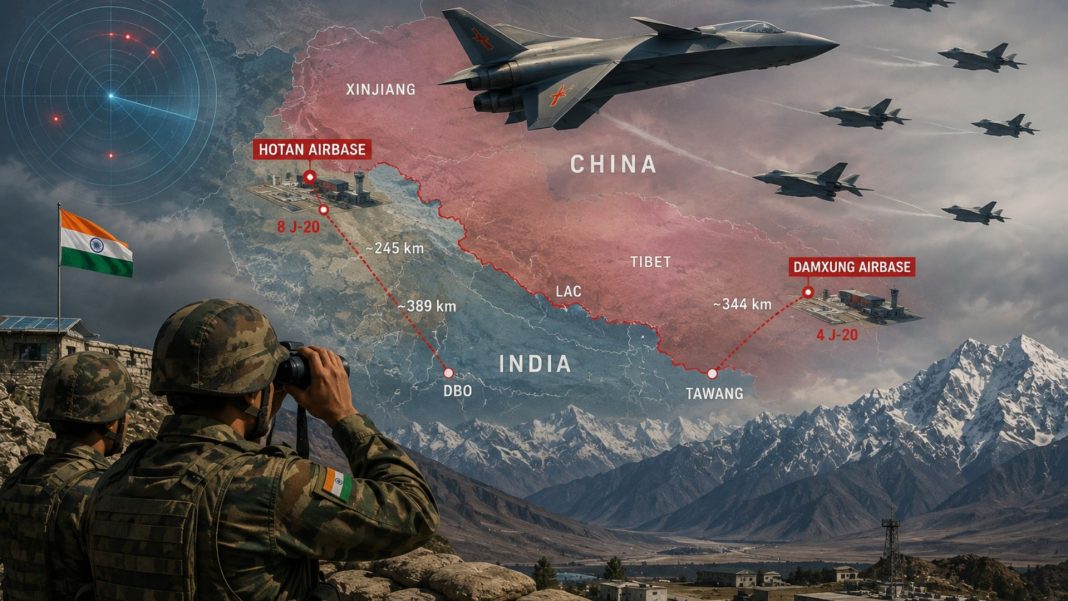

China Bolsters Airpower Near LAC: In a major strategic escalation along the 3,488-kilometer Line of Actual Control (LAC), recent high-resolution commercial satellite imagery reveals that China’s People’s Liberation Army Air Force (PLAAF) has deployed its most advanced fifth-generation J-20 “Mighty Dragon” stealth fighter jets to key forward airbases opposite India.
The developments come amid lingering military tensions following the 2020 Galwan Valley clash, signaling Beijing’s transition from temporary training exercises to routine operational deployments near Indian airspace.
The Satellite Breakdown: 12 Stealth Jets Caught on Camera
China Bolsters Airpower Near LAC: According to satellite imagery captured by commercial provider Vexcel (Venter) on July 9 and June 25, a total of 12 Chengdu J-20 fighters were identified across two key PLAAF hubs in Xinjiang and Tibet:
Hotan Airbase (Xinjiang): Eight J-20 stealth fighters were photographed standing in the open apron area on July 9.
Damxung Airbase (Tibet): Four J-20 jets were spotted stationed beneath protective aircraft shelters on June 25.
Military analysts view this as one of the largest concentrations of fifth-generation stealth aircraft observed near the disputed border in recent years.
| Airbase Location | Region | J-20 Aircraft Deployed | Proximity to Key Indian Assets |
|---|---|---|---|
| Hotan Airbase | Xinjiang | 8 | ~245 km from Daulat Beg Oldi (DBO); ~389 km from Leh |
| Damxung Airbase | Tibet | 4 | ~344 km northwest of Tawang (Arunachal Pradesh) |
Strategic Proximity: Threatening Both Western and Eastern Theatre Command
The strategic positioning of these two airbases enables the PLAAF to threaten both India’s Western (Ladakh) and Eastern (Arunachal Pradesh) sectors:
The Western Flank (Hotan): Situated just 245 kilometers from India’s crucial Daulat Beg Oldi (DBO) airstrip and 389 kilometers from Leh, Hotan serves as the primary forward operational node for the PLAAF in Xinjiang.
The Eastern Flank (Damxung): Located 344 kilometers northwest of Tawang in Arunachal Pradesh, Damxung provides the Chinese military a high-altitude springboard directly facing India’s northeast corridor.
Hotan Airbase: Beijing’s Mega High-Altitude Fortress
Hotan is far more than just a landing strip; it is a heavily modernized, dual-use military and civil hub. Equipped with a 3,700-meter-long runway, it can facilitate heavy strategic transport aircraft and bombers.
In addition to the newly spotted J-20 stealth jets, Hotan hosts a diverse array of advanced Chinese air assets:
KJ-500 Airborne Early Warning & Control (AEW&C) radar aircraft.
CH-4 strike and reconnaissance drones.
H-6 Strategic Bombers (routinely deployed during military drills and heightened border standoffs).
Hardened aircraft shelters, revamped aprons, and modern operational support infrastructure.
Why the J-20 Deployment Changes the Game
The J-20 “Mighty Dragon” is China’s flagship fifth-generation twin-engine stealth fighter, designed to slip past enemy radar, conduct long-range precision strikes, and dominate modern air-to-air combat using beyond-visual-range (BVR) missiles.
Defense Experts’ Take: While satellite images alone cannot verify whether these 12 aircraft are permanently stationed or part of a temporary rotation unit, their sustained presence at high-altitude airbases proves that the PLAAF is integrating stealth technology into its active daily operations along the Indian frontier.
The Border Reality: Standoff Persists Post-Galwan
Though multiple rounds of military and diplomatic talks have led to partial disengagement in select friction points since the June 2020 Galwan Valley clash, the overall frontier remains heavily militarized.
Both India and China continue to maintain tens of thousands of troops, heavy artillery, armored vehicles, and advanced surface-to-air missile (SAM) systems deployed along the LAC.
Challenges Ahead for the Indian Air Force (IAF)
This steady buildup of fifth-generation fighters creates a tactical dilemma for the Indian Air Force, which currently faces a shortfall in its authorized squadron strength:
Delivery Delays: The supply of indigenous LCA Tejas Mk1A fighters has faced scheduling delays.
Procurement Timelines: The process to acquire 114 Multi-Role Fighter Aircraft (MRFA) under the IAF modernization program is still underway.
While India’s front-line Rafale jets, Su-30MKIs, and S-400 Triumf air defense systems provide robust high-altitude deterrence, air power experts emphasize that monitoring China’s expanding air superiority capabilities along the border will remain a critical priority for New Delhi.
Also Read : Egypt earthquake: Moderate Earthquake Shakes Egypt and Neighboring Regions, No Major Casualties Reported