


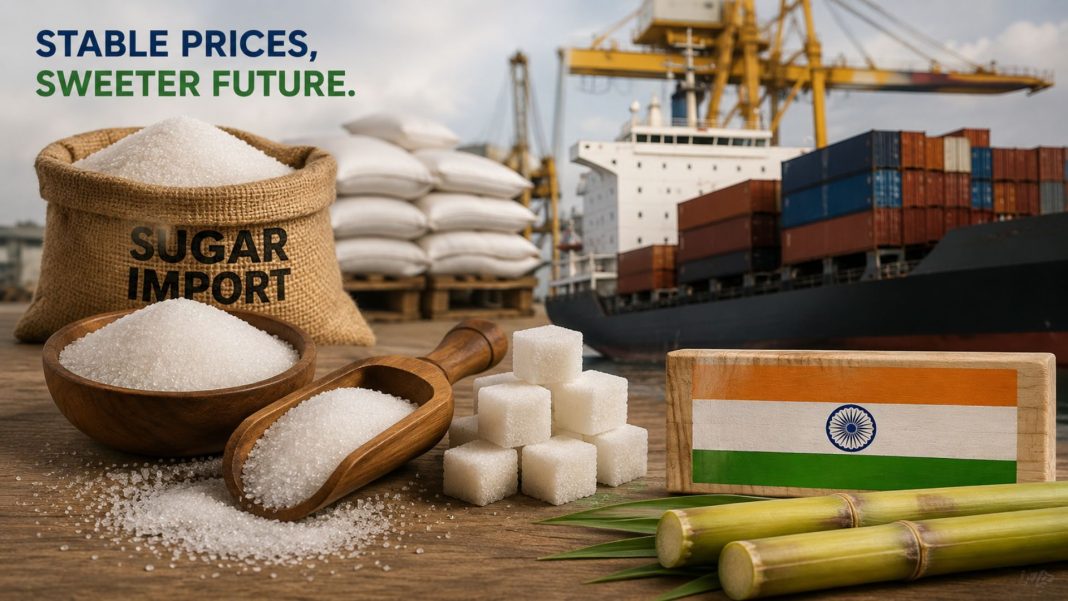

India Sugar Imports Proposal: To stabilize domestic food inflation ahead of the peak festive season, India is contemplating allowing limited duty-free sugar imports for the first time in nearly a decade.
According to media reports, high-level discussions are underway within government departments to deploy a series of administrative and market interventions aimed at curbing an unexpected spike in wholesale sweetening agent costs.
The potential policy reversal comes at a critical juncture when seasonal demand surges across the country due to upcoming festivals such as Ganesh Chaturthi, Dussehra, and Diwali.
Understanding the Factors Behind Rising Domestic Sugar Prices
India Sugar Imports Proposal: Wholesale sugar prices in key trading hubs have witnessed a rapid upward surge.
In Kolhapur, a major sugar distribution hub in Maharashtra, spot prices climbed by nearly 20% within a matter of weeks, reaching a record high of ₹5,350 per 100 kg.
Market analysts note that the sudden price increase is driven by several compounding operational factors:
Festive Demand Surge: Household and industrial consumption of sweets, beverages, and confectionery reaches its annual peak between August and November.
Localized Supply Tightness: While overall seasonal reserves remain technically adequate, immediate physical availability in wholesale markets has tightened significantly.
Delayed New Crop Arrival: Fresh sugarcane crushing for the new season typically begins in November, leaving a narrow temporal window where physical supply remains restricted.
Industry representatives state that while the long-term supply outlook is balanced, short-term liquidity in domestic markets requires immediate intervention to keep retail prices accessible for consumers.
Key Interventions Under Government Consideration
According to news reports citing government and trade sources, authorities are evaluating a multi-pronged approach to stabilize domestic supply chains and manage pricing expectations.
| Proposed Policy Intervention | Primary Objective | Potential Impact |
|---|---|---|
| Duty-Free Raw Sugar Imports | Allow mills to import up to 1 million metric tonnes duty-free before late October. | Adds immediate sugar inventory ahead of the domestic crushing season. |
| Stock Limit Restrictions | Cap the inventory held by bulk traders and wholesalers. | Discourages hoarding and encourages supply into active markets. |
| Port Refinery Stock Diversion | Allow port-based refineries to release around 300,000 tonnes of raw sugar into local markets. | Speeds up supply without waiting for new imports to arrive. |
| Ethanol Diversion Curbs | Reduce sugarcane juice diverted to ethanol production in the upcoming season. | Helps maximize domestic sugar production from available sugarcane. |
Operational Dynamics of Potential Imports
India Sugar Imports Proposal: If approved, trade sources indicate that Indian sugar mills will overwhelmingly favor importing raw sugar rather than fully refined white sugar.
High international prices for white sugar offer minimal operational margins, whereas raw sugar can be efficiently processed at port-based refineries or inland mills.
India already operates a specialized framework where designated port-based refineries import raw sugar duty-free under export obligations.
According to media reports, asking these specialized units to temporarily divert existing inventory into the domestic market could quickly supply up to 300,000 tonnes of physical stock to local traders.
The broader proposal to allow mills to import around 1 million metric tonnes would serve as a bridge mechanism, keeping wholesale prices stable until new-season domestic cane crushing gains full momentum toward the end of the year.
Global Market Implications and Outlook
As the world’s largest consumer of sugar, any shift in India’s trade policy carries significant weight across international commodity exchanges.
A formal decision to open import channels even temporarily would introduce a major new buyer to global markets, providing underlying support to benchmark raw sugar futures in London and New York.
Historically, the government has relied heavily on export bans and domestic quota adjustments to manage local availability, including extending export restrictions through September 2026.
Transitioning from export curbs to active import considerations highlights the priority placed on maintaining domestic price stability during peak festival periods.
While formal cabinet approval remains pending, the market expectation is that targeted administrative measures and temporary import concessions will keep essential commodity prices under control.
Also Read: FSSAI Liquor Crackdown: Diageo to Reformulate Royal Challenge, Antiquity Blue & McDowell’s No. 1