


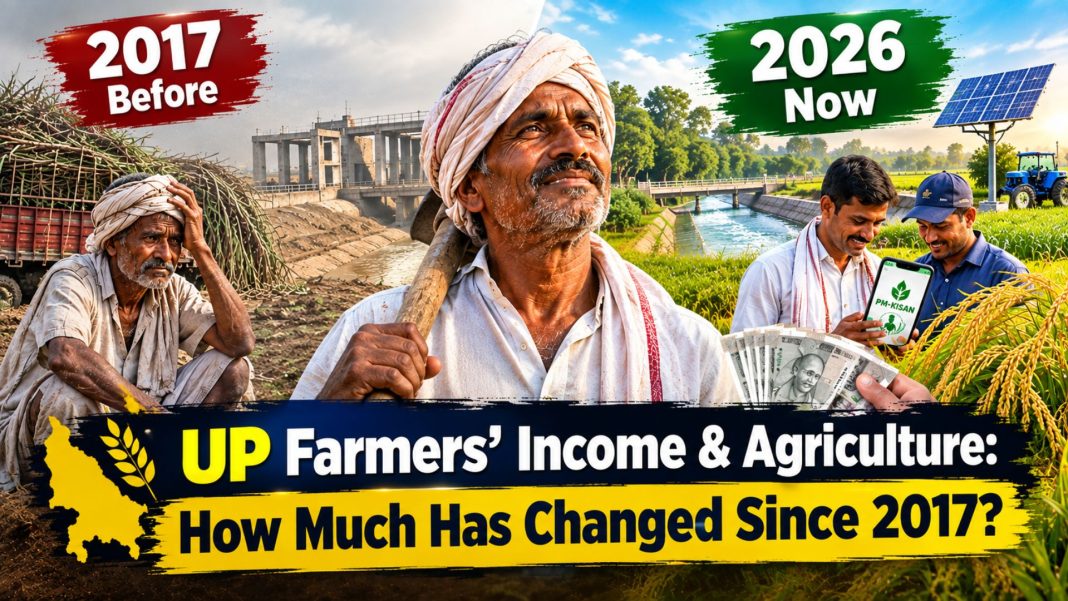

UP Farmers Income and Agriculture Transformation: Agriculture in Uttar Pradesh has always been closely tied to the state’s socio-economic landscape. Historically, rural economic grievances have dictated public sentiment, carrying a tradition built over decades by leaders like former Prime Minister Chaudhary Charan Singh, who reshaped post-1967 regional governance by prioritizing the agrarian vote.
As Uttar Pradesh moves closer to its upcoming 2027 assembly elections, evaluation centers on how rural economic management shifted between the pre-2017 era and the post-2017 period.
Key indicators like sugarcane dues, crop procurement, direct benefit transfers, and irrigation infrastructure outline the tangible changes and persistent hurdles on the ground.
Pre-2017 Agrarian Challenges: Delays and Infrastructure Deficits
UP Farmers Income and Agriculture Transformation: Before 2017, the agricultural framework in Uttar Pradesh struggled with systemic bottlenecks. The sugarcane industry the economic backbone of Western UP was routinely burdened by delayed mill payments, with pending dues often stretching across multiple crushing seasons.
Irrigation infrastructure also suffered from long-standing delays. A prominent example was the Saryu Nahar National Project, which was initially conceptualized in 1978.
Official central records show that despite receiving national project status in 2012, the initiative languished for decades due to inadequate budgetary releases and inter-departmental coordination gaps.
The Post-2017 Shift: From Debt Waiver to Direct Transfers
UP Farmers Income and Agriculture Transformation: Following the formation of Chief Minister Yogi Adityanath’s administration in March 2017, the state took immediate measures to alter its rural welfare delivery model.
Immediate Financial Relief: The government launched the Fasal Rin Mochan Yojana in 2017, waiving crop loans of up to ₹1 lakh for small and marginal farmers, supported by an allocated outlay of over ₹36,000 crore.
Modernization of Sugarcane Clearance: According to media reports, digitizing acreage registration, slip issuance, and mill monitoring streamlined sugarcane operations.
State budget documents indicate that cumulative sugarcane payouts exceeded ₹3.04 lakh crore since 2017. Furthermore, during the 2025-26 crushing season, the State Advisory Price (SAP) was increased by ₹30 per quintal, bringing early-maturing varieties to ₹400 per quintal.
Completion of Long-Pending Infrastructure: In December 2021, the Saryu Nahar National Project was completed at a total cost of over ₹9,800 crore.
This interlinked five rivers Saryu, Ghaghara, Banganga, Rapti, and Rohini to extend assured irrigation to 14 lakh hectares across nine eastern districts, benefiting an estimated 29 lakh farmers.
Financial Inputs and Production Dynamics
UP Farmers Income and Agriculture Transformation: The combination of central direct benefit transfers and state-level policy interventions has significantly increased the volume of funds flowing directly into rural bank accounts.
Direct Cash Support: Over ₹94,668 crore has been disbursed via PM-KISAN to approximately 3.12 crore farmers across the state.
Crop Insurance Coverage: Over ₹5,110 crore in claims has been settled for nearly 62 lakh farmers under the Pradhan Mantri Fasal Bima Yojana between 2017 and 2025.
Sugarcane Price (SAP): Raised to ₹390–₹400 per quintal with total payouts crossing ₹3 lakh crore since 2017.
Irrigation & Power: Free power provisions were extended for private tubewells along with major project completions to reduce irrigation overheads.
Total Foodgrain Output: Foodgrain production increased from nearly 620 lakh metric tonnes to an estimated 722 lakh metric tonnes in recent years.
Persistent Challenges Facing Rural Households
While production volumes and administrative structures have improved, critical ground challenges remain:
Stray Cattle Management: Despite state shelter initiatives, stray cattle continue to damage standing crops, forcing farmers to incur additional fencing and night-watch costs.
Input Costs vs. Market Realities: Rising prices for diesel, fertilizers, labor, and equipment offset increases in minimum support prices for many smallholders.
Last-Mile Procurement Gaps: While wheat and paddy procurement systems have digitized, smaller non-grain farmers still rely heavily on local middlemen during bumper harvest periods.
Looking Ahead to 2027
The evolution of Uttar Pradesh’s agricultural policy shows a clear transition from reactive crisis management toward structured, direct-transfer governance.
As the state approaches the 2027 electoral cycle, public discussions will focus on balancing formal policy achievements against the daily operating expenses and net earnings of farm households.