


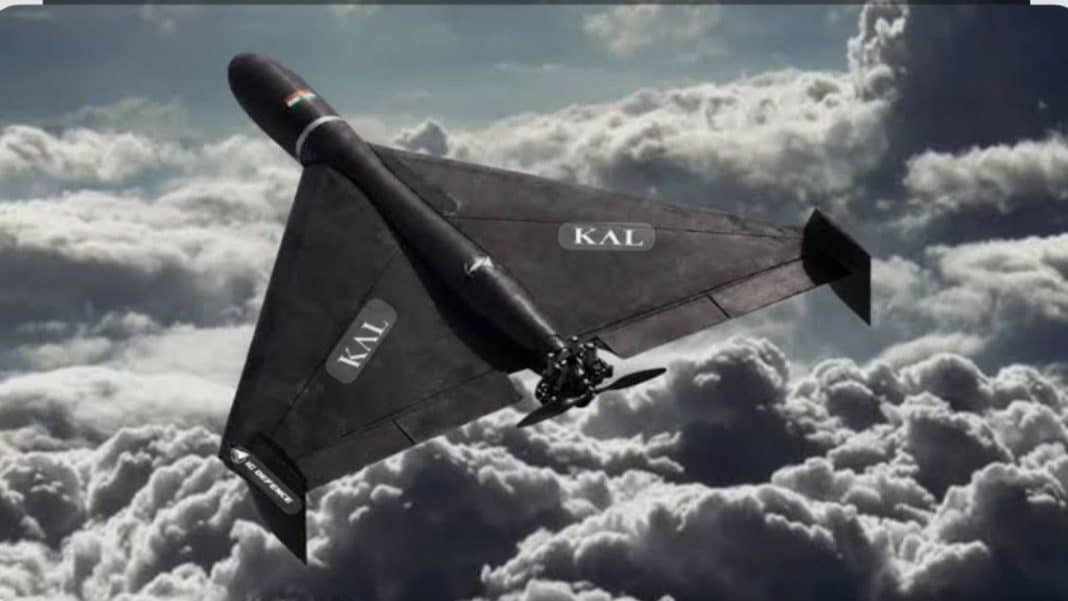

India’s Indigenous Might Resonates in Pokhran: India has achieved a significant milestone in indigenous defence technology. Noida-based defense firm IG Defence successfully tested its long-range one-way attack drone, KAL, alongside its soft-kill counter-drone system, T-Shul BEAM, at the Pokhran field firing range in Rajasthan.
The successful trials mark a major step forward in building national military capabilities, providing India with scalable, cost-effective options for long-range precision strikes and anti-drone security.
KAL Attack Drone: Technical Capabilities and Mission Profile
India’s Indigenous Might Resonates in Pokhran: The newly tested KAL platform belongs to the emerging class of long-range, one-way attack unmanned aerial vehicles (UAVs), often referred to as “loitering munitions” or “kamikaze drones.” Designed entirely in-house by IG Defence, the system focuses on long-distance payload delivery, high endurance, and autonomous flight operation.
Key Performance Specifications:
Operational Range: Up to 1,000 kilometres
Flight Endurance: 7 to 8 hours
Payload Capacity: Up to 50 kg
Operating Altitude: Up to 5,000 metres above mean sea level
Navigation Suite: Combined Multi-Band Global Navigation Satellite System (GNSS) and Inertial Navigation System (INS)
The dual GNSS and INS integration ensures that KAL can execute fully autonomous missions over long distances, maintaining flight stability and trajectory accuracy even under challenging conditions.
Strategic Role: High-Precision Target Engagement
India’s Indigenous Might Resonates in Pokhran: KAL is tailored to engage high-value strategic targets deep within enemy territory. Its operational roles include targeting:
Fixed strategic infrastructure
Early-warning radar installations
Air-defence missile batteries
Logistics nodes and command posts
By utilizing a high payload-to-cost ratio, platforms like KAL provide military commanders with a flexible tool to neutralize critical targets without putting human pilots or high-cost crewed aircraft at risk.
Modern Warfare Context: The Rise of One-Way Attack Systems
The Pokhran trials come at a time when long-range, low-cost drones are reshaping global conflict dynamics. Battlefield observations from the Russia-Ukraine war highlight how platforms like the Iranian-designed Shahed-136 and Russian Geran-2 can influence combat operations.
Lessons from Recent Conflicts:
Air Defence Saturation: Swarms of low-cost drones force opponents to expend expensive surface-to-air interceptor missiles, creating gaps in air-defence coverage.
High-Volume Campaigns: Large-scale manufacturing enables continuous, long-range pressure against enemy logistics and infrastructure.
Widespread Threat Multipliers: Similar drone systems have expanded across theatres, including operational use in the Middle East and maritime attack routes in the Red Sea.
IG Defence developed KAL to meet the growing demand for national strategic autonomy, ensuring India possesses locally produced, mass-manufacturable strike systems designed to match these evolving battlefield realities.
Integration with Grid Strike and GRID BMS
The KAL drone forms part of Grid Strike, IG Defence’s dedicated long-range precision-strike portfolio.
To maximize operational effectiveness on the modern battlefield, KAL can be integrated into the company’s GRID Battle Management System. This network relies on an AI-powered C5ISRT (Command, Control, Computers, Communications, Cyber, Intelligence, Surveillance, Reconnaissance, and Targeting) architecture.
When connected to the GRID system, operators can coordinate multiple unmanned platforms simultaneously, processing battlefield information in real time to streamline mission planning and target assignments.
Counter-Drone Success: T-Shul BEAM Neutralises 5 Targets
Alongside the offensive showcase of KAL, IG Defence demonstrated its counter-unmanned aerial system (C-UAS) technology at Pokhran.
The company’s indigenously developed T-Shul BEAM anti-drone system successfully and simultaneously neutralised five foreign-origin drones during the trials.
System Type: Man-portable, directional Counter-UAS
Intervention Method: Soft-kill technology
Mechanism: Electronic link disruption targeting communication, navigation, and data links
Operational Edge: Neutralises hostile drones without kinetic destruction or leaving behind explosive debris
Unlike traditional “hard-kill” anti-drone weapons that rely on missiles or heavy gunfire to physically destroy incoming UAVs, T-Shul BEAM uses directional electronic jamming. By disrupting signal links and satellite guidance, the system safely forces hostile drones out of control or grounds them without causing secondary explosive damage on the ground.
Strengthening India’s Defence Ecosystem
The successful combined trial at Pokhran marks a critical validation step for IG Defence’s airframe, propulsion, avionics, navigation, and command architectures.
By proving the performance of both long-range strike weapons (KAL) and point-defence counter-measures (T-Shul BEAM), the trials highlight India’s growing capacity to build sophisticated, end-to-end unmanned hardware locally, supporting national self-reliance and boosting modern warfighting readiness.
Also Read : Modi Celebrates 76th Birthday as Global Leaders and Film Stars Extend Warm Wishes