
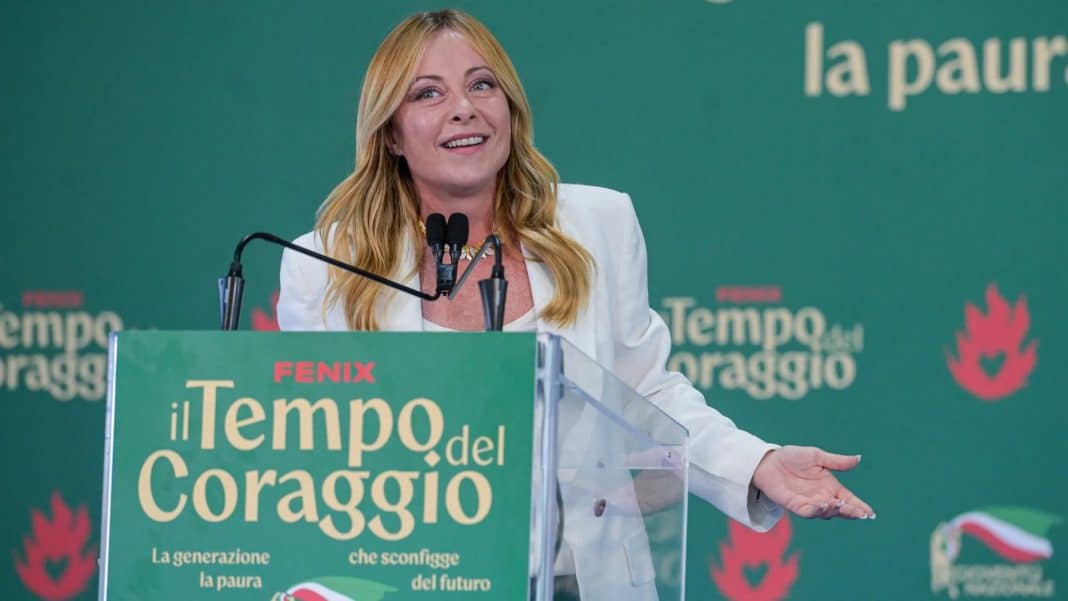

Italy Proposes Strict Ban on Burqas and Niqabs in Schools: Italy’s Prime Minister Giorgia Meloni has announced plans to implement a strict ban on burqas and full-face veils (niqabs) in schools across the nation.
Speaking on Sunday, Meloni revealed that the Italian Cabinet will soon review and decide on a formal proposal targeting face coverings inside educational institutions.
The Italian Prime Minister emphasized that classrooms must remain spaces where faces are fully visible and identifiable. She firmly stated that no individual, especially young women and girls, should be pressured or forced to cover their faces under the guise of cultural or religious tradition.
“Schools should be places where face-to-face interaction is open, and no one should feel forced to hide their identity behind cultural practices.“
Language Mandatory for Parents and Foreign Student Cap Introduced
Italy Proposes Strict Ban on Burqas and Niqabs in Schools: The proposed legislation extends far beyond dress codes, introducing structural changes to how foreign students integrate into the Italian educational framework:
Cap on Foreign Students: The Meloni administration plans to limit the percentage of foreign students permitted per classroom to avoid heavy concentration and encourage balanced assimilation.
Mandatory Italian Classes for Parents: Under the new rules, parents of foreign students who struggle to integrate, adjust, or keep pace with the Italian education system will be required to learn the Italian language.
The goal, according to government sources, is to foster rapid social integration and ensure that language barriers do not hinder academic progress or community cohesion.
Existing Identity Laws vs. New Educational Directives
Italy Proposes Strict Ban on Burqas and Niqabs in Schools: Italy is not entering entirely uncharted territory regarding face coverings. Public identification laws have existed in the country for decades
While the 1975 public safety law focused broadly on security and identification, the 2008 court ruling allowed flexibility for religious attire. Meloni’s new legislative push seeks to eliminate these loopholes within educational settings. Once approved by the Cabinet, the bill will head to the Italian Parliament, where it must be passed into law within 60 days.
Joining a Broader European Trend
Italy’s move aligns it with a growing list of nations worldwide. Nearly two dozen countries, including France and China, already enforce various restrictions or full bans on face-covering garments in public spaces or state institutions.
Legal Precedents in Europe
The European Court of Human Rights (ECHR) has repeatedly upheld similar restrictions across the continent:
France (2014): The court ruled that banning full-face veils in public places was justified to preserve the conditions of “living together.”
Belgium (2017): The ECHR affirmed a similar ban, prioritizing social interaction and public safety over religious exemptions.
While European courts have validated these measures, human rights organizations and representatives from the United Nations continue to express strong opposition, arguing that such bans infringe upon personal freedoms and religious expression.
Political Pressure Ahead of 2027 General Elections
Immigration remains one of Italy’s most volatile political battlegrounds as the country approaches its next general election in 2027. Meloni’s party, Brothers of Italy (FdI), faces intense pressure from hard-right political rivals.
Rise of National Future (FN): The far-right party National Future has been advocating for even stricter immigration policies than Meloni’s administration.
Early Demands: In July, National Future publicly called for an immediate ban on burqas and niqabs in schools.
Meloni’s current proposal is widely seen by political analysts as a strategic move to address voter concerns and reclaim the narrative on immigration and cultural policy before her opponents gain further momentum.
Demographic Realities: Foreign Students in Italian Classrooms
Data from the prominent research institute Fondazione ISMU highlights the changing demographics within Italian schools:
930,000 Foreign Students: Approximately 930,000 students enrolled in Italian schools do not hold Italian citizenship.
Classroom Ratio: Foreign students account for roughly 12 out of every 100 students (12%) nationwide.
Declining Youth Population: Despite their visible presence in classrooms, the total population of foreign minors in Italy has actually decreased by 4.5% over the past decade.
These statistics highlight the delicate balance the government faces: managing a significant foreign student body while responding to a broader demographic decline among foreign youth overall.
What Comes Next?
Cabinet Approval: The draft bill will be presented to Italy’s Cabinet for official endorsement.
Parliamentary Vote: Once submitted to Parliament, lawmakers will have a strict 60-day window to debate, amend, and vote the proposal into law.
Implementation: If passed, school administrators across Italy will begin enforcing the ban on full-face veils and setting up mandatory language programs for parents
Also Read : Explosion Near Mosque in Pakistan’s Kohat: 16 Dead Including 5 Police Officers, Over 50 Injured