



Bangladesh Workers Protest: Tensions flared across Bangladesh on Sunday as thousands of garment factory workers poured into the streets of the capital city and nearby industrial zones, demanding a substantial increase in their minimum monthly wages.
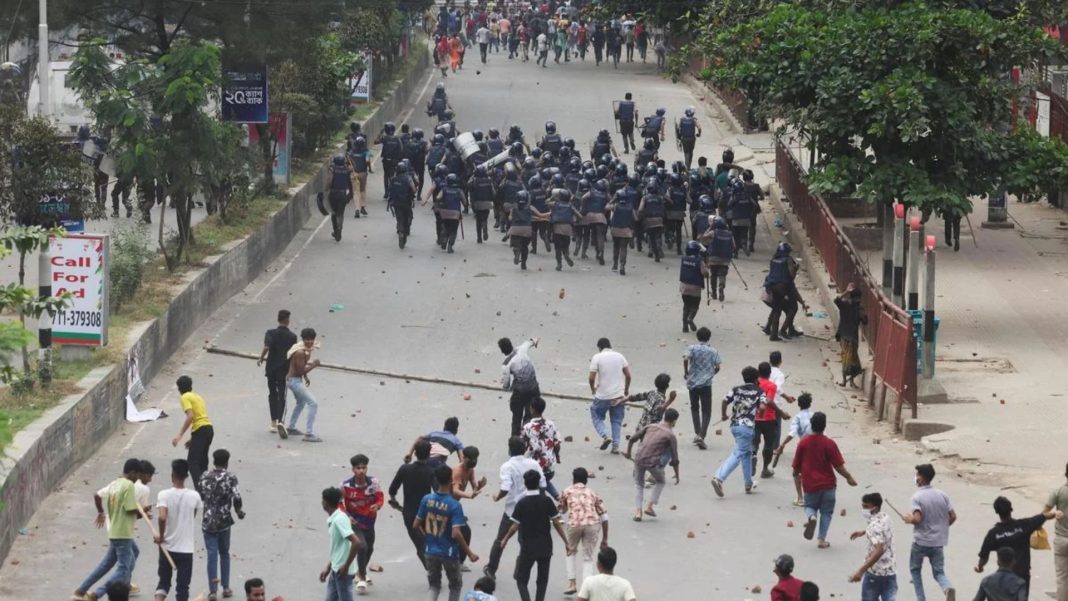
What began as a peaceful demonstration quickly escalated into violent clashes between security forces and angry protesters, disrupting normal life and industrial operations.
According to media reports, the most severe confrontations took place in Dhaka’s Mirpur area, where hundreds of workers blockaded key roads and major intersections early Sunday morning.
The Mirpur-10 crossing turned into a chaotic battleground as demonstrators pelted bricks and stones at law enforcement officials. In the ensuing violence, a police vehicle was set ablaze.
To regain control of the situation and disperse the growing crowds, local police resorted to baton charges and fired tear gas shells. Due to the escalating security threat, authorities were forced to temporarily shut down the gates of the busy Mirpur-10 metro station. Local sources indicated that this was the second consecutive day of disruptions, following a similar four-hour road blockade in the area on Saturday.
Highway Blockades and Torched Outposts in Gazipur
Bangladesh Workers Protest: The unrest was not confined to the capital. In Gazipur, a major manufacturing suburb situated north of Dhaka, widespread protests disrupted normal life throughout the day. Workers gathered along key transit routes, effectively bringing highway traffic to a complete standstill in the Kaliakair area.
In Konabari, Gazipur, the situation turned hostile when protesters targeted local infrastructure and torched a police outpost. In response to the rapidly deteriorating security situation, local administration officials announced the immediate deployment of five platoons of the Border Guard Bangladesh (BGB) to restore law and order and secure public property.
Over 30 Factories Forced to Shut Down in Ashulia
Bangladesh Workers Protest: The ripple effects of the agitation were acutely felt in Ashulia, another critical industrial sector near Dhaka. Following incidents of vandalism and sporadic violence on Saturday and Sunday, management across several units halted operations.
Fearing further damage to facility infrastructure and to ensure the safety of personnel, factory management declared an unscheduled holiday. Media reports confirm that at least 30 major garment manufacturing units remained completely closed, halting production lines across the hub.
The Core Demand: A Pay Raise to Fight Rising Inflation
At the heart of the widespread unrest is a steep mismatch between worker earnings and the rapidly rising cost of living in Bangladesh.
Current Base Wage: The existing minimum wage for garment workers was fixed in December 2023 at approximately 9,600 INR (around 12,500 Bangladeshi Taka).
The Reality on the Ground: Workers state that even after adding strenuous overtime hours, their total monthly earnings cap out at roughly 14,000 to 15,000 INR.
The Workers’ Demand: Protesters are demanding that their base monthly wage be raised to 30,000 Taka (approximately 23,000 INR).
Workers point out that skyrocketing inflation has made basic survival nearly impossible. For instance, house rents that stood at around 2,000 INR a few years ago have surged to nearly 6,000 INR today.
Combined with rising expenses for food, daily essentials, healthcare, and children’s education, families are struggling to make ends meet on their current income.
Government Responds: Minimum Wage Board Formed
In an attempt to defuse the growing crisis, the Bangladesh government announced on Sunday the formation of a six-member Minimum Wage Board tasked with reviewing and restructuring the pay scale for ready-made garment (RMG) workers.
Speaking on the development, Labor Minister Ariful Haque Choudhury assured that the newly constituted board would work swiftly to finalize a fair pay structure. The board comprises balanced representation, including:
Factory owners’ representatives
Trade union leaders and worker representatives
An independent neutral panel member
While the government has appealed to the workers to clear the roads and resume work peacefully, union leaders remain cautious. The government has yet to announce the specific timeline for the new rates to take effect or the exact percentage of the proposed increase.
What Is at Stake for Bangladesh’s Textile Sector?
The ongoing strikes highlight the vulnerability of Bangladesh’s most crucial economic engine. According to data from the Bangladesh Garment Manufacturers and Exporters Association (BGMEA), the sector plays a pivotal role in the nation’s economy:
| Key Sector Metric | Statistics / Figure |
| Registered Garment Factories | ~4,000 units nationwide |
| Total Workforce Employed | Over 4 million workers |
| Global Export Ranking | 2nd Largest (after China) |
| Global Reach | Exported to over 150 countries |
| FY 2025–26 Export Revenue | Approx. ₹3.68 Lakh Crore |
Because Bangladesh supplies apparel to major global fashion brands across North America and Europe, prolonged disruptions, factory shutdowns, and labor instability risk delaying international shipments and eroding buyer confidence at a crucial fiscal period.
Looking Ahead
While the setup of the Wage Board offers a path toward negotiation, tension remains high across Dhaka, Gazipur, and Ashulia. Both government authorities and factory owners face the delicate task of balancing economic competitiveness with fair living wages for millions of workers who form the backbone of the country’s export economy.