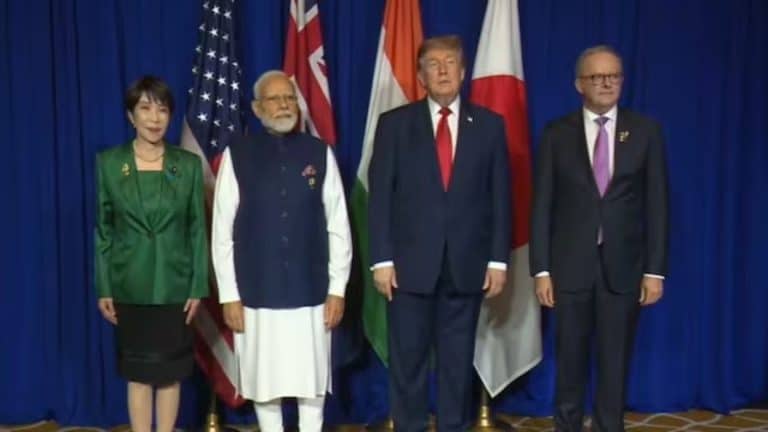
Quad Summit 2026: For the first time in two years, leaders of the Quadrilateral Security Dialogue, commonly known as the Quad, gathered in Manila, the Philippines, on Tuesday. The high-stakes meeting brought together Indian Prime Minister Narendra Modi, US President Donald Trump, Australian Prime Minister Anthony Albanese, and Japanese Prime Minister Sanae Takaichi.
The gathering marks the first leaders-level summit since September 21, 2024, when former US President Joe Biden hosted the group in his hometown of Wilmington. However, according to media reports, the format of the current engagement reflects a notable shift in global diplomatic priorities, taking place on the sidelines of the ASEAN summit rather than as a standalone, full-scale summit.
Lighthearted Banter Sets the Stage
Quad Summit 2026: Before formal discussions began, the four leaders posed for a traditional family photograph, where President Trump set a casual and humorous tone. Pointing toward Prime Minister Modi, Trump described him as “a very tough man,” before gesturing to Japanese Prime Minister Sanae Takaichi and adding that she was “even tougher.” Turning his attention to Australian Prime Minister Anthony Albanese, Trump remarked in a lighthearted vein that the two of them got along “okay.”
Setting Concrete Goals for the Next Phase
Quad Summit 2026: In his opening public remarks ahead of the closed-door talks, Prime Minister Modi struck an optimistic tone, expressing confidence that the Manila meeting would define clear, actionable targets for the alliance’s future.
Highlighting the steady diplomatic momentum maintained behind the scenes, Modi noted that Quad foreign ministers had convened multiple times over the last two years, a frequency that media reports demonstrates strong political will and shared commitment among the member nations.
“From maritime security to supply chains, and from new technologies to disaster response, the Quad provides trusted solutions for the entire Indo-Pacific,” Prime Minister Modi stated. He extended his appreciation to his counterparts for their continued support, adding that the grouping remains a constructive and reliable partnership for India.
From Centrepiece to Sidelines: A Changing Strategic Landscape
The two-year hiatus between leaders’ summits underscores a period of transition for the four-nation bloc. Originally formed in 2007, the Quad remained largely inactive for a decade due to diplomatic sensitivities surrounding China. It was revived in 2017 by Donald Trump, Narendra Modi, and then-Japanese Prime Minister Shinzo Abe to counter Beijing’s expanding economic, military, and diplomatic footprint in the region.
Between 2021 and 2024, the Biden administration and the Indian government worked closely to elevate the Quad as the cornerstone of their Indo-Pacific strategy. Beyond security concerns, the group launched wide-ranging partnerships with Pacific island nations focusing on science, technology, and economic development.
However, following Donald Trump’s return to the White House in January 2025, Washington’s approach to the grouping shifted. Media reports indicate that the Trump administration accorded less priority to the Quad as a central diplomatic forum, resulting in the two-year pause at the leaders’ level.
Quiet Progress Through Working Groups and New Initiatives
Despite the absence of a full-scale leaders’ summit since 2024, operational cooperation among India, the US, Japan, and Australia has continued steadily at the ministerial and working-group levels. According to media reports, Quad foreign ministers have met six times since the Wilmington gathering, including a preparatory meeting in Manila just weeks prior to Tuesday’s talks.
During this period, the alliance rolled out several major strategic programs aimed at bolstering regional resilience:
Critical Minerals Initiative and Framework: Designed to secure and diversify supply chains for essential raw materials.
Indo-Pacific Maritime Surveillance Collaboration (IPMSC): Focused on enhancing domain awareness and monitoring regional waters.
Initiative of Indo-Pacific Energy Security: Aimed at stabilizing clean and reliable energy access across member and partner nations.
Quad AI Accelerator: The newest addition to the bloc’s portfolio, focusing on collaborative artificial intelligence development and governance.
Navigating a Complex China Policy
Tuesday’s summit unfolds against a backdrop of evolving geopolitical tensions and ongoing debate over Washington’s approach to Beijing. According to media reports and foreign policy analysts, the US administration’s posture toward China over the past two years has been marked by significant shifts.
Following an initial trade dispute, President Trump moved toward a more accommodative diplomatic stance with Chinese President Xi Jinping, including discussions around a bilateral ‘G-2’ framework. Analysts cited in media reports note that this recalibration has coincided with a perceived reduction in American diplomatic and military focus on the Indo-Pacific.
Anushka Saxena, a China researcher at the Takshashila Institution, observed in media reports that current US policies have reshaped regional alliances. She pointed out that Washington’s recent decisions, ranging from pausing high-level Quad summits and reviewing the AUKUS security partnership to easing certain technology restrictions on Chinese artificial intelligence labs, have aligned closely with Beijing’s long-standing strategic objectives.
Meanwhile, regional friction with China has persisted. Media reports highlight increased Chinese assertiveness in international waters near Taiwan, the Philippines, and Australia, alongside renewed provocations along the India-Tibet border areas in recent months.
As the four leaders conclude their discussions in Manila, observers across the Indo-Pacific are watching closely to see whether the Quad can successfully adapt to these shifting geopolitical currents and translate its working-group initiatives into sustained strategic momentum.
Also Read : US Aviation Gridlock: Air Traffic Control Glitch Grounds Thousands of Flights, Strands 1.5 Million Flyers