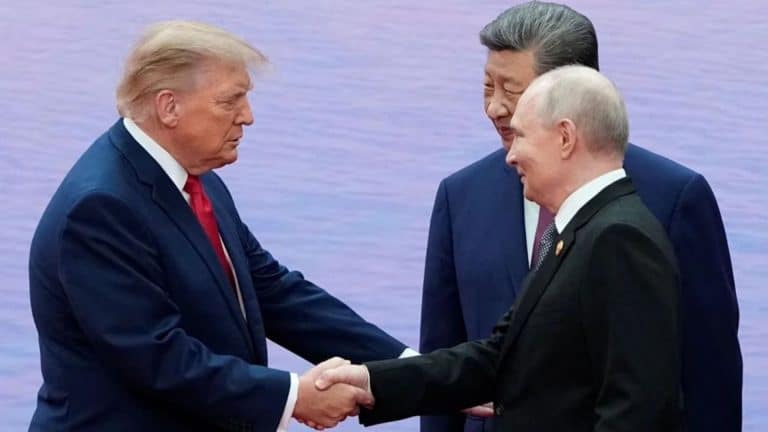
Superpower Showdown in China: As global leaders gathered in Shenzhen for the Asia-Pacific Economic Cooperation (APEC) summit on Tuesday, Chinese President Xi Jinping and Russian President Vladimir Putin presented a united front against Western influence, pitching their vision of a reshaped international order to developing nations.
According to media reports, the coordinated messaging comes just days before high-stakes trilateral talks between Xi, Putin, and US President Donald Trump, a meeting observers are already comparing to a modern-day “Yalta 2.0.”
While Beijing and Moscow sought to position themselves as champions of stability and growth for the Global South, middle powers like Canada and Australia used the platform to urge economic diversification, predictable trade rules, and responsible technological development.
Xi Positions China as a Champion of Free Trade
Superpower Showdown in China: In a speech that offered a sharp contrast to the tariff policies pursued by the United States over the past two years, Xi Jinping framed China as a reliable anchor for global commerce. Without naming Washington directly, Xi criticized protectionism and urged nations to support open markets and supply chain stability.
“China has shared opportunities with other countries and worked for common development,” Xi told delegates, adding that Beijing has consistently brought predictability to international trade. To back up this pitch, he pledged that China would lower tariffs for developing countries, expand market access, and reform domestic trade regulations to create a steadier environment for foreign businesses.
Addressing ongoing European criticism over Chinese state subsidies, which Western officials argue artificially lower export prices and undercut foreign competitors, Xi remained firm. He stated that China would continue investing in its industrial base and developing new technologies, insisting these advancements benefit the broader global economy. According to media reports citing George Chen, a partner at The Asia Group, while such arguments face skepticism in Western capitals, they are likely to find a receptive audience across the Global South.
Putin Dismisses Western Sanctions and Looks East
Superpower Showdown in China: Russian President Vladimir Putin took a more combative tone, directly mocking Western economic penalties imposed following Russia’s 2022 invasion of Ukraine. Putin declared that Western “instruments of economic dominance”, including sanctions, tariffs, and export restrictions, have failed to weaken Russia or curb its strategic ambitions.
“Sanctions, tariffs, and export restrictions have outlived their usefulness and have largely lost their intimidating effect,” Putin stated, arguing that the West is no longer central to the Russian economy. He noted that the use of the US dollar and the euro in Russian exports has dropped sharply due to banking restrictions, with Moscow successfully building alternative financial networks to keep trade flowing.
Turning his attention to Europe, Putin claimed the continent has suffered from rising inflation, growing deficits, and shrinking industrial capacity since cutting back on Russian energy imports. In contrast, he emphasized Russia’s pivot toward the Indo-Pacific, noting that the region now accounts for more than half of Russia’s total trade. Signaling long-term regional ambitions, Putin also announced that Russia has applied to chair APEC in 2035.
Middle Powers Push for Diversification and Stability
With Washington stepping back from traditional multilateral trade leadership and Beijing and Moscow asserting their influence, middle powers used the Shenzhen summit to chart a cautious, balanced path forward.
Canadian Prime Minister Mark Carney, who has emerged as a vocal advocate for cooperation among middle-sized economies, welcomed a recent thaw in Ottawa’s relations with Beijing. Carney noted that bilateral ties had stabilized over the past year after China restored market access for over 90 percent of Canadian exports previously hit by tariffs.
However, in an apparent nod to concerns over supply chain vulnerabilities and economic coercion, Carney warned against over-reliance on any single trading partner. He revealed that Canada has signed more than 50 critical minerals agreements with over 15 countries over the past year to broaden its supply networks. Carney also encouraged nations to diversify away from dependence on single international payment channels.
Meanwhile, Australian Prime Minister Anthony Albanese focused on securing his country’s interests in the Indo-Pacific through technological leadership. Addressing widespread fears that artificial intelligence could lead to job losses, Albanese argued that AI must be harnessed to create secure employment and drive innovation.
“We are doing this the Australian way to ensure that AI investment is done on Australia’s terms,” Albanese said, promoting Canberra’s upcoming national AI standards as a potential global model for safe and responsible regulation.
Eyes Turn to Thursday’s Trilateral Summit
The speeches on Tuesday set the stage for Thursday’s closely watched meeting between Xi, Putin, and Trump. According to media reports and international analysts, the talks carry significant weight, with concerns among smaller and middle powers that the three leaders may attempt to negotiate broad spheres of influence. As diplomatic maneuvering intensifies in Shenzhen, countries across the Asia-Pacific are watching closely to see whether the summit yields new frameworks for cooperation, or deepens existing global divides.