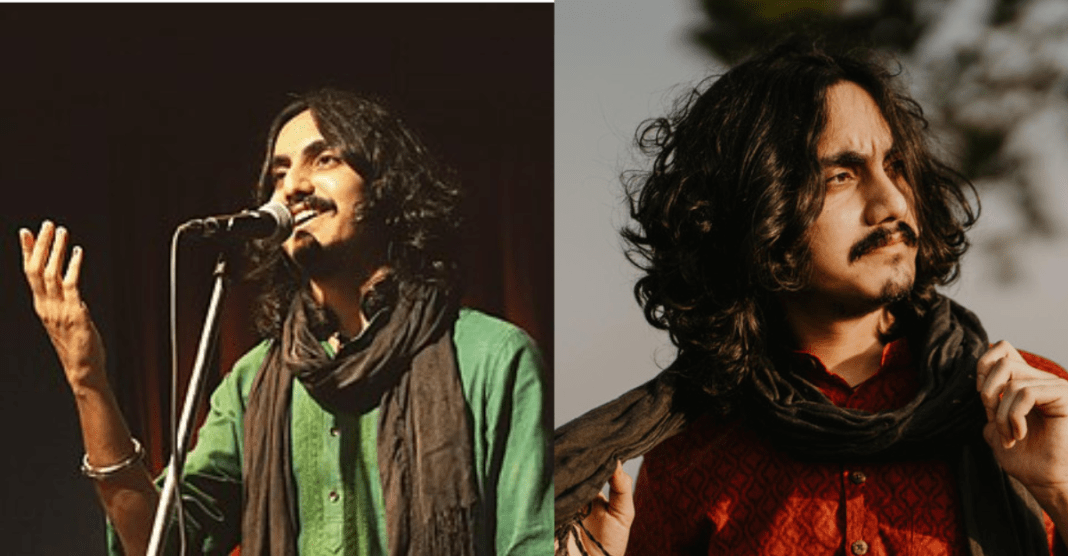

Aditya Gadhvi Biography: Imagine a song born in the rugged coastal landscapes of Gujarat a sailor’s chant, centuries old suddenly exploding on Instagram reels, TikTok feeds, and stadium screens across the world.
That is precisely what happened when Aditya Gadhvi stepped into a Coke Studio Bharat studio and reimagined the folk piece ‘Khalasi.’ Within weeks, the song had crossed 200 million views.
Prime Minister Narendra Modi tweeted about it. Global audiences who had never heard a word of Gujarati were humming its chorus.
But who is the man behind this cultural phenomenon?
The story of Aditya Gadhvi is not just a biography it is the story of a dying art form finding a new heartbeat.
Personal Overview
| Full Name | Aditya Gadhvi |
| Birth Date | April 3, 1994 (Age: 31) |
| Birthplace | Surendranagar, Gujarat, India |
| Nationality | Indian |
| Father | Yogesh Gadhvi (Renowned Musician & Folk Singer) |
| Education | St. Xavier’s College, Ahmedabad |
| Profession | Playback Singer, Composer, Lyricist |
| Height | Approx. 175 cm (5’9″) |
| Languages Known | Gujarati, Hindi, Marathi |
| Signature Songs | “Khalasi” (Gotilo), “Rang Morla,” “Aava De” (GT Anthem), “Hansla” |
Early Life and Background
Aditya Gadhvi was born on April 3, 1994, in the small town of Dudhrej, in Surendranagar district, Gujarat.
He grew up in a world where stories were not read from books they were sung.
His community, the Charans, are historically revered as the bards, poets, and oral historians of Gujarat’s royal courts, entrusted with preserving the culture and genealogies of kingdoms through song and verse.
This wasn’t merely a cultural backdrop for Aditya it was his inheritance.
Aditya Gadhvi Biography: His great-grandfather was a poet, and the family carried a lineage the locals proudly called the ‘royal poets of Zalawad.’ From childhood, Aditya breathed music not as entertainment, but as identity.
Family and Musical Roots
Aditya Gadhvi Biography: The most influential person in Aditya Gadhvi’s early life was his father, Yogesh Gadhvi, a respected folk singer who introduced him to Sufi music and Gujarati folk traditions at a very young age.
While other children learned nursery rhymes, Aditya was growing up with the soulful sounds of his cultural roots.
He gave his first public performance during a school assembly on Janmashtami, where the loud applause made him realize the power of his voice.
His sister, Jhanvi Gadhvi, later became a director, reflecting the family’s artistic spirit.
Even his surname, ‘Gadhvi,’ comes from ‘Gadh,’ meaning fort historically linked to guardians of tradition.
In many ways, Aditya continues that legacy today by preserving and promoting folk culture through his music.
Education and Initial Struggles
Aditya Gadhvi trained in Indian classical music under Ustad Shoukat Hussain Khan for two years, building a strong foundation.
At 18, after winning a major regional competition, he moved to Chennai to study at KM Music Conservatory, founded by A. R. Rahman, where he spent four transformative years.
There, he was exposed to global music styles, which inspired him to blend traditional Gujarati literature with modern rhythms.
Despite industry pressure to shift toward Sufi singing and the dominance of Bollywood in the early 2010s, he stayed true to his folk roots.
Instead of compromising, he independently released his bhajan “Hansla” on YouTube — and its powerful response proved that young audiences were ready for authentic folk music.
Entry into the Music Industry
Aditya Gadhvi gained his first major recognition at 18 after winning Lok Gayak Gujarat on Lok Gayak Gujarat, one of the highest-rated shows in the state.
The win earned him the title “The Pride of Gujarat” and solid regional fame.
While studying at KM Music Conservatory, he sang “Aiyyo Ji” and “Har Har Mahadev” for Kamasutra 3D, which were shortlisted at the 86th Academy Awards, a remarkable milestone for a teenager.
He also worked as a backing vocalist in live shows of A. R. Rahman and contributed to the background score of Lekar Hum Deewana Dil, steadily building industry credibility while staying rooted in folk music.
Breakthrough Moment and Viral Fame
The defining breakthrough for Aditya Gadhvi came in 2023 with “Khalasi” (Gotilo) on Coke Studio Bharat.
Blending Gujarati folk with powerful contemporary beats, the song about a fearless sailor navigating life’s storms went globally viral, crossing 200 million views.
Prime Minister Narendra Modi publicly praised him for taking Gujarati folk music global, turning the moment into powerful validation after years of industry doubt.
That same year, he performed at the 2023 ICC Cricket World Cup Final at Narendra Modi Stadium marking the arrival of Gujarati folk on one of the world’s biggest stages.
Popular Songs
• Khalasi (Coke Studio Bharat version – viral breakthrough)
• Ranchhod Rangila
• Hansla
• Naagar Nandji Na Laal
• Moti Veraana
• Garbo (Traditional Navratri Performances)
• Jai Adhya Shakti (Live Garba version)
• Vhalam Aavo Ne (Folk rendition)
Awards, Recognition, and Achievements
Aditya Gadhvi’s honours reflect both national and global recognition. He received the prestigious Ustad Bismillah Khan Yuva Puraskar for his contribution to folk music and was featured in Forbes India 30 Under 30 (2024) for elevating regional music to global audiences.
His track “Albeli Matwali Maiya” was entered for consideration at the 68th Annual Grammy Awards in the Global Music Performance category.
Earlier, he won the Global Indian Music Academy Awards (GiMA) for Best Traditional Folk Single for “Hansla” in 2020 and was named Times Men of the Year (2018) by The Times Group.
He also earned the National Scholarship from the Government of India and the Pt. Bhimsen Joshi Scholarship for classical music recognition that came well before mainstream fame.
Lesser-Known Facts
• During the 2020 lockdown, he explored cooking and painting, his poha and pulao were a success, but his rava dosa attempt was a “flop show.”
• Fondly called “Kaviraj” (King of Poets), he proudly represents his Charan community’s legacy of royal bards.
• He often revives the poetry of Zaverchand Meghani through his music, introducing classic Gujarati literature to young listeners.
• Contributed to the background score of Lekar Hum Deewana Dil and performed as a backing vocalist in live shows of A. R. Rahman.
• His songs from Kamasutra 3D were Oscar-shortlisted when he was just 19 and still a student.
• His surname “Gadhvi” comes from “Gadh” (fort), reflecting his ancestral role as custodians of forts and oral traditions, a legacy he continues through music.
Impact on Gujarati Folk and Modern Music
The most powerful part of Aditya Gadhvi’s journey isn’t just a hit song or an award it’s the cultural shift he created.
Before him, Gujarati folk music was often seen as niche and limited to older audiences. He transformed that perception.
By blending centuries-old Gujarati literature with funk, electronic, and pop elements, he made the language feel modern and globally relevant.
Without relying on Bollywood, he proved that a regional artist could achieve massive streaming success, opening doors for a new wave of Gujarati indie musicians.
In an era of fleeting trends, Aditya stands as a bridge-builder between tradition and modernity, roots and reinvention.
Like the fearless sailor in “Khalasi,” he moves forward without fear, carrying his culture with him.
Biography By: Namita