
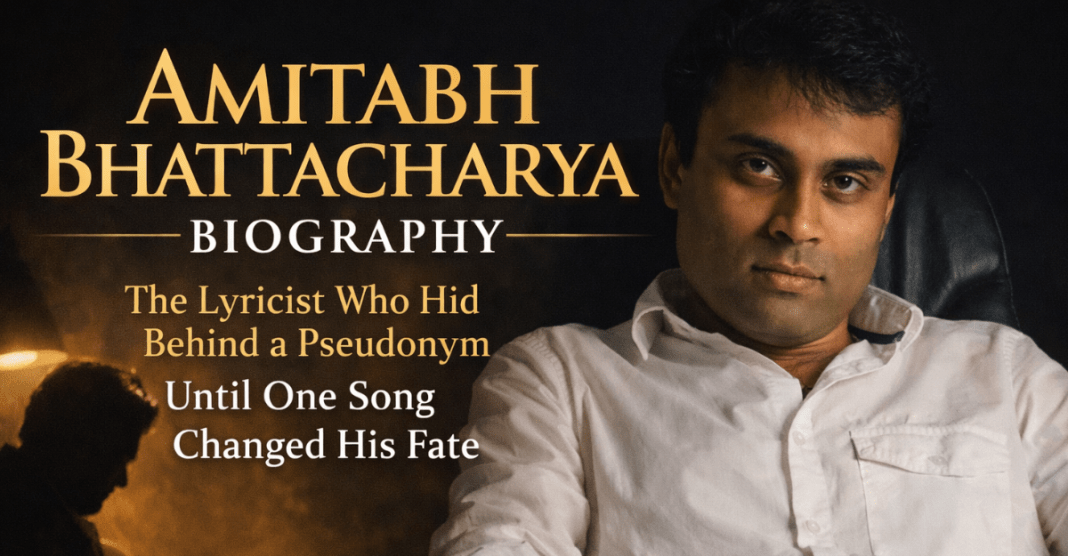

Amitabh Bhattacharya Biography: When “Emosanal Attyachar” exploded across Bollywood in 2009, few people knew the man behind those quirky, rebellious lyrics had no intention of becoming a writer at all.
The Amitabh Bhattacharya’s life is a story of accidental brilliance, where a hopeful singer carrying demo cassettes around Mumbai for eight years transformed into one of Hindi cinema’s most influential voices almost against his will.
Personal Overview
Full Name | Amitabh Bhattacharya |
| DOB | November 16, 1976 |
| Age | (as of 2026) 49 Years |
| Birthplace | Lucknow, Uttar Pradesh, India |
| Ethnicity | Bengali |
| Hometown | Lucknow (often refers to himself as a “Lucknow boy”) |
| Education Schooling | Spring Dale College, Lucknow (1995) |
| Graduation | Lucknow University (1999) |
| Current Residence | Mumbai, Maharashtra |
| Marital Status | Private / Not publicly disclosed |
| Father | Name Not Known, Retired Civil Servant |
| Mother | Name Not Known, (Housewife) |
| Sister | Name Not Known, His “biggest supporter” (supported him during struggle years) |
| Hobbies & Interests | Listening to old Hindi classics, travelling, and exploring local cuisines. |
| Personality Traits | Self-proclaimed introvert, media-shy, and highly selective about interviews. |
From Lucknow Dreams to Mumbai Struggles
Born on November 16, 1976, in Lucknow, Uttar Pradesh, Amitabh Bhattacharya grew up in a Bengali household obsessed with old Hindi film music.
His early inspirations included legendary lyricists like Sahir Ludhianvi, Shailendra, Anand Bakshi, and Gulzar.
Amitabh Bhattacharya Biography: After completing his schooling at Spring Dale College in 1995 and graduating from Lucknow University in 1999, Bhattacharya moved to Mumbai with a singular dream, to become the next great playback singer.
The reality proved far harsher. For nearly eight years, the young Amitabh Bhattacharya knocked on music directors’ doors with demo cassettes in hand, hoping for a break that never came.
During this period, he worked as an assistant to composer Pritam, sometimes even doubling as a delivery boy running payments to vendors.
To sustain himself, he began writing lyrics for advertisement jingles a skill he considered merely a survival tactic, not a career path.
The Breakthrough That Changed Everything
Amitabh Bhattacharya Biography: A major turning point in Amitabh Bhattacharya’s Bollywood journey came through his friendship with composer Amit Trivedi.
While helping Trivedi pitch songs, Bhattacharya began writing temporary lyrics instead of using random sounds. At the time, he did not want to be known as a writer, so he used a pen name, Indraneel, fearing it would hurt his dream of becoming a singer.
Everything changed with Dev.D in 2009. Anurag Kashyap’s bold film needed an unusual soundtrack, and Bhattacharya’s song “Emosanal Attyachar” became a huge hit.
Written quickly at a coffee shop, the song used an exaggerated singing style meant as a joke. When Kashyap decided to keep it, Bhattacharya was so embarrassed that he asked the team to credit the vocals to a fake name.
The song’s success made him accept his true strength. Amit Trivedi encouraged him to take credit for his work, marking the start of Amitabh Bhattacharya’s successful career as a lyricist.
A Unique Writing Philosophy
Amitabh Bhattacharya Biography: What sets Amitabh Bhattacharya apart in an industry often dominated by heavy Urdu poetry and ornate metaphors? His answer is disarmingly simple, everyday language.
He views himself as a “servant of the script,” whose job is to serve the film’s narrative rather than showcase lyrical gymnastics.
“If my mother can’t understand the emotion of the word without asking me, I don’t use it,” he once explained.
This philosophy has led to Amitabh Bhattacharya songs that feel deeply conversational yet profoundly moving.
He prefers “zaroorat” over the more formal “avashyakta” and famously inserted everyday objects into poetic contexts like comparing a heart to a hot samosa (a line that got rejected) or likening disappointment to soap foam in “Bhaag D.K. Bose.”
His range is extraordinary. He’s the same person who wrote the rebellious, Hinglish-heavy “Badtameez Dil” from Yeh Jawaani Hai Deewani and the soul-crushing “Channa Mereya” from Ae Dil Hai Mushkil. While tracks like “Bhaag D.K. Bose” from Delhi Belly took just 15 minutes to write, finding the perfect word “Iktara” for Wake Up Sid reportedly took 15 days.
Chart-Topping Hits and Iconic Collaborations
The list of Amitabh Bhattacharya collaborated with almost every major name in Bollywood music.
His work with Pritam has produced romantic anthems like the entire Ae Dil Hai Mushkil album, Brahmastra’s “Kesariya,” and Yeh Jawaani Hai Deewani’s “Kabira.”
With Amit Trivedi, he’s crafted soulful masterpieces like the complete Lootera soundtrack, Udaan’s “Aazaadiyan,” and Qala’s vintage-styled songs.
His partnership with A.R. Rahman, Ajay-Atul, and Sachin-Jigar has further cemented his position as Bollywood’s go-to lyricist.
Some of his most beloved works include “Abhi Mujh Mein Kahin” from Agneepath, “Khairiyat” from Chhichhore, and “Iktara” from Wake Up Sid where he also lent his unique, earthy voice.
Awards and Industry Recognition
The Amitabh Bhattacharya awards collection is a testament to his impact. In 2011, he won the National Film Award for “Agar Zindagi” from the indie film “I Am” an ironic achievement considering most people haven’t heard the song, despite his massive commercial success.
He has won multiple Filmfare Awards, including for “Abhi Mujh Mein Kahin” (2012), “Channa Mereya” (2017), and the entire Jagga Jasoos album (2018).
“Channa Mereya” alone earned him a record-breaking nine awards across various platforms.
Yet the Amitabh Bhattacharya age and experience haven’t changed his humble approach.
He remains media-shy, introverted, and deeply respectful of the collaborative process, often crediting singers like Arijit Singh for providing the “body” to his “soul.”
The Singer Within Still Lives
Despite becoming one of the most sought-after lyricists in Hindi cinema, Bhattacharya has never completely abandoned his first love.
His unique, textured voice can be heard in “Iktara” (Wake Up Sid), “Tera Rastaa Chhodoon Na” (Chennai Express), “Manmarziyan” (Lootera), “Offo” (2 States), “Hai Jamalo” (Munjya), and “Fikar Not” (Chhichhore).
Each performance carries an earthy authenticity that complements his grounded writing style.
Continuing Legacy: 2025-2026 and Beyond
As of early 2026, Amitabh Bhattacharya remains one of Bollywood’s busiest and most respected songwriters.
Recent projects include “Sitaare” from Ikkis (sung by Arijit Singh), collaborations with Pritam on Metro In Dino (“Qayde Se,” “Ishq Ya Tharak”) and War 2 (“Janaab-e-Aali,” “Aavan Jaavan”), and work with Sachin-Jigar on Thamma and Do Deewane Seher Mein.
His creative habits remain unchanged. He rarely writes lyrics beforehand, waiting instead for the fixed melody so the “phonetics” of words can match the “curves” of the tune.
He still jams in cars, famously writing the title track of Ae Dil Hai Mushkil in the backseat of Pritam’s car while stuck in Mumbai traffic.
A Journey Worth Celebrating
The Amitabh Bhattacharya biography is more than a success story. It’s a reminder that sometimes our greatest gifts arrive through unexpected detours.
A man who spent years chasing one dream found a different calling entirely. one that has touched millions of hearts through words that feel less written and more lived.
From “Emosanal Attyachar” to “Channa Mereya,” from “Kabira” to “Kesariya,” his lyrics have become the soundtrack to contemporary Indian life.
They play at weddings and breakups, road trips and quiet moments of reflection.
His ability to blend street smart Hinglish with soulful poetry, to make the everyday profound without making it heavy, has redefined what Bollywood lyrics can be.
Also Read: Sonu Nigam Biography: The Voice That Feels Like Home