


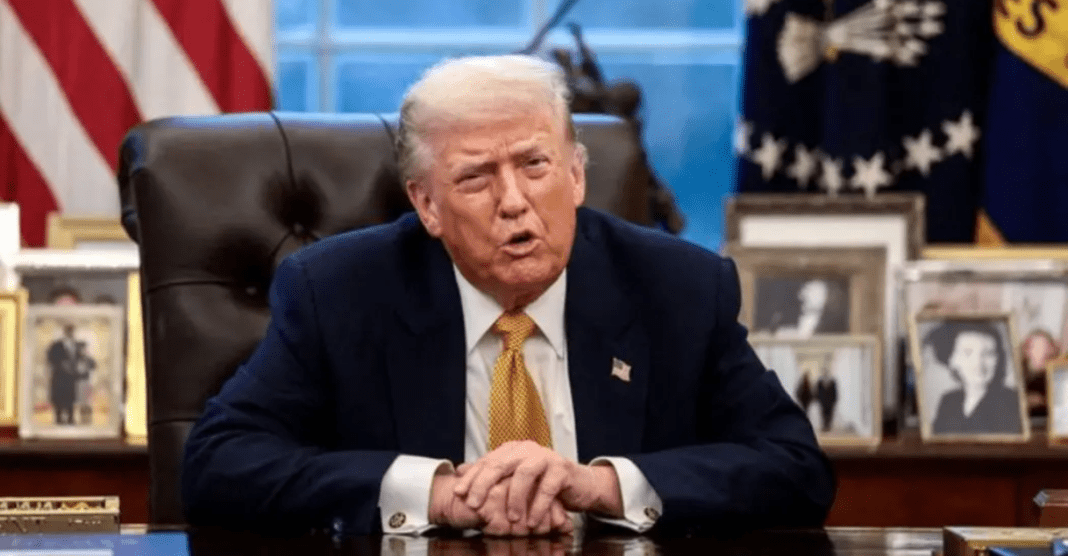

Donald Trump Iran tensions: Global financial markets staged a broad recovery on Tuesday after US President Donald Trump announced a five-day postponement of planned military strikes against Iranian energy infrastructure, pulling back from the brink of an escalation that had sent oil prices surging and equity markets into a sharp decline over the previous 48 hours.
The announcement, made via a post on Truth Social late Monday, cited “very good and productive conversations” over the weekend aimed at a “complete and total resolution” of hostilities with Tehran.
The immediate market response was significant crude oil fell sharply, Wall Street reversed course, and Asian equities opened higher.
But analysts and investors remain cautious, with the underlying conflict showing no signs of resolution on the ground.
What Triggered the Market Panic
Donald Trump Iran tensions: The sell-off that preceded Tuesday’s recovery had been building since Trump issued a 48-hour ultimatum demanding Iran fully reopen the Strait of Hormuz or face military action targeting its power plants.
The threat landed hard on global markets already on edge over the 25-day-old US-Israel military campaign against Iran.
In India, the damage was swift and considerable. The BSE Sensex fell over 1,800 points in a single session, erasing approximately ₹14 lakh crore in investor wealth.
The Indian Rupee weakened sharply, approaching the 94-per-dollar level territory it has never previously entered.
Sentiment across emerging markets deteriorated in tandem, with foreign institutional investors pulling back from risk assets across the board.
Donald Trump Iran tensions: The core concern driving the panic was straightforward, the Strait of Hormuz carries roughly 20 percent of global oil supply.
Any prolonged disruption to shipping through the waterway would have immediate and severe consequences for energy prices worldwide, with particularly acute effects for import-dependent economies like India.
The Announcement and Its Immediate Effect
Trump’s postponement post changed the market calculus quickly. Brent crude, which had been pushing toward $120 per barrel, fell between 10 and 13 percent following the announcement, settling just under the $100 mark after briefly touching $96.
It was one of the sharpest single-day reversals in the crude market in recent years.
The drop in oil prices set off a chain reaction across sectors that had been under severe pressure.
Airlines and cruise operators, among the hardest hit during the escalation phase due to their direct exposure to fuel costs, saw some of the sharpest gains of the session.
Delta Air Lines and United Airlines surged between 4 and 8 percent as traders priced in the prospect of meaningfully lower jet fuel bills in the near term.
Norwegian Cruise Line posted comparable gains for the same reason, fuel is one of the largest operating costs in the cruise industry, and a sustained retreat in crude prices directly improves the earnings outlook for the sector.
Energy stocks moved in the opposite direction, as would be expected. ExxonMobil and Chevron each slipped between 1 and 3 percent as the crude price decline weighed on their revenue projections.
The pullback was orderly rather than alarming, a straightforward repricing of earnings expectations rather than a sign of broader distress in the sector.
Gold, which had climbed sharply as investors sought safety during the escalation, also gave back ground.
Prices fell below $4,400 per ounce, declining between 2.5 and 4 percent as the immediate flight-to-safety impulse eased.
The retreat in gold was read by many analysts as a confirmation that markets were genuinely treating the five-day pause as a meaningful de-escalation signal, at least in the short term.
On Wall Street, US equities swung from significant losses to meaningful gains.
The S&P 500 closed up between 1.1 and 1.9 percent, while the Dow Jones Industrial Average recovered more than 600 points after an intraday swing exceeding 1,100 points.
The VIX, a widely tracked measure of market volatility, pulled back from nearly 31 toward 25 — still elevated by historical standards, but well off its recent highs.
Asian markets followed suit on Tuesday morning. Japan’s Nikkei 225 gained 0.9 percent, South Korea’s Kospi rose 1.1 percent, and Hong Kong’s Hang Seng climbed 1.4 percent.
In India, the Rupee opened at 93.63 on Tuesday, recovering 34 paise from its Monday lows, while Dalal Street opened in positive territory.
Donald Trump Iran tensions: For Indian markets specifically, the relief was tangible.
The threat of oil prices remaining above $110-115 per barrel for an extended period would have placed serious pressure on the country’s current account deficit and complicated the Reserve Bank of India’s monetary policy calculus.
Every $10 sustained rise in crude adds approximately $15 billion to India’s annual import bill.
The Diplomacy Behind the Pause
Trump credited the five-day postponement to intensive weekend discussions led by Middle East envoy Steve Witkoff and his son-in-law Jared Kushner.
Reports indicate the two held Omani-mediated talks with Iranian counterparts in Geneva, focused in part on a proposed joint oversight mechanism for the Strait of Hormuz.
Trump subsequently indicated there were 15 points of agreement between Washington and Tehran emerging from those discussions.
Iran’s government offered a sharply different account. Senior Iranian officials, including Revolutionary Guard Corps commanders and members of parliament, denied any direct or indirect contact with the United States, describing the claims as fabricated to influence energy markets and allow additional time for US military positioning in the region.
The Iranian Foreign Ministry characterised the reported breakthrough as “fake news.”
The contradictory accounts have done little to reassure analysts who track the region closely.
When the basis for a market-moving diplomatic development is disputed by one of the two parties involved, the durability of any resulting calm is inherently uncertain.
On the Ground: The War Continues
Whatever the status of the diplomatic back-channel, the military situation in West Asia showed no sign of de-escalation on Tuesday.
Iranian missiles struck several areas of Tel Aviv, causing structural damage to buildings and resulting in at least four casualties.
Iran’s Revolutionary Guard Corps dismissed Trump’s announcement entirely, saying his “contradictory behaviour will not make us lose sight of the battlefront.”
The scale of the US-led military campaign has been significant. US Central Command confirmed it has conducted strikes on more than 9,000 Iranian targets since the conflict began 25 days ago, including over 140 Iranian naval vessels, across more than 9,000 combat sorties.
A human rights monitoring group reported that the strikes have killed more than 3,200 people inside Iran, including at least 214 children.
Most significantly for global energy markets, the Strait of Hormuz remains closed. Iranian Foreign Minister Abbas Araghchi stated on Tuesday that Tehran’s position on the waterway had not changed.
US military officials separately confirmed that Iranian-manufactured underwater mines have been laid throughout the strait, a development that would complicate any rapid reopening regardless of the outcome of diplomatic talks.
What Comes Next
The five-day window gives negotiators until Friday to produce a verifiable agreement. Markets have responded to the pause with measured relief, but the conditions underpinning Monday’s sell-off a closed strait, an active military conflict, and disputed diplomacy remain substantially intact.
The sectoral picture makes the stakes clear. Airlines and cruise operators have already priced in lower fuel costs.
Energy majors have absorbed a revenue hit. Gold has retreated on the assumption that calm will hold.
If Friday passes without a concrete and verified breakthrough, each of those trades will need to be unwound and the reversals, coming after a period of false hope, could be sharper than the original moves.
The recovery seen on Tuesday reflects expectation, not resolution. Whether that distinction matters will become clear before the week is out.
Written By- Namita Deora