


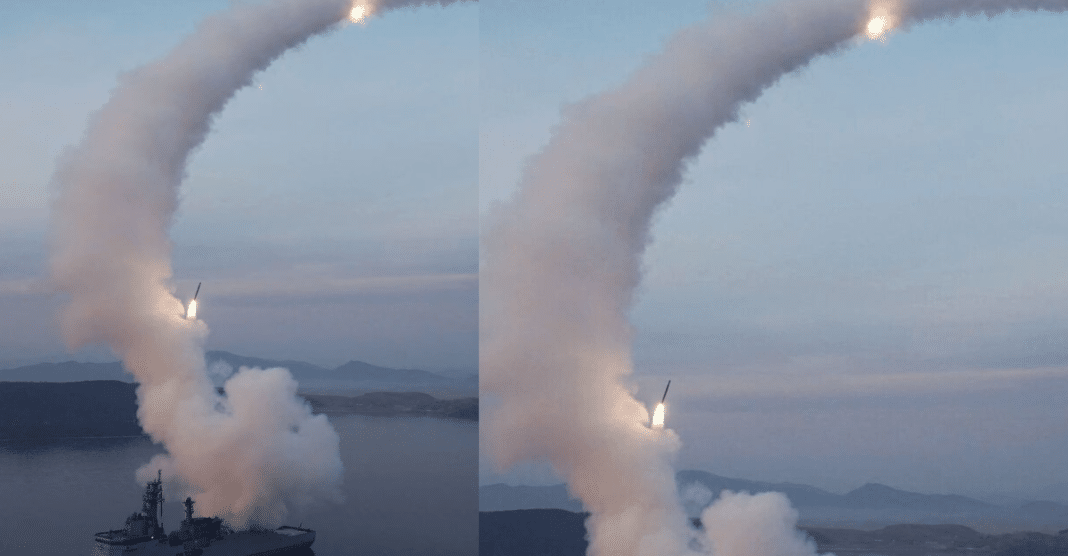

Global Security Under Pressure: In a strong show of military power, Kim Jong Un’s government launched around 10 ballistic missiles toward the Sea of Japan on Saturday, March 14, 2026.
The missiles were detected by the military of South Korea at about 1:20 p.m. local time. They were fired from the Sunan area near the capital city, Pyongyang.
According to officials from South Korea and Japan, the missiles traveled about 340–350 kilometers before falling into the sea.
They landed outside Japan’s Exclusive Economic Zone, meaning they did not enter waters directly controlled by Japan. No damage or injuries were reported.
However, the number of missiles launched at once has raised serious concerns.
North Korea usually fires one or two missiles during tests, but launching around ten at the same time shows a larger and more aggressive move.
Testing Possible Security Weaknesses
Global Security Under Pressure: The missile launches happened during the annual joint military exercise called Freedom Shield.
These drills are held by the United States and South Korea to practice defense strategies and improve military cooperation.
The exercises began earlier in March and will continue until March 19.
North Korea has often criticized these drills and calls them practice for a possible invasion.
Because of this, Pyongyang frequently responds with missile tests during the exercises.
This year’s situation is more tense because the United States is also deeply involved in a growing conflict in the Middle East with Iran.
Global Security Under Pressure: Due to this conflict, the U.S. has moved some of its advanced missile defense systems from South Korea to the Middle East.
These systems include parts of the Terminal High Altitude Area Defense (THAAD) and Patriot missile system.
They are designed to stop incoming missiles before they hit their targets.
Because some of these systems are being moved, security experts worry that South Korea might temporarily have weaker missile defense.
By launching many missiles at once, North Korea may be trying to test whether the U.S. and its allies can handle security problems in two different regions at the same time.
Growing Ties Between Iran and North Korea
The missile launch also shows growing political support between North Korea and Iran.
Although North Korea is not directly fighting in the Middle East conflict, its leaders have strongly criticized the actions of the United States and its allies.
Recently, North Korea’s Foreign Ministry called the U.S. and Israeli strikes on Iran illegal acts of aggression.
At the same time, Kim Yo Jong, the sister of Kim Jong Un, warned that the actions of the U.S. and its partners are causing the global security system to become unstable.
Experts believe North Korea is closely watching the war involving Iran.
The conflict may strengthen Pyongyang’s belief that strong missile forces and nuclear weapons are necessary to protect its government from outside threats.
By launching several missiles during this tense period, North Korea may be trying to show that it has powerful weapons and cannot be ignored on the world stage.
The launches also act as a blunt rejection of recent attempts at diplomacy. Just days prior, reports surfaced that U.S. President Donald Trump had signaled an openness to a new summit with Kim Jong Un.
Pyongyang’s decision to fire a massive missile barrage less than 48 hours later makes it clear: North Korea is uninterested in dialogue while it perceives itself to be under strategic pressure.
However, the large missile launch just two days after these reports suggests that North Korea is not interested in talks right now.
Instead, the country appears to be focusing on showing military strength.
Rising Tensions in the Region
Following the missile tests, both South Korea and Japan increased their security monitoring and remained on high alert.
Military forces in the region are carefully watching North Korea’s next moves.
The situation highlights a growing challenge for global security.
With the United States involved in conflicts in different parts of the world, some countries may try to take advantage of the situation.
North Korea’s missile launch shows that tensions in the Indo-Pacific region remain high.
It also demonstrates how events in one region like the conflict in the Middle Eastcan quickly affect security in another part of the world.
For now, the missile barrage serves as a reminder that global stability is fragile, and even small actions can increase tensions between major countries.
BY: Namita Deora