


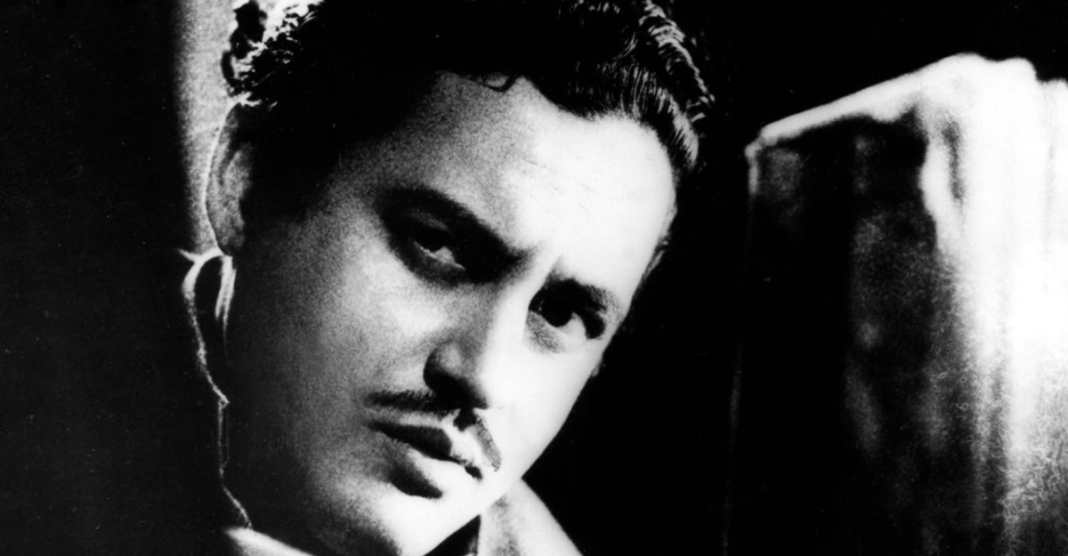

Guru Dutt Biography: There is a particular cruelty in the way history sometimes treats its greatest artists celebrating them only after they are gone, long after their hearts have broken under the weight of indifference.
Guru Dutt knew this cruelty intimately. He lived it, filmed it, and ultimately, could not survive it.
He was a man who made movies the way poets write verses bleeding quietly onto the page, hoping the world would understand. And the world, for a long time, did not.
His masterpiece Kaagaz Ke Phool was dismissed at the box office when it released in 1959. His cry for artistic recognition went largely unanswered during his lifetime.
And yet, decades after his death at just thirty-nine years of age, the world came around placing his films alongside the greatest works of cinema ever made.
TIME Magazine listed Pyaasa among the 100 best films since 1923. Film scholars from London to New York began calling him the “Orson Welles of India.”
Guru Dutt Biography: The man who felt invisible in his own time became immortal in ours.
This is the story of Guru Dutt filmmaker, actor, dreamer, and one of the most achingly human figures in the history of Indian cinema.
Personal Profile
| Full Name | Vasant Kumar Shivshankar Padukone |
| Screen Name | Guru Dutt |
| Date of Birth | July 9, 1925 |
| Place of Birth | Bangalore, Mysore State, British India |
| Date of Death | October 10, 1964 (Age 39) |
| Place of Death | Peddar Road, Mumbai |
| Nationality | Indian |
| Religion / Caste | Hindu · Konkani Chitrapur Saraswat Brahmin |
| Languages | Kannada, Hindi, Bengali, Konkani |
| Education | Uday Shankar India Culture Centre, Almora |
| Occupation | Film Director · Producer · Actor · Choreographer |
| Active Years | 1944 – 1964 |
| Production House | Guru Dutt Films Pvt. Ltd. |
| Spouse | Geeta Dutt (m. 1953; d. 1964) |
| Children | Tarun Dutt · Arun Dutt · Nina Dutt |
| Iconic Films | Pyaasa · Kaagaz Ke Phool · Sahib Bibi Aur Ghulam · Chaudhvin Ka Chand |
| Key Collaborators | V. K. Murthy · S. D. Burman · Abrar Alvi · Sahir Ludhianvi |
| Known For | Chiaroscuro lighting · Poetic realism · Song-as-narrative |
| Global Recognition | TIME Magazine – 100 Greatest Films (Pyaasa, 2005) |
| Nickname / Title | “The Orson Welles of India” |
Early Life: The Making of a Sensitive Soul
He was born Vasant Kumar Shivshankar Padukone on July 9, 1925, in Bangalore, into a Konkani Chitrapur Saraswat Brahmin family.
The name Guru Dutt came later reportedly after a childhood accident, when the new name was believed to carry auspicious change.
His early years were spent far from the sun-soaked south. The family relocated to Bhowanipore, a quiet, literary neighbourhood in Calcutta, and it was here that the young boy began absorbing the world around him with remarkable depth.
Calcutta in the 1930s was a city alive with ideas. Its Bengali intellectual tradition ran deep literature, music, theatre, and a fierce love for artistic expression were woven into its very air. Guru Dutt soaked it all in.
He grew fluent in Bengali, read widely, and developed a sensitivity and interiority that would define everything he later created.
Guru Dutt Biography: His films would always carry within them something unmistakably Bengali in spirit that emphasis on poetry, on the decay of old-world grace, on the quiet suffering of the idealist in a cruel and indifferent society.
Education and the Dance That Shaped a Director
In the early 1940s, Guru Dutt joined the Uday Shankar India Culture Centre in Almora.
Uday Shankar was one of the most celebrated dancers of his time, known for blending Indian classical dance with modern artistic expression.
Studying there was not simply about learning choreography. It was about understanding rhythm, movement, space, and emotional expression.
This training shaped Guru Dutt’s cinematic language in remarkable ways. When he later directed films, his scenes often moved like carefully choreographed performances. Actors, camera movements, and lighting were arranged with the precision of a dance composition.
Even his songs were never mere musical breaks. They became emotional extensions of the story. The dancer in him never truly disappeared.
Entry Into the Film Industry and Early Struggles
The path to cinema was neither straight nor easy. After completing his studies, Guru Dutt took up a brief, unfulfilling job as a telephone operator in Calcutta a chapter that convinced him his destiny lay elsewhere.
He moved to Bombay in the mid-1940s with little more than ambition and a tremendous eye for the world.
He found his first foothold at the prestigious Prabhat Film Company in Pune, working first as a choreographer and then as an assistant director learning the grammar of filmmaking from the ground up, frame by frame.
It was here that he struck one of the most consequential friendships in Indian cinema history.
He and Dev Anand, both young men burning with enormous dreams, made a pact: if either of them found success first, he would offer the other a break.
It was a promise that would change the course of both their lives, and, through them, the course of Hindi cinema itself.
From Assistant to Auteur: The Birth of a Director
Dev Anand found his footing first. He co-founded Navketan Films and, true to their promise, offered Guru Dutt his directorial debut with Baazi in 1951.
The film announced the arrival of a distinct new voice a “Bombay noir” sensibility marked by moody atmospherics, morally complex characters, and a visual confidence that felt startling in the context of post-independence Hindi cinema.
More films followed: Jaal (1952) and Baaz (1953) consolidated his reputation as a director with a striking visual imagination.
But Guru Dutt was not content to make films that were merely stylish. He wanted to say something.
He wanted to make films that felt like they mattered to him, and to the world watching them.
That ambition would eventually produce some of the most enduring works of world cinema, but first, it would lead him through a period of remarkable commercial success.
Breakthrough Films and the Rise to Fame
The years between 1954 and 1957 marked Guru Dutt’s rise as a major filmmaker in Hindi cinema.
Aar Paar (1954) became a big hit with its lively storytelling and urban charm, while Mr. & Mrs. ’55 (1955) showed his talent for romantic comedy and sharp social satire.
CID (1956), which he produced, also turned into a successful thriller.
But these films only hinted at what was coming next. In 1957, Guru Dutt released Pyaasa, a film that changed the landscape of Indian cinema.
It told the story of Vijay, a struggling poet whose work is ignored during his lifetime but celebrated after he is believed to be dead.
More than just a film, Pyaasa felt like a deeply personal expression of Guru Dutt’s own fears and frustrations as an artist.
With its powerful storytelling, emotional depth, and unforgettable music, the film established him as one of the most visionary filmmakers of his time.
His Unique Filmmaking Style and Storytelling Approach
To understand what made Guru Dutt extraordinary, you have to understand what he did with a camera.
In an era when most Hindi films were brightly lit, stage-bound productions, Guru Dutt and his cinematographer V.K. Murthy were doing something entirely different.
They were painting with light and shadow crafting frames that were as visually arresting as any work of fine art.
Inspired by German Expressionism and American film noir, they pioneered the use of chiaroscuro in Indian cinema the dramatic interplay of deep, inky blacks and sharp, sculpted light that turns a film frame into a visual poem.
Characters in a Guru Dutt film are often surrounded by darkness, with light falling on them as if from another world, emphasising their isolation, their longing, and their inability to belong.
The camera itself was a participant tracking shots followed characters through layered sets with a fluid intelligence; close-ups lingered on faces until emotions became almost unbearable.
“Dutt understood that the camera has a gaze. He used that gaze to make audiences feel what his characters felt without a single word of excess.”
The Iconic Films: Works That Outlived Their Time
Pyaasa (1957)
Directed and acted by Guru Dutt, Pyaasa is considered one of the greatest films in Indian cinema.
It tells the story of Vijay, a struggling poet whose work is ignored during his life but celebrated after he is believed to be dead.
The film explores artistic rejection and society’s materialism.
Its powerful songs by Sahir Ludhianvi and music by S. D. Burman add emotional depth.
In 2005, Time Magazine included it among the 100 greatest films ever made.
Kaagaz Ke Phool (1959)
India’s first CinemaScope film, Kaagaz Ke Phool tells the tragic story of a famous director whose career and personal life collapse.
Although it failed at the box office, the film later gained recognition as a masterpiece.
Its famous lighting sequence featuring Waheeda Rehman is still studied in film schools.
Chaudhvin Ka Chand (1960)
A visually rich romantic drama, Chaudhvin Ka Chand became a major commercial success. The film is remembered for its beautiful title song picturised on Waheeda Rehman.
Though officially directed by M. Sadiq, Guru Dutt’s artistic style is clearly visible.
Sahib Bibi Aur Ghulam (1962)
Directed by Abrar Alvi, the film carries Guru Dutt’s creative influence.
It portrays the decline of a feudal household and features a legendary performance by Meena Kumari as Chhoti Bahu.
The film won the National Film Award for Best Feature Film in Hindi and was India’s entry for the Academy Awards in 1963.
Personal Life: Geeta Dutt and a Marriage of Two Souls
In 1953, Guru Dutt married Geeta Roy the celebrated playback singer known as Geeta Dutt in what was, by all accounts, a love match between two extraordinarily gifted people.
They had three children: Tarun, Arun, and Nina. But the marriage was also marked by deep, irreconcilable strains.
Guru Dutt’s creative perfectionism made him exhausting to live with.
His intense professional and emotional closeness to Waheeda Rehman, his muse and leading lady, created wounds the marriage could not absorb.
The couple separated, and the separation added another layer of grief to a man already prone to profound melancholy.
Geeta Dutt’s own career faded in later years, and she never recovered from the personal devastation of their estrangement.
She died in 1972, just eight years after Guru Dutt leaving behind one of the most beautiful and tragic dual legacies in Indian cultural history.
Creative Collaborations: The Team Behind the Magic
No account of Guru Dutt is complete without acknowledging the extraordinary creative family that surrounded him.
V.K. Murthy, his cinematographer, was the technical genius who translated Dutt’s visual instincts into the language of light and shadow.
Together, they created some of the most beautiful images in the history of Indian cinema. Screenwriter Abrar Alvi matched Dutt’s emotional depth with literary precision.
Composer S.D. Burman crafted soundscapes of unparalleled beauty. And lyricist Sahir Ludhianvi gave voice to the films’ deepest themes his words for Pyaasa expressing the artist-outsider’s anguish with a power that still resonates today.
Struggles, Failures, and Emotional Collapse
The commercial failure of Kaagaz Ke Phool in 1959 marked a turning point from which Guru Dutt never truly recovered.
He stopped taking director’s credit after that film, his confidence shattered by an audience that had not understood what he offered them.
Depression deepened. Alcoholism tightened its grip. He attempted suicide at least twice in the early 1960s, his personal and professional worlds collapsing in tandem.
Several ambitious projects were left unfinished among them Gauri, intended to be India’s first colour film starring Geeta Dutt, and the historical romance Love & God, which was eventually completed posthumously by others.
The Night of October 10, 1964
On the morning of October 10, 1964, Guru Dutt was found dead in his apartment on Peddar Road, Mumbai.
He was thirty-nine years old. The cause of death was an overdose of alcohol and sleeping pills.
Whether it was deliberate suicide or a tragic accidental overdose taken in a moment of unbearable despair without full conscious intention has remained a subject of quiet debate ever since.
What is certain is that he was alone, and that he had been deeply, persistently unhappy for a long time.
He left behind three young children, an estranged wife who still loved him, a team of collaborators who were devastated, and a body of work that had not yet found its true audience.
The world that had largely ignored him in life took its time in understanding what it had lost.
Recognition After Death: The World Finally Listens
The rehabilitation of Guru Dutt’s reputation began in the decades following his death, as film scholars and critics started examining his work with the attention it deserved.
International voices were among the first to recognise its extraordinary quality.
French and British film writers compared his visual language to the great European auteurs.
The term “chiaroscuro” entered discussions of Indian cinema specifically because of him.
In 2005, TIME Magazine placed Pyaasa on its list of the 100 greatest films made since 1923, putting Guru Dutt in the company of Bergman, Fellini, and Kurosawa.
The British Film Institute’s Sight & Sound polls began including both Pyaasa and Kaagaz Ke Phool. In 2010, CNN named him one of the Top 25 Asian Actors of All Time.
In 2004, the Government of India issued a commemorative postage stamp in his honour. And in 2022, filmmaker R. Balki’s Chup: Revenge of the Artist served as an explicit tribute to the wounds inflicted on Guru Dutt by a world that failed to understand his genius while he was alive.
His Influence on Indian and World Cinema
Guru Dutt’s influence on subsequent generations of filmmakers has been deep and far-reaching.
His treatment of the song as a psychological and narrative device permanently changed the grammar of Hindi film music.
Every cinematographer who uses dramatic light to express a character’s inner state owes something to the Dutt-Murthy visual language.
The archetype of the brooding, idealistic hero too sensitive for a harsh, materialistic world runs in an unbroken line from Vijay in Pyaasa through Amitabh Bachchan’s angry young man and into the protagonists of modern indie directors like Anurag Kashyap.
His work is mandatory viewing at the Film and Television Institute of India in Pune, and is taught at international institutions including NYU’s Tisch School of the Arts.
He proved to the world that Indian cinema could be more than spectacle that it could be introspective, intimate, and profoundly, devastatingly human.
Eight Lesser-Known Facts About Guru Dutt
• He was a reluctant actor and preferred directing. He played the lead in Pyaasa only after Dilip Kumar declined the role.
• Guru Dutt was known as a perfectionist, sometimes demanding over 100 takes to capture the exact emotion he wanted in a scene.
• After the box-office failure of Kaagaz Ke Phool, he reportedly helped shape Sahib Bibi Aur Ghulam but avoided taking official directing credit.
• He discovered comedian Johnny Walker on a Mumbai bus, where Walker entertained passengers. Guru Dutt later cast him in Baazi.
• Though born in South India, he became fluent in Bengali due to his childhood in Kolkata, and Bengali literature strongly influenced his films.
• The famous “shaft of light” scene in Kaagaz Ke Phool was carefully created using mirrors, dust, and controlled lighting.
• He started filming Gauri, planned as India’s first colour film with the Gevacolor process, starring Geeta Dutt, but abandoned it midway.
• His birth name was Vasant Kumar Shivshankar Padukone, and the name “Guru Dutt” was given after a childhood accident, believed to bring better fortune.
Written by – Namita Deora
Also Read: Irrfan Khan Biography: The Quiet Storm Who Conquered Bollywood and Hollywood With Pure Acting