


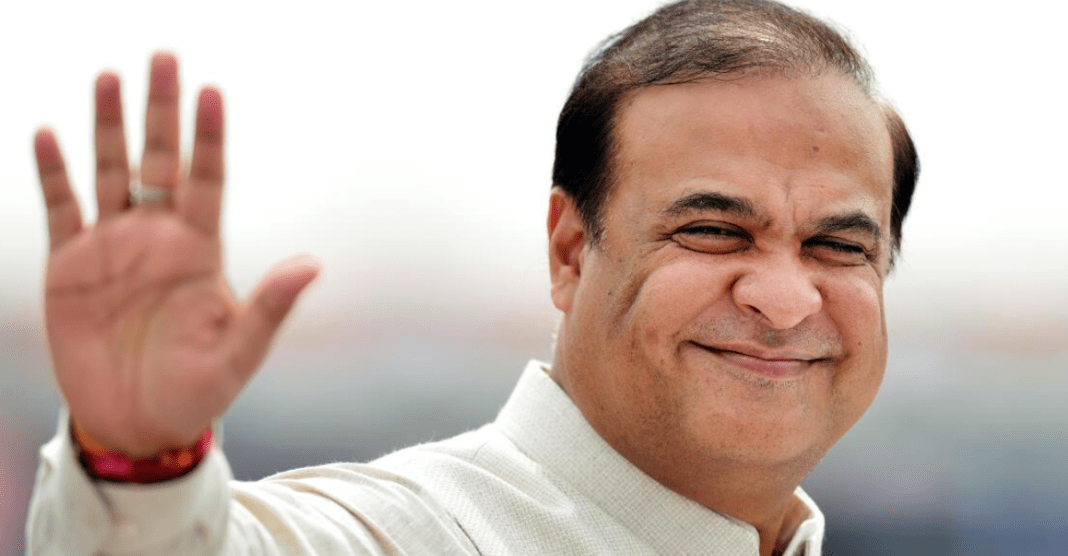

Himanta Biswa Sarma Biography: A leader whose presence can change the entire atmosphere, someone who makes tough decisions with confidence, yet remains approachable and relatable.
A person who understands the complexities of politics and ensures that every step he takes makes people feel heard and valued.
His energy seems endless, his thoughts sharp and clear, and his strategies work in every situation.
In truth, this individual is known for his discipline, courage, and adaptability , someone who not only makes policies but also ensures they are effectively implemented on the ground.
Yes, you guessed it right, we are talking about Dr. Himanta Biswa Sarma, the current Chief Minister of Assam, whose story is not just about politics, but about inspiration, connection, and exemplary leadership.
Dr. Himanta Biswa Sarma is a prominent Indian politician serving as the 15th Chief Minister of Assam, a key leader in the Bharatiya Janata Party (BJP), and a defining figure in the politics of Northeast India.
He was previously associated with Indian National Congress and joined Bharatiya Janata Party on 23 August 2015.
His political journey is marked by a rise from student leadership to the highest executive office in the state.
Personal Overview:
| Category | Details |
|---|---|
| Full Name | Himanta Biswa Sarma |
| Date of Birth | February 1, 1969 |
| Place of Birth | Jorhat, Assam |
| Father | Late Kailash Nath Sarma |
| Mother | Mrinalini Devi |
| Spouse | Riniki Bhuyan Sarma (Married in 2001; Media Entrepreneur) |
| Children | Nandil Biswa Sarma (Son), Sukanya Sarma (Daughter) |
| Education | Cotton University, Gauhati University |
| Academic Qualifications | BA, MA (Political Science), LLB, PhD |
| Early Interest | Child Artiste (Film: Koka Deuta Nati Aru Hati, 1984) |
| Political Entry | Joined Congress in 1991; Joined BJP in 2015 |
| Key Role | 15th Chief Minister of Assam (Assumed Office: May 10, 2021) |
| Other Roles | President, Badminton Association of India; Convener of NEDA |
Early Life and Family Background:
- Birth and Family Background: A Legacy of Letters
Born on February 1, 1969, in Jorhat, Assam, Himanta’s roots were far more academic and literary than political.
A Literary Household: His father, the late Kailash Nath Sarma, was a respected literary figure and scholar. Growing up, Himanta’s home was filled with books and intellectual debates rather than political slogans.
The Mother’s Influence: His mother, Mrinalini Devi, played a crucial role in his upbringing, ensuring that despite having seven siblings, Himanta stayed focused on his education and cultural roots.
The Move to Guwahati: Though born in Jorhat, his family eventually moved to the Gandhi Basti area of Guwahati, which would later become his political playground.
- Childhood and Upbringing: The Unlikely Child Star
While most politicians have a linear path, Himanta’s childhood had a touch of stardom.
The Boy on the Elephant: In 1984, long before he became a household name in politics, he appeared as a child actor in the Assamese film Koka Deuta Nati Aru Hati. He is still remembered for a scene where he sang while riding an elephant—a glimpse of the confidence that would later define his public life.
The “Cottonian” Legacy: He attended Kamrup Academy for school but found his true calling at Cotton College (now University). This institution is often called the “Nursery of Assam’s Chief Ministers,” and Himanta was its brightest star, serving as General Secretary of the Students’ Union for an unprecedented three terms.
- Influences and Values: Born in the Heat of Protest*
Himanta Biswa Sarma Biography: His values weren’t just learned from books; they were forged in the fires of social unrest.
The Assam Agitation: During his teenage years, Assam was engulfed in a massive movement against illegal immigration. Being in the middle of this social upheaval taught him the importance of identity, indigenous rights, and grassroots mobilization.
Academic Excellence: Despite his heavy involvement in student politics, he never neglected his studies. He earned an MA in Political Science, an LLB, and eventually a PhD. This blend of “street-smart” politics and “academic depth” is what makes him a lethal strategist today.
A Value of Pragmatism: If there is one value that defines him, it is fearless pragmatism. He learned early on that to protect his people’s interests, one must be willing to take bold risks and adapt to changing political tides.
Education
Before he was “The Architect of Modern Assam,” Dr. Himanta Biswa Sarma was a student leader who spent more time in college corridors and library halls than most. His academic journey is a rare blend of intellectual rigor and grassroots fire.
- School Education: The Foundation in Guwahati
Himanta’s school years were spent in the heart of Guwahati, where he was exposed to the vibrant and often turbulent social life of the city.
Kamrup Academy: He completed his Senior Secondary (10+2) education at Kamrup Academy School in 1985. This was a pivotal time in Assam’s history (the height of the Assam Movement), and even as a schoolboy, he was keenly aware of the political shifts happening around him.
- Higher Education: The “Cottonian” Legend
If there is one place that defines Himanta Biswa Sarma, it is the prestigious Cotton College (now Cotton University).
Undergraduate & Post-Graduate: He stayed at Cotton College for nearly seven years, earning both his Bachelor of Arts (1990) and Master of Arts (1992) in Political Science.
The Student Leader: He didn’t just study politics; he lived it. He was elected as the General Secretary of the Cotton College Students’ Union (CCSU) for an unprecedented three terms (1988–89, 1989–90, and 1991–92).
Law School: Understanding that power requires a legal foundation, he moved to the Government Law College, Guwahati, where he earned his LLB degree. He even practiced as a solicitor at the Gauhati High Court for five years (1996–2001) before entering the Assembly.
- Academic Achievements: The “Dr.” in the Title
Himanta Biswa Sarma Biography: Unlike many politicians who leave academia behind once they enter office, Sarma doubled down on his intellectual pursuits.
The Doctorate (PhD): In 2006, while he was already a sitting MLA and a rising star in the state cabinet, he successfully completed his PhD in Political Science from Gauhati University.
His Thesis Topic: His research was a deep dive into regional administration: “North Eastern Council: A structural and functional analysis.” This academic specialization explains his mastery over the intricate administrative machinery of the Northeast.
A “Nursery” for CMs: He is the 7th Chief Minister of Assam to have emerged from Cotton University, joining a legendary lineage of leaders who shaped the state.
Summary of Qualifications
- Level Institution Degree
- Schooling Kamrup Academy, Guwahati HSLC (1985)
- Graduation Cotton College BA (Political Science)
- Post-Graduation Cotton College MA (Political Science)
- Legal Govt. Law College, Guwahati LLB
- Doctorate Gauhati University PhD (Political Science)
Entry into Politics
- Early Political Interest: The “Child Wonder”
His political spark didn’t start in a boardroom; it started on the streets during the Assam Agitation (1979–1985).
The Teenage Orator: Even as a schoolboy, he was captivated by the movement for indigenous rights. He was so active that senior leaders and the local media dubbed him a “Child Wonder” for his ability to mobilize crowds and give fiery speeches.
The “Errand Boy” of Giants: He started out by helping legendary AASU (All Assam Students’ Union) leaders like Prafulla Kumar Mahanta and Bhrigu Kumar Phukan. He was the young, energetic worker who learned the “alphabet of power” by watching the masters at work.
- Association with Political Parties: The Great Shift
His journey is famous for a dramatic mid-career pivot that changed Indian politics forever.
The Congress Era (1991–2015): He was personally scouted by the legendary Congress CM Hiteswar Saikia, who saw his potential early on. For over two decades, he was the “engine” of the Congress party in Assam, serving as the right-hand man to CM Tarun Gogoi and winning election after election.
The Breakup: In 2015, after a very public and bitter fallout with the Congress leadership (including the famous “dog/biscuit” anecdote involving Rahul Gandhi), he made a historic move.
The BJP Era (2015–Present): He joined the Bharatiya Janata Party (BJP) and didn’t just join—he conquered. He became the architect of the North-East Democratic Alliance (NEDA), helping the BJP win power in states where they previously had almost no presence.
- Initial Political Roles: Winning the Fortress
Every leader has a “home base,” and for Himanta, it is Jalukbari.
The First Battle (1996): Believe it or not, he actually lost his first attempt at the Jalukbari seat. But he didn’t give up; he spent the next five years building a grassroots network that became unbreakable.
The Breakthrough (2001): He finally won the Jalukbari seat in 2001, defeating his own former mentor, Bhrigu Kumar Phukan. Since then, he has held that seat for five consecutive terms, often winning by some of the highest margins in the country.
The Multi-Tasker: Right from his early years as a Minister of State, he was given “heavyweight” portfolios. Whether it was Health, Finance, or Education, he gained a reputation as the man who actually “gets things done” a trait that eventually made him the natural choice for Chief Minister.
Quick Timeline of Power
- 1980s: AASU Student Leader (The “Wonder Boy”).
- 2001: First-time MLA from Jalukbari.
- 2002: Becomes Minister of State (Agriculture & Planning).
- 2015: Leaves Congress, joins BJP.
- 2021: Becomes the 15th Chief Minister of Assam
Political Career
The Rise: From Student Leader to Power Player:
The Student Firebrand: His journey began at Cotton University, where he served as General Secretary of the Students’ Union for an unprecedented three terms.
The Congress Strongman: He spent 24 years in the Congress, becoming the right-hand man to CM Tarun Gogoi. He was the key strategist behind the Congress’s victories in 2006 and 2011.
The 2015 Switch: After a high-profile fallout with the Congress leadership, he joined the BJP in August 2015. He didn’t just join; he transformed the party’s fortunes across the entire region.
Key Positions Held: The Man of Many Portfolios
He is often called a “super-minister” because of his ability to handle multiple complex departments simultaneously with extreme efficiency.
Period Key Portfolios
2002 – 2014: Minister of State/Cabinet for Health, Education, and Finance (Congress)
2016 – 2021: Cabinet Minister for Finance, PWD, Health, and Education (BJP)
2016 – Present Convener of NEDA (Overseeing political alliances in the Northeast)
2021 – Present Chief Minister of Assam
Major Elections: The Jalukbari Fortress:
His electoral record is one of the most dominant in modern Indian politics.
Unbroken Streak: He has won the Jalukbari seat five consecutive times since 2001.
Record Margins: * In 2011, he won by a massive margin of 78,000+ votes.
In 2021, he secured over 77% of the total votes in his constituency, a testament to his local popularity.
State-Level Impact: In 2021, he was the primary face of the BJP campaign, single-handedly managing ticket distribution and election narratives that led the NDA to secure 75 out of 126 seats.
Achievements and Contributions
Under Dr. Himanta Biswa Sarma’s leadership (2021–2026), Assam has transitioned from a state of “unrest” to one of India’s fastest-growing economies. His governance is a blend of high-tech industrialization and deep-rooted social welfare.
Political Challenges
1. The Battle for “Identity”
Sarma has shifted the political focus of Assam from “anti-outsider” to “anti-infiltrator,” which has created sharp political divisions.
The “Miya” Vote Controversy (2026): In early 2026, Sarma sparked a national debate by stating that 4 to 5 lakh “Miya” (Bengali-speaking Muslim) voters would be deleted from electoral rolls during a special revision. Opposition parties, led by Gaurav Gogoi, have accused him of using state machinery for political exclusion.
The Rise of Gaurav Gogoi: The 2026 Assembly election has turned into a personality clash. After Gogoi’s strong win in the 2024 Lok Sabha polls, Sarma has faced a revitalized Congress that is aggressively questioning his family’s business interests and land holdings.
- The “Point-Blank” Video Row (Feb 2026)
The most recent and perhaps most explosive controversy involves a video shared (and later deleted) by the Assam BJP’s social media handle.
The Controversy: The video purportedly showed an AI-generated or symbolic clip of the CM taking a “point-blank shot” with a rifle at individuals depicted as illegal immigrants.
The Response: National leaders like Asaduddin Owaisi have filed police complaints, and Left parties have moved the Supreme Court, alleging the video incites communal violence and genocide.
Sarma has denied knowledge of the video but stands firm on his anti-infiltrator stance.
- Criticisms of Major Policies:
While Sarma calls them reforms, critics call them “discriminatory” or “harsh”:
The Madrasa Conversion: His decision to convert all state-funded madrasas into general schools was met with massive protests.
While he argues it modernizes education, critics see it as an attack on religious freedom.
Eviction Drives: Under his “zero-tolerance” policy, thousands of people have been evicted from government and forest lands.
Human rights groups frequently point out that the vast majority of those displaced are Bengali-speaking Muslims, leading to accusations of “selective targeting.”
Pakistan Link Allegations: In a recent political slugfest (Feb 2026), Sarma alleged that Gaurav Gogoi and his family have “deep links” with Pakistan.
Gogoi has dismissed these as “C-grade cinema” scripts intended to divert attention from real issues.
Awards and Honors:
Sri Chandrasekarendra Saraswathi National Eminence Award (2025): In December 2025, he was conferred this prestigious award in Mumbai for Public Leadership. The award recognized his governance initiatives in Assam, including massive job creation and digital land reforms.
Top-Performing CM Rankings: He has consistently been ranked among the top 3 Chief Ministers in India by various national surveys (such as the Mood of the Nation) for his administrative efficiency and direct connection with the youth.
Cotton University Recognition: As an alumnus, he was specially honored by Cotton University as its “very own CM,” being part of a legacy of seven Chief Ministers produced by the institution.
International Recognition & Global Presence
World Economic Forum (Davos 2026): In January 2026, he made history as the first Assam Chief Minister to attend the WEF Annual Meeting in Davos, Switzerland. He showcased Assam’s economic transition moving from a history of insurgency to a future of semiconductors and AI to global investors and heads of state.
UNESCO Heritage Milestone: He played a pivotal role in the international campaign that led to the Charaideo Moidams being declared a UNESCO World Heritage Site in 2024. In February 2026, he formally unveiled the UNESCO recognition plaque, marking a major cultural achievement on the world stage.
Badminton World Federation (BWF) Leadership: On the global sports front, he serves as a member of the Executive Council of the Badminton World Federation and is the Vice-President of Badminton Asia.
Legacy and Impact:
- Contribution to the State: The Industrial Architect :
Global Recognition: In January 2026, he became the first Assam CM to attend the World Economic Forum (Davos), securing investment commitments worth roughly ₹1.5 lakh crore.
Tech Revolution: His most significant “win” is the ₹27,000 crore Tata Semiconductor plant in Jagiroad, making Assam a key player in the global electronics supply chain.
Infrastructure: He has fast-tracked the construction of four major bridges over the Brahmaputra and established Dibrugarh as the second capital to decentralize the state’s administration.
- Long-term Impact on Politics: The “Action-First” Model :
Merit-Based Jobs: He dismantled the old bribe-based system, providing over 1.56 lakh government jobs purely on merit a move that has deeply impacted the aspirations of Assam’s youth.
Administrative Reform: Through Mission Basundhara, he digitized land records for millions, and with his “Cabinet on Wheels,” he took the state government to the doorstep of rural districts.
Bold Policy Shifts: Converting state-run madrasas into general schools and implementing strict laws against cattle smuggling and child marriage have set a new political template in the Northeast.
- Impact on Society: Identity and Empowerment :
Women’s Empowerment: Schemes like Orunodoi (financial aid for 38 lakh women) and Nijut Moina (stipends for 4 lakh female students) have turned women into a major economic and political force.
Indigenous Pride: He secured UNESCO World Heritage status for the Charaideo Moidams, reviving the legacy of the Ahom Kingdom.
Social Polarization: His firm stance on “Miya” identity and eviction drives remains his most controversial impact, creating a sharp divide between his supporters, who see him as a protector of indigenous rights, and critics, who view his rhetoric as divisive.
Unique Facts About Dr. Himanta Biswa Sarma :
1. The “Mama” of Assam: He is affectionately known as “Mama” (maternal uncle) by the youth. This nickname started as a student joke about asking for gifts (like bikes) but is now a powerful political brand used even in national quizzes like KBC.
2. Davos Trailblazer (2026): Last month, he became the first Assam CM to attend the World Economic Forum in Davos, where he pitched Assam’s shift from “insurgency to AI” and aimed for investments worth ₹1 lakh crore.
3. World Record Holder: He has led Assam to multiple Guinness World Records, including the largest Bihu dance (11,304 performers) and a massive 2024 environmental drive that planted millions of saplings.
4 Academic High-Achiever: He is a PhD holder in Political Science and was a record-breaking student leader at Cotton University, elected as General Secretary three times.
5 CEO-Style Work Ethic: Known for sleeping only 4–5 hours, he often conducts surprise 2 AM site inspections and has pioneered the “Cabinet on Wheels,” holding official meetings in rural districts to bring the government to the people.
Also Read: Brij Bhushan Biography: A Journey Through Parliament, Wrestling, and Legal Battles