

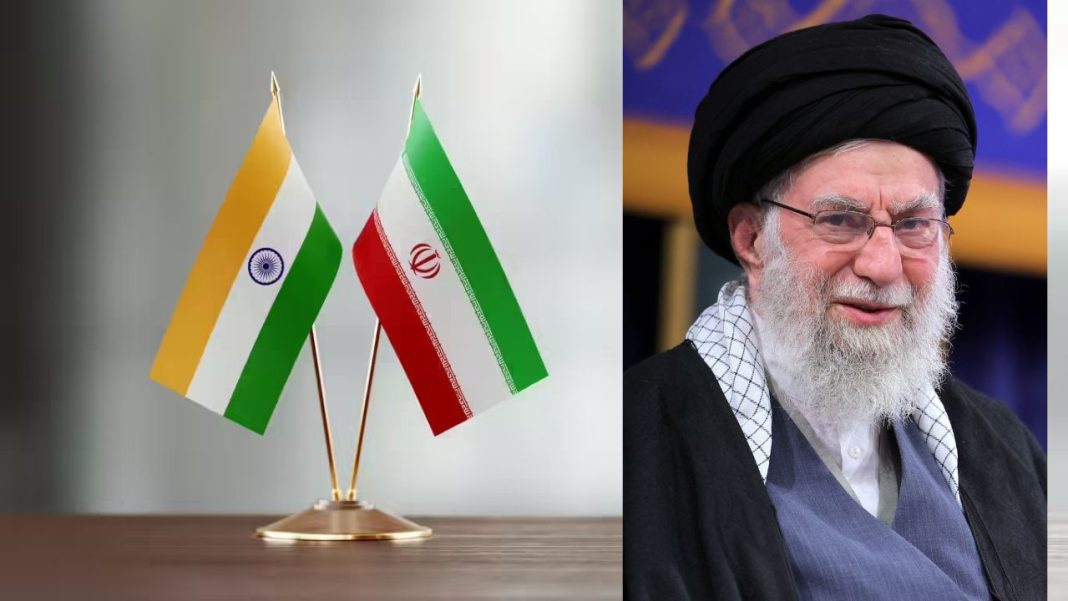

IRAN-ISRAEL WAR: Recent developments in the Middle East, particularly reports surrounding the death of Iran’s Supreme Leader Ali Hosseini Khamenei—have triggered reactions far beyond Iran’s borders.
Surprisingly, these reactions have reached deep into India, from villages in Uttar Pradesh to Shia communities in Rajasthan, Karnataka, Kashmir, and beyond.
Across several Indian states, people have taken to the streets—some in protest, others in public mourning.
This has raised a key question: what is the Indian connection, and why are Indians responding so intensely to events in Iran?
Misconceptions About “Indian Roots”
A widely circulated claim suggests that Ali Khamenei has Indian roots. However, this is largely a misconception.
Khamenei himself is not ethnically Indian, nor does his immediate family originate from India. He was born in Mashhad in 1939 and comes from an Iranian clerical family.
The confusion arises from the historical background of Iran’s revolutionary leadership, particularly the lineage of the man Khamenei succeeded.
In 1965, Khamenei married Mansoureh Khojasteh Bagherzadeh, and the couple had six children—three sons (Mostafa, Mojtaba, Masoud) and three daughters.
After the death of Ayatollah Ruhollah Khomeini, the architect of Iran’s 1979 Islamic Revolution, Khamenei became Iran’s Supreme Leader.
It is Khomeini—not Khamenei—whose ancestry links back to India.
Khomeini’s paternal grandfather, Syed Ahmad Musavi, is widely reported to have been born in Kintoor village, Barabanki district, Uttar Pradesh.
In the early 19th century, he migrated west to Najaf (present-day Iraq) and later settled in Iran. Over time, this ancestral detail became politically and symbolically magnified.
Visits and Cultural Ties With India
Beyond genealogy, Indo-Iranian ties were also shaped by direct personal engagement.
Archival records indicate that Ali Khamenei visited India in 1981, including a stop in Alipur village in Karnataka. The village, predominantly Shia Muslim, witnessed the inauguration of a hospital project supported by Iran. Large crowds reportedly welcomed him, and residents still recall the visit decades later.
In Kashmir, Khamenei’s 1980–81 visit also left a lasting impression. He participated in Friday prayers and interacted with local religious figures during a politically sensitive period. For many, these encounters created a sense of spiritual, ideological, and emotional connection that continues today.
Why Are Indians Protesting or Mourning?
Recent demonstrations across Uttar Pradesh, Rajasthan, Punjab, Delhi, Bihar, Jharkhand, and Telangana reflect a complex mix of religious sentiment, political alignment, and emotional attachment.
- Shia communities in cities such as Jaipur, Ajmer, and Jodhpur held mourning gatherings and processions, drawing parallels with historic Islamic mourning traditions.
- In villages associated with Khamenei’s visits or Khomeini’s ancestral memory, people observed closures, special prayers, and public expressions of grief.
- In some regions, protests were framed as opposition to foreign military intervention, with demonstrators condemning the United States and Israel for airstrikes reportedly linked to his death.
India’s government has historically taken a cautious stance on foreign religious commentary. In the past, remarks by Khamenei on issues such as Kashmir or the treatment of Muslims in India drew criticism from New Delhi, which urged foreign clerics to focus on their own domestic challenges.
Why Are Many Iranians Celebrating in Iran?
While parts of India mourned, segments of Iranian society—particularly women and exile communities—responded very differently, with celebrations and public expressions of relief.
Critics of Khamenei point to Iran’s strict laws under his leadership:
- Mandatory hijab enforced from puberty, with punishment for violations
- Women barred from cycling publicly
- Married women required to obtain husband’s permission for passports
- Legal marriage age set at 13, with court approval needed below that
- Women denied equal divorce rights
- Husbands legally allowed to block wives from employment
- Women receiving half the inheritance of men
- Women banned from attending men’s football matches in stadiums
A viral image showing a woman—identified by some reports as an Iranian exile in Canada—smoking a cigarette beside a burning photograph of Khamenei resurfaced online following reports of his death.
She later stated she had lived most of her life in Iran but now resides in Canada, with family members still inside the country.
The belief that Ali Khamenei has Indian roots is more myth than reality, yet decades of historical memory, religious symbolism, and personal interaction have made Iran’s leadership emotionally relevant in parts of Indian society.
According to various reports, Khamenei’s daughter, granddaughter, daughter-in-law, and son-in-law were killed in US- and Israel-linked strikes, though full confirmation and details remain unclear. Other reports suggest that his son Mojtaba Khamenei could emerge as a future leader of Iran.
Meanwhile, speculation has also surfaced that Ayatollah Arfi, announced by some outlets as a new Supreme Leader, may himself have been killed in an airstrike—claims attributed to Israeli media but not independently verified.
What is clear is that Iran’s internal struggle has global echoes, and in India—because of history, faith, and politics—those echoes are louder than many expected.