
Iran’s ‘Silent Coup’: Imagine a country where the President has a title but no power, and the Supreme Leader has a name but no face.
This is the grim reality of Iran in April 2026. For years, analysts debated whether the “Republic” or the “Islamic” side of the regime held more weight.
Today, that debate is dead. The question is no longer who leads the Islamic Republic, but whether the Republic even exists anymore, or if it has been swallowed whole by its own army.
For decades, the Islamic Revolutionary Guard Corps (IRGC) was described by historians and intelligence agencies as a “state within a state.”
They controlled the missiles, the black-market economy, and the foreign proxies. But today, that description is outdated.
The IRGC has moved from the shadows to the driver’s seat, effectively becoming the de facto ruler of Iran.
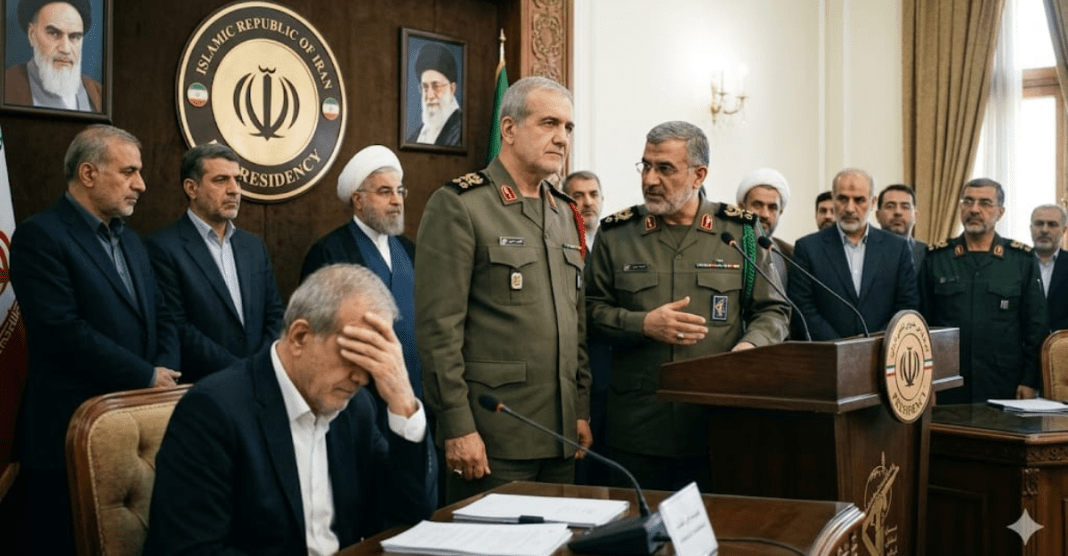
In doing so, they have turned President Masoud Pezeshkian into a political ghost, a man haunting the halls of a palace where his voice no longer carries any weight.
The Missing Leader and the “Military Council”
Iran’s ‘Silent Coup’: The current crisis began with a mystery that has gripped the world’s intelligence agencies. Following the death of Ali Khamenei earlier this year, amidst the chaos of regional strikes, his son, Mojtaba Khamenei, was swiftly named the new Supreme Leader.
It was supposed to be a seamless transition to maintain stability.
But there is a problem: Mojtaba has not been seen in public for over a month.
Since his formal appointment on March 8, 2026, there have been no video addresses, no televised prayers, and no public audiences with foreign dignitaries.
While rumors suggest he might be ill, injured, or even incapacitated following the February airstrikes, the reality on the ground points to a deliberate isolation.
In his absence, a group of senior IRGC officers has formed what insiders call a “Military Council.”
This council now controls the “security cordon” around the Leader’s office. They are the gatekeepers. They decide:
Who is allowed to see the Supreme Leader.
Which intelligence reports reach his desk.
Which “decrees” are issued in his name.
By controlling the physical person of the Leader, the IRGC has effectively hijacked the highest office in the land.
They are no longer taking orders from the clergy; they are issuing orders through them.
A President in Handcuffs
Iran’s ‘Silent Coup’: Masoud Pezeshkian won the presidency by promising a “new deal” for the Iranian people, reform, a stabilized economy, and a “pragmatic” foreign policy.
Instead, he has hit what observers call a “complete political deadlock.”
The IRGC isn’t just disagreeing with the President; they are systematically erasing his authority.
The Battle for the Cabinet
Iran’s ‘Silent Coup’: Last week, a major fracture appeared in the government.
Pezeshkian attempted to appoint a new Intelligence Minister to replace the hardline holdovers.
He wanted someone who could de-escalate tensions. However, the IRGC Chief-Commander, Ahmad Vahidi, reportedly entered the cabinet room and rejected every single candidate on the President’s list.
Vahidi’s message to the President was blunt and terrifying: “In wartime, the military picks the leaders, not the President.
Your job is to manage the budget; our job is to manage the state.”
The Forced Appointment
The President was recently pressured into appointing Mohammad Baqr Zolghadr, a high-ranking IRGC veteran, as the head of the National Security Council.
This move was the equivalent of a corporate hostile takeover.
By putting Zolghadr in this position, the IRGC effectively put a general in charge of the President’s own security and foreign policy briefings.
The Silent Treatment
Perhaps most humiliating is the isolation. Pezeshkian has reportedly requested an urgent audience with Mojtaba Khamenei five times in the last fortnight to discuss the collapsing economy. Every single request has been blocked by the IRGC guards at the door, citing “security protocols” or “the Leader’s health.” The President of Iran cannot even speak to his own superior without a general’s permission.
The “Wartime” Excuse
The IRGC is using the ongoing conflict with Israel and the U.S. as the perfect excuse to seize total power.
They are operating under a “state of emergency” that has no expiration date.
Their argument is simple: a civilian government is “too slow,” “too weak,” and “too compromised” for a time of existential war.
The clash between the civilian presidency and the military junta can be summarized by these two starkly different realities:
- Diplomacy vs. Aggression
The President’s Vision: Masoud Pezeshkian is pushing for an immediate ceasefire and a return to nuclear negotiations.
He warns that without a diplomatic breakthrough to lift sanctions, the country’s “economic bleeding” will become fatal.
The IRGC’s Reality: The Guard has adopted a “fire at will” doctrine.
They believe that any sign of diplomacy is a sign of weakness and that direct, unrestricted strikes against regional adversaries are the only way to ensure the regime’s survival.
- Economy vs. Control
The President’s Vision: Pezeshkian has warned the leadership that the Iranian economy is on the verge of a total collapse.
He argues that only major structural reforms and the attraction of foreign investment can save the system.
The IRGC’s Reality: The military has moved toward a “war economy.”
They have bypassed the government to hike taxes by 60% and have begun seizing private assets and businesses to fund their massive military expansion and proxy networks.
- Social Order vs. Suppression
The President’s Vision: Fearing another massive domestic uprising like those seen in early 2026, Pezeshkian has suggested easing the “Hijab” crackdowns and morality policing to act as a “safety valve” for public anger.
The IRGC’s Reality: The Guard views leniency as an invitation to revolution.
They have deployed shadow “Security Committees” in every major city, authorized to use lethal force to crush any sign of dissent instantly.
This “Wartime Doctrine” allows the IRGC to bypass the Parliament (Majlis) and the Judiciary.
They are now making calls on oil sales, foreign alliances (specifically deepening the “missiles-for-tech” pact with Russia), and regional escalations without a single vote from an elected official.
- A Nation Without a Pilot
While the IRGC consolidates its power, the Iranian people are the ones paying the price.
The economy is not just in trouble; it is in freefall.
The local currency (Rial) has become so worthless that in the shops of North Tehran, basic goods like milk and bread are now being priced in U.S. Dollars or gold.
To keep control of a starving population, the IRGC has taken desperate and dangerous measures:
Proxy Deployment: Reports indicate that the IRGC has moved foreign proxy fighters from Iraq and Afghanistan into Iranian cities to act as a “morality and security” force, fearing that the regular Iranian police might refuse to fire on their own citizens.
Human Shields: In a move that has horrified the civilian government, the IRGC is reportedly using schools, hospitals, and residential basements as “missile cover.”
By placing military assets in civilian hubs, they are betting that their enemies will be too afraid of the “bad PR” to strike back.
This isn’t a government protecting its people.
This is a military protecting its own survival at any cost, using its own citizens as a literal shield.
The Hard Truth: The Turban vs. The Boot
The “Green Shadow” of the IRGC has finally covered the entire country.
For decades, the clergy (the Turbans) held the ultimate power, and the military (the Boots) served them.
In 2026, that relationship has flipped.
The struggle in Tehran is no longer a political one between “reformists” and “hardliners.” That is a story for the history books.
The current struggle is between a civilian government that is dying and a military council that has already taken over.
If President Pezeshkian cannot even choose his own ministers or speak to the Supreme Leader, he is no longer a leader.
He is a spokesperson for a military dictatorship.
He provides a “civilian face” to the world, while the generals in the back room decide where the next missiles will land.
As we move further into 2026, the world must wake up to a new Iran. The days of negotiating with diplomats who have no power are over.
The IRGC has taken the throne. They have sidelined the President, isolated the Supreme Leader, and turned the nation into a garrison.
The “Republic” is gone. Only the “Guard” remains.
Iran is now at a point of no return. The biggest question is: can a nation survive when its own military sees the government as an obstacle?
The answer to this will now be found only in the pages of history.
Written By – Arushi Sharma