
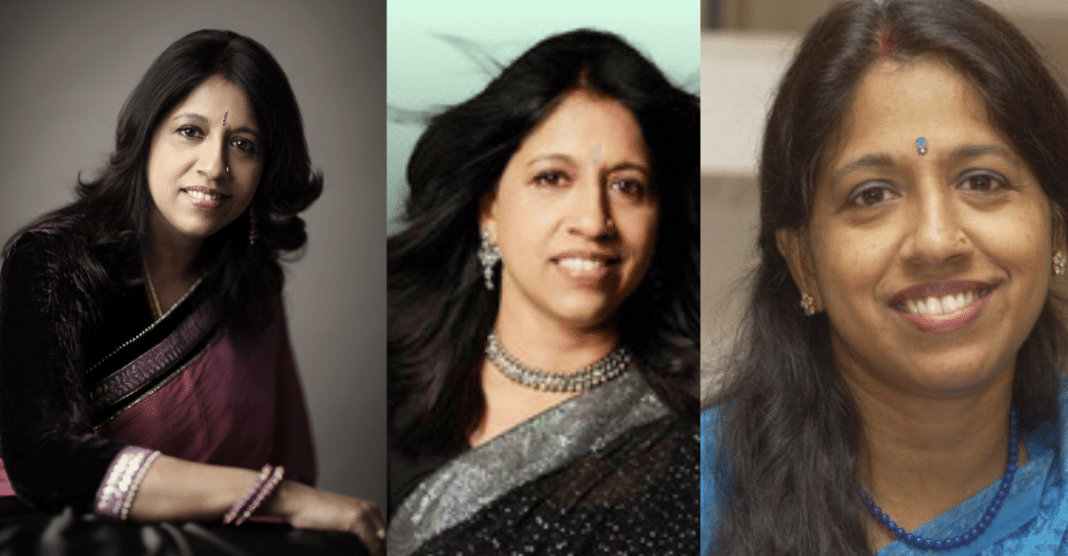

Kavita Krishnamurthy Biography : Close your eyes for a moment. Imagine the crackle of a cassette tape sliding into its player.
The hiss before the music starts. Then that voice. High-spirited, playful, then achingly tender a few songs later.
If you grew up in India in the 1980s and 90s, chances are Kavita Krishnamurthy’s voice was the soundtrack to your childhood, echoing from the kitchen radio while your mother made chai, blaring from a neighbour’s window on a sultry afternoon, floating through the bus on a long school trip.
Kavita Krishnamurthy Biography : From the madcap, breathless energy of “Hawa Hawai” that irresistible anthem from Mr. India (1987) that made the whole country feel like it could fly to the soul-stirring romance of “Pyar Hua Chupke Se,” her voice seemed to know exactly what you were feeling before you did. You may not have known her name back then.
But you knew her voice. Everyone did. This is the story of Kavita Krishnamurthy one of the greatest voices in the history of Indian music.
Personal Profile
| Detail | Information |
|---|---|
| Full Birth Name | Sharada Krishnamurthy |
| Professional Name | Kavita Krishnamurthy |
| Date of Birth | 25 January 1958 |
| Age (2025) | 67 years |
| Place of Birth | New Delhi, India |
| Nationality | Indian |
| Religion | Hindu |
| Ethnicity | Tamil Iyer |
| Profession | Playback Singer, Classical & Fusion Vocalist |
| Active Since | 1971 |
| Spouse | Dr. L. Subramaniam (m. 1999) |
| Children (Step) | Gingger Shankar, Bindu Subramaniam, Ambi Subramaniam, Narayana Subramaniam |
| Education | BA Honours in Economics, St. Xavier’s College, Mumbai |
| Musical Training | Rabindra Sangeet (Guru Surama Basu), Hindustani Classical (Balram Puri) |
| Languages Sung In | 45+ languages |
| Songs Recorded | 25,000–50,000+ |
| Notable Awards | Padma Shri (2005), 4× Filmfare Awards, Honorary Doctorate (2015) |
| Estimated Net Worth | ~$10 million (approx. ₹80–84 crore) |
| Residence | Bengaluru, Karnataka, India |
Early Life and Background
Kavita Krishnamurthy was born Sharada Krishnamurthy on 25 January 1958 in New Delhi, into a Tamil Iyer family.
Her father, T. S. Krishnamurthy, was a Ministry of Education official disciplined, principled, a man of books.
Her mother, however, was a passionate admirer of classical Indian music and dance, and it was she who ensured that little Sharada’s ears were filled with melody from the very beginning.
A significant influence on her early life was her aunt, Protima Bhattacharya, who along with her uncle served as a second set of parents for the young girl.
It was at her aunt’s insistence that she began her first formal music lessons a nudge that would quietly change the course of Indian music.
Interestingly, as a teenager, Kavita’s ambitions pointed toward the Indian Foreign Service (IFS).
She was academically sharp and intellectually curious. But music had already claimed her long before she had a chance to choose.
Introduction to Music
Kavita Krishnamurthy Biography: Her early musical training was rigorous and eclectic. She first learned Rabindra Sangeet under Guru Surama Basu, absorbing the emotive poetry and melodic depth of the Bengali classical tradition.
She then moved on to formal training in Hindustani classical music under the noted singer Balram Puri.
The discipline of classical training the breath control, the raga-awareness, the emotional precision would later become the invisible backbone of every Bollywood song she sang.
By the age of eight, she had won a gold medal in a music competition. Throughout the mid-1960s, she continued winning medals at Inter-Ministry Classical Competitions.
The girl called Sharada was already becoming something rare: a technically brilliant singer with an intuitive emotional range.
At 14, she moved to Mumbai to chase her dream. She enrolled at St. Xavier’s College, graduated with a BA Honours in Economics, and immersed herself in the city’s music scene.
It was during the college festival Malhar that she met Ranu Mukherjee, daughter of the legendary composer Hemant Kumar a chance encounter that cracked open the doors of the film industry.
Struggles and Early Career
The world of Bollywood playback singing in the 1970s was not welcoming to newcomers.
Lata Mangeshkar and Asha Bhosle were giants who cast long shadows, and young Kavita spent nearly a decade working largely in the shadows as a “dubbing artist” recording scratch or demo versions of songs intended to guide established legends in the studio.
Her first professional recording came in 1971 a duet with Lata Mangeshkar herself for the Bengali film Shriman Prithviraj, directed by Hemant Kumar.
Kavita Krishnamurthy Biography: She was reportedly so nervous standing beside her idol that she forgot her lines. Nevertheless, Hemant Kumar was impressed enough to feature her in his live stage performances.
It was there that the veteran singer Manna Dey spotted her and hired her to sing advertisement jingles.
Her first Hindi film song came in 1976 a re-rendition of “Aayega Aanewala” for Kadambari, composed by Vilayat Khan.
But the road remained rough. She was firmly branded an “LP-campwalli” so frequently used by the prolific composer duo Laxmikant–Pyarelal for demos and scratch recordings that other music directors assumed she worked exclusively for them and avoided hiring her.
At auditions, she was dismissed as sounding too much like a “schoolgirl.” She performed at weddings and small concerts where artists were not always treated with dignity on one such occasion, the celebrated poet Majrooh Sultanpuri noticed her discomfort at a rowdy event and gently urged her to go home.
She also battled chronic bronchitis and sinus issues a health struggle that has lasted over 35 years.
Yet she never cancelled a recording session, never asked for a lower scale, never let her physical battles seep into her voice.
The turning point finally arrived in 1985 with “Tumse Milkar Na Jaane Kyon” from Pyaar Jhukta Nahin proof at last that she could anchor a film song in her own right.
Breakthrough in Bollywood
The year 1987 changed everything. The film was Mr. India. The song was “Hawa Hawai.”
Originally recorded as a filler, Kavita’s performance was so electrically alive so perfectly suited to Sridevi’s on-screen abandon that the filmmakers immediately decided to keep it as the final version.
Kavita herself felt she had made a small mistake in the recording and requested a re-take. The music directors refused. They loved every note of it.
Her second, even greater breakthrough came in 1994 with 1942: A Love Story composer R. D. Burman’s final masterwork before his death. Songs like “Pyar Hua Chupke Se” and “Rim Jhim Rim Jhim” were achingly beautiful, semi-classical ballads that showcased a dimension of her voice the world hadn’t fully heard before.
She won her first Filmfare Award for “Pyar Hua Chupke Se” in 1995 and it was only the beginning.
Career Highlights and Iconic Songs
What followed was a golden era of unmatched dominance.
Kavita Krishnamurthy won the Filmfare Best Female Playback Singer Award three consecutive times, from 1995 to 1997:
• 1995 — “Pyar Hua Chupke Se” (1942: A Love Story)
• 1996 — “Mera Piya Ghar Aaya” (Yaraana), iconic for Madhuri Dixit’s electrifying performance
• 1997 — “Aaj Main Upar” (Khamoshi: The Musical), lending soul to Manisha Koirala’s most memorable role
She went on to win a fourth Filmfare Award in 2003 for “Dola Re Dola” from Devdas, shared with Shreya Ghoshal.
Her Kavita Krishnamurthy 90s songs reads like a hall of fame of Bollywood music:
Song Film Year
- “Hawa Hawai” Mr. India 1987
- “Pyar Hua Chupke Se” 1942: A Love Story 1994
- “Tu Cheez Badi Hai Mast Mast” Mohra 1994
- “Tu Hi Re” Bombay 1995
- “Aaj Main Upar” Khamoshi: The Musical 1996
- “Nimbooda” Hum Dil De Chuke Sanam 1999
- “Bole Chudiyan” Kabhi Khushi Kabhie Gham 2001
- “Dola Re Dola” Devdas 2002
She collaborated with virtually every great music director of her generation R. D. Burman, Laxmikant–Pyarelal, A. R. Rahman, Ismail Darbar, Jatin–Lalit and became the preferred voice for an extraordinary roster of Bollywood’s biggest actresses: Sridevi, Madhuri Dixit, Manisha Koirala, and Aishwarya Rai.
International Collaborations
After stepping back from the intense pace of Bollywood in the late 1990s, Kavita Krishnamurthy reinvented herself as a global ambassador for Indian music a transition few playback singers have ever attempted, let alone achieved.
She collaborated with jazz legends including Al Jarreau, George Duke, and Stanley Clarke, as well as fusion guitar pioneer Larry Coryell and became the main featured soloist on the Warner Bros.
Global Fusion album, which brought together musicians from five continents.
Her orchestral career has been equally remarkable. She has performed as a featured soloist with the London Symphony Orchestra (recording the Dutta Symphony at the historic Abbey Road Studios), the Beijing Symphony Orchestra, the Leipzig Philharmonic, and the BBC Radio Orchestra.
She has graced the stages of Royal Albert Hall in London, Madison Square Garden in New York, and The Kennedy Center in Washington D.C.
Alongside her husband Dr. L. Subramaniam, she organises the Lakshminarayana Global Music Festival, one of India’s largest free music festivals —which has toured 55 cities across 22 countries.
Awards and Achievements
| Award | Year | Details |
|---|---|---|
| Padma Shri | 2005 | Awarded by the Government of India for exceptional contribution to music |
| Filmfare Best Female Playback Singer Award | 1995, 1996, 1997, 2003 | Won four times |
| IIFA Best Female Playback Singer | 2003 | For the song “Dola Re Dola” |
| Honorary Doctorate | 2015 | Conferred by Jain University, Bengaluru |
| Lata Mangeshkar Award | 2005 | Presented by the Government of Madhya Pradesh |
| Best Singer of the Millennium | 2000 | Stardust Millennium Award |
| Golden Flame Lifetime Achievement Award | 2024 | Presented at the UK Asian Film Festival, London |
| S. D. Burman International Award | 2025 | For international contribution to music |
| Amrit Ratan Award | 2024 | Special recognition award |
Personal Life
Kavita Krishnamurthy’s personal life tells its own beautiful story.
She met world-renowned violinist and composer Dr. L. Subramaniam while collaborating on his ambitious Global Fusion project in the late 1990s.
Before meeting him, she had quietly accepted that she might remain single forever, even a spiritual encounter with Sri Sathya Sai Baba, who reportedly told her she would find her partner through music, seemed almost too hopeful to believe.
They married on 11 November 1999, and she moved from Mumbai to Bengaluru, intentionally stepping away from the frenetic demands of mainstream Bollywood to build a life around family and global music.
She became stepmother to Dr. Subramaniam’s four children, Gingger Shankar (a musician and instrumentalist based in Los Angeles), Bindu Subramaniam (a singer-songwriter and educator), Ambi Subramaniam (an acclaimed violinist), and Narayana Subramaniam (a doctor who also performs music).
By all accounts, she is enormously close to all four.
In 2007, the couple co-founded the Subramaniam Academy of Performing Arts (SaPa) in Bengaluru a music school that blends Indian and Western classical traditions and has since taken music education to over 30,000 children through its “SaPa in Schools” initiative.
Lesser-Known Facts
• The name “Kavita” was given to her by legendary composer Hemant Kumar, who suggested she change her birth name Sharada to avoid confusion with another singer already active in the industry.
• She wanted to be a diplomat. As a young girl, her dream was to join the Indian Foreign Service, not to sing for the movies.
• She asked for a re-take on “Hawa Hawai.” She felt she had made an error in the recording. The filmmakers disagreed and kept the original, believing her natural energy was exactly right.
• She speaks fluent Bengali despite being a Tamilian by birth, a result of being raised in part by her Bengali aunt and uncle in New Delhi.
• She has battled chronic bronchitis for over 35 years, often recording high-pitched Bollywood songs while suffering from asthma and blocked sinuses — and never once cancelling a session.
• Her first recording was alongside Lata Mangeshkar herself, and she was so overawed that she reportedly forgot her lines mid-session.
The legacy of Kavita Krishnamurthy rests on a rare convergence of technical mastery, emotional authenticity, and extraordinary range.
Peers and critics consistently describe her as possessing perfect pitch and exceptional breath control vocal gifts that survived decades of health battles and never faltered.
Biography By: Namita Deora
Also Read: Alka Yagnik Biography: A Voice That Defined the Sound of Romance in Bollywood