


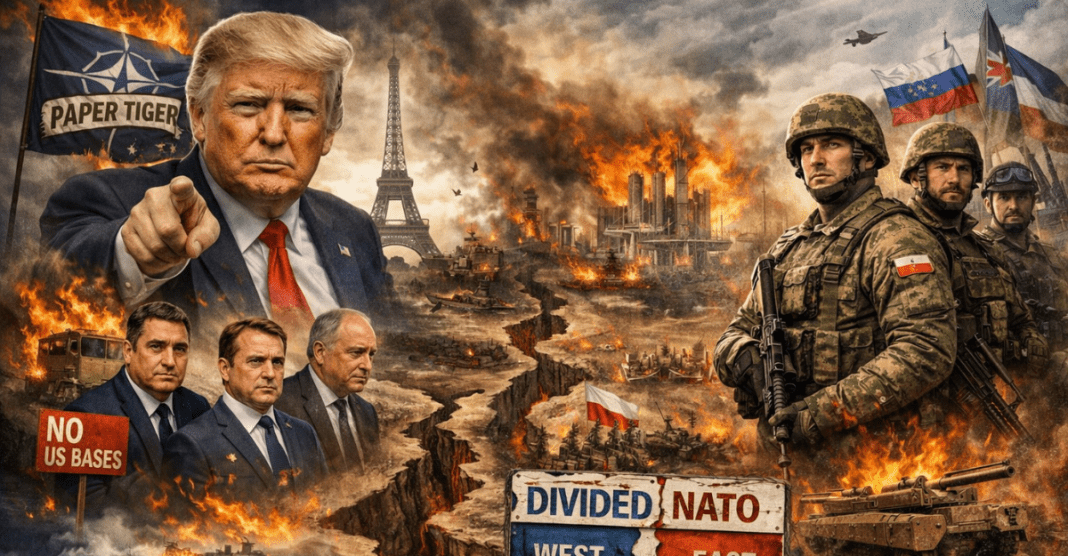

NATO Alliance: NATO, the military alliance that has kept peace among Western nations since 1949, is now facing what military historians are calling its worst crisis ever.
On Wednesday, U.S. President Donald Trump dropped a bombshell, calling the 77-year-old alliance a “paper tiger” and strongly hinting that America’s commitment to protecting Europe may be finished.
NATO Alliance: These harsh words did not come from nowhere. They are the direct result of a bitter month-long fight between the U.S. and its European allies over “Operation Epic Fury” America’s ongoing military campaign against Iran.
As European powers continue to refuse naval and logistical support to reopen the blockaded Strait of Hormuz, NATO has effectively cracked into two hostile camps: a Western bloc that is fighting for the “Rule of Law,” and an Eastern bloc that is fighting for sheer “Physical Survival.”
The ‘Paper Tiger’ Ultimatum
NATO Alliance: The crisis exploded into public view during a fiery interview Trump gave to the Daily Telegraph, where he made his frustration with NATO absolutely clear.
“I was never swayed by NATO,” Trump said bluntly. “I always knew they were a paper tiger, and Putin knows that too, by the way.
They want our protection, they want our nukes, they want our money.
But when it’s time to secure the world’s oil or stop a nuclear-capable Iran, they turn into cowards.”
By using the phrase “paper tiger” a term originally used by Mao Zedong to describe enemies who look powerful but won’t actually fight Trump sent a very clear message to both allies and enemies: the United States no longer trusts NATO’s collective will to act.
This is being seen by foreign policy experts as a potentially historic turning point in the NATO alliance and global security.
The Western Front: The ‘Legalist’ Rebellion
NATO Alliance: In Western Europe, refusing to join the Iran war is not being described as weakness.
Instead, countries like Spain, France, and Italy are framing their refusal as a moral and legal stand.
Their argument is that the U.S. and Israel have launched a “war of choice” without a United Nations mandate, which they say directly violates the core principles of the NATO treaty.
Spain has taken perhaps the most dramatic step. Prime Minister Pedro Sánchez has officially closed Spain’s airspace to any U.S. military aircraft involved in Iran operations.
This forced the Pentagon to pull its tanker aircraft from the Rota and Morón bases, adding thousands of miles to flight routes.
“This war is profoundly illegal,” Sánchez declared. “Spain will not be a launchpad for unprovoked aggression.”
Italy, usually one of America’s most dependable partners, shocked Washington last week by denying landing rights to U.S. B-1 and B-52 bombers at the Sigonella air base in Sicily.
Italian officials argue that NATO was designed to defend Europe from invasion not to support offensive military “regime change” missions in the Middle East.
France, under President Emmanuel Macron, has gone further, blocking the transit of munitions-heavy flights to Israel and doubling down on his long-held belief in “Strategic Autonomy” the idea that Europe must be able to defend itself without depending on Washington.
“We will not be dragged into a global chaos that ignores the rule of law,” Macron said.
The Middle-Power Resistance
Not every NATO member has taken such a firm stance.
A group of middle powers Germany, Canada, and the Netherlands are caught in the middle, trying to stay friendly with the U.S. while avoiding being dragged into an active war.
Germany’s Chancellor Friedrich Merz is walking a political tightrope.
Berlin still allows the U.S. to use Ramstein Air Base for medical evacuations and basic logistics, but Merz has flatly refused to allow German jets to participate in offensive strikes.
He says Germany will only help secure shipping lanes “when the weapons fall silent.”
Canada’s Prime Minister Mark Carney has ruled out any military involvement in “Operation Epic Fury.”
Instead, Canada is channeling its energy into the International Energy Agency to stabilize global oil markets.
Carney’s remark that “nostalgia for 20th-century NATO is not a viable strategy for 2026” was widely read as a direct dig at old-guard U.S. diplomats still dreaming of unified Western action.
The Netherlands has been more measured but equally firm. While Dutch officials support the principle of “freedom of navigation,” they have drawn a clear line at supporting strikes targeting Iranian leadership or civilian energy infrastructure, and are calling for a “comprehensive moratorium” on such attacks a demand that has deeply frustrated the Trump cabinet.
The Eastern Front: The Battle for Physical Survival
While Western Europe argues over legal texts, the Eastern flank of NATO Poland and the Baltic States of Lithuania, Latvia, and Estonia is living in a state of real fear.
For these countries, NATO is not a diplomatic debating society. It is the only wall standing between them and a potential Russian invasion.
Poland and the Baltics have deliberately stayed quiet about the “legality” debate.
Instead, they have quietly offered logistical support and loud political backing for President Trump.
Their logic is brutally simple: if they refuse to help the U.S. now, Trump may pull American troops away from the Russian border and that could be a death sentence for their nations.
Lithuania’s President Gitanas Nausėda put it plainly: “The alliance is built on trust.
NATO Alliance: If we refuse to help our greatest partner in their time of need, how can we expect American mothers and fathers to send their children to defend Vilnius or Warsaw?
We fight where the Americans fight, so that the Americans stay here.”
Poland is not leaving its survival to chance. Fearing the collapse of the U.S. security umbrella, Warsaw has ramped up its defense spending to a remarkable 5.2% of GDP one of the highest in the world.
It is buying tanks from South Korea and jets from the U.S. in a race to become a military fortress that can defend itself, just in case NATO falls apart entirely.
Operational Impact: The Logistics of a ‘Unilateral’ War
The European rebellion is not just a political embarrassment for Washington it has created serious military consequences on the ground.
The loss of Spanish and Italian bases has created a dangerous “refueling bottleneck” in the Mediterranean. U.S. Air Force tanker planes are now forced to fly long, expensive detour routes over Africa, which has nearly tripled the cost per flight and slowed the pace of military operations against Iran.
The situation at sea is equally strained. In a normal crisis involving the Strait of Hormuz, the U.S. would expect a ten-nation NATO naval task force to share the burden.
Today, the U.S. Navy is essentially operating alone conducting airstrikes, escorting commercial tankers through dangerous waters, and trying to keep the world’s most important oil shipping lane open, all at the same time.
Military analysts warn that this “overstretch” is pushing the U.S. Fifth Fleet toward exhaustion.
Can Trump Actually Leave NATO?
Trump’s “paper tiger” comment has sparked an urgent legal question: can the U.S. President actually pull America out of NATO?
The answer, for now, is no at least not easily.
The National Defense Authorization Act of 2024 explicitly bars any president from withdrawing from NATO without either a two-thirds majority in the Senate or a full Act of Congress.
On paper, Trump is legally tied to the alliance. But military and constitutional experts warn that Trump doesn’t need to formally leave NATO to make it meaningless. As Commander-in-Chief, he could simply choose not to honor Article 5 the foundational promise that an attack on one NATO member is an attack on all.
If a Baltic state were invaded tomorrow and Trump decided not to respond, NATO would become what analysts are already calling “Zombie NATO” an organization that still technically exists in Brussels, but provides zero real deterrent to anyone.
The Multipolar Dawn
The Iran war of 2026 has exposed a painful truth: geography now defines loyalty more than any treaty ever could. Western Europe is studying its law books. Eastern Europe is watching its borders.
As the conflict continues to drain global resources, Trump’s “paper tiger” comment may be remembered as the moment the post-World War II security order began its final collapse.
The idea of a “Unified West” nations bound together by shared values and mutual defense is no longer a given.
It is a memory being fought over in meeting rooms and press conferences.
Whether NATO survives its upcoming July Summit in Ankara will depend on whether its members can find any common ground before the cracks become permanent.
Eight decades of peace guaranteed by this alliance are now genuinely at risk and the world is watching to see what comes next.
By- Namita Deora