


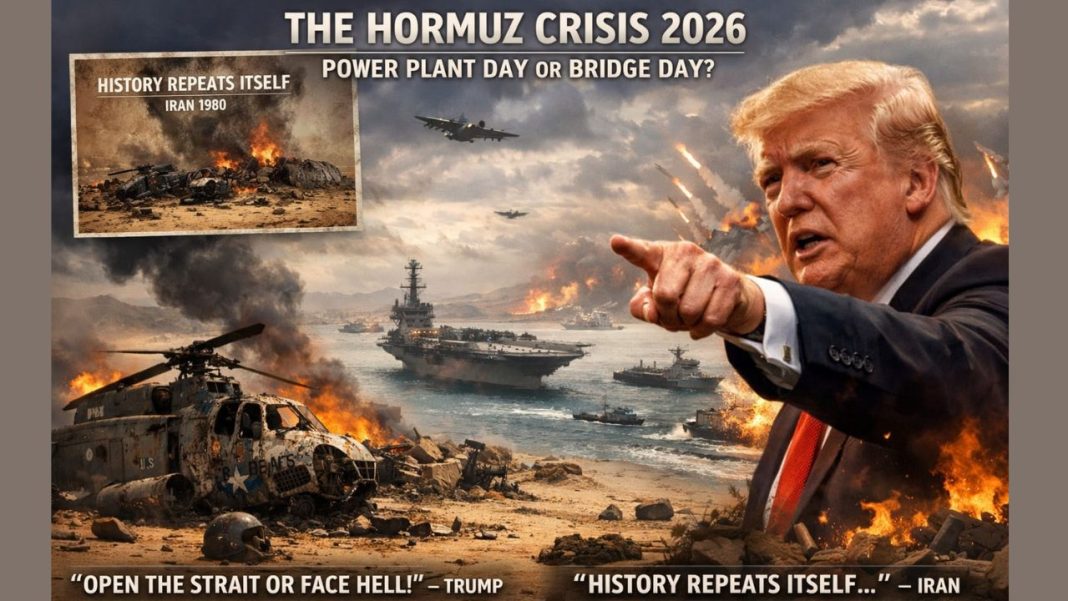

Operation Eagle Claw 2.0: The “Hormuz Crisis” of 2026: Trump’s Ultimatum and Iran’s Ghost of 1980
Imagine a world on the brink of total war where diplomatic cables have been replaced by social media insults.
Today, the Strait of Hormuz is the world’s most dangerous bottleneck, and as President Donald Trump threatens a “Hell” of destruction by Tuesday, Iran has responded not with missiles (yet), but with a haunting video from 1980 reminding the U.S. of its greatest military embarrassment: “Operation Eagle Claw”.
The 2026 Ultimatum: “Power Plant Day and Bridge Day”
The current tension reached a boiling point on April 6, 2026. President Donald Trump, utilizing his platform on Truth Social, issued a final warning to the Iranian leadership.
The core of the dispute lies in the Strait of Hormuz, a vital maritime artery through which nearly 20% of the world’s oil passes.
Trump’s post was blunt and aggressive. He demanded that Iran reopen the Strait by Tuesday, April 7, 2026.
If the deadline is missed, Trump threatened to launch massive airstrikes targeting Iran’s civilian and military infrastructure. In a controversial stylistic choice, he mockingly referred to the potential destruction as “Power Plant Day” and “Bridge Day,” suggesting that Iranian infrastructure would be leveled simultaneously.
“Open the Strait of Hormuz, or you will find yourselves in Hell—just watch!” Trump posted, sparking immediate global panic and a surge in oil prices.
Iran’s Psychological Warfare: “History Repeats Itself”
Rather than responding with standard diplomatic jargon, Iran’s Ministry of Foreign Affairs and its global embassies (including the embassy in India) took to social media to strike a nerve.
They shared a high-definition, archival video of the charred remains of American aircraft in the Iranian desert.
The caption was simple but chilling: “History repeats itself.”
By invoking Operation Eagle Claw, Iran is reminding the world that even the most sophisticated military plans can crumble on Iranian soil.
This move is designed to demoralize the American public and remind military strategists of the “Desert One” disaster, suggesting that any new American intervention in 2026 would meet the same humiliating fate as the mission in 1980.
What was Operation Eagle Claw?
In November 1979, Iranian student revolutionaries stormed the U.S. Embassy in Tehran, taking 63 Americans hostage. They demanded the return of the deposed Shah, Mohammad Reza Pahlavi, who was in the U.S. for cancer treatment. While some hostages were released early on, 53 remained in captivity for months.
The Failed Mission (April 24, 1980)
After five months of failed diplomacy, President Jimmy Carter authorized a high-stakes rescue mission. The plan was incredibly complex, involving all four branches of the U.S. military.
The Plan: Eight RH-53D Sea Stallion helicopters from the USS Nimitz were to meet six C-130 transport planes at a remote salt flat in the Iranian desert, code-named “Desert One.”
The “Habub” Factor: As the aircraft entered Iranian airspace, they were engulfed by a Habub a massive, unexpected sandstorm. The dust blinded pilots and caused mechanical failures.
The Tragedy: Only six helicopters reached the rendezvous point (the minimum required for the mission). However, one helicopter suffered a hydraulic failure. When the decision was made to abort, a helicopter collided with a C-130 during refueling in the dark, dusty chaos.
The Toll: The collision resulted in a massive explosion, killing 8 U.S. servicemen. The survivors were forced to retreat, leaving behind the bodies of their comrades and several intact aircraft, which the Iranian military later displayed as trophies.
The Social Media Battlefield: Diplomacy in 2026
The war of words has extended beyond the President and the Embassies. Iranian Vice President Mohammad Reza Aref recently criticized the U.S. administration, claiming that while Trump threatens foreign nations with “Stone Age” destruction, the U.S. is failing to provide basic facilities for its own citizens.
Meanwhile, the Iranian Embassy in Thailand added fuel to the fire, stating that Trump’s “childish insults” are a sign that the American leadership is losing its grip on reality.
What’s at Stake?
While rumors of a 45-day ceasefire negotiation have surfaced, the rhetoric on the ground tells a different story. If the Strait of Hormuz remains closed:
Global Economy: Oil prices could triple, causing a worldwide recession.
Military Escalation: If Trump follows through on his “Tuesday” threat, it could trigger a full-scale regional war involving Israel and other Middle Eastern allies.
The 1980 Shadow: The U.S. military of 2026 is far more advanced than that of 1980, but Iran’s geography vast deserts and rugged mountains remains a formidable “natural defense” that technology hasn’t fully conquered.
As we approach the April 7 deadline, the world watches with bated breath. Iran’s use of the “Operation Eagle Claw” footage is a calculated move to remind the U.S. that military superiority does not always guarantee victory.
For now, the “History Repeats Itself” slogan serves as a grim warning: in the desert of Iran, the line between a “surgical strike” and a “national disaster” is razor-thin.
By: Snigdha