
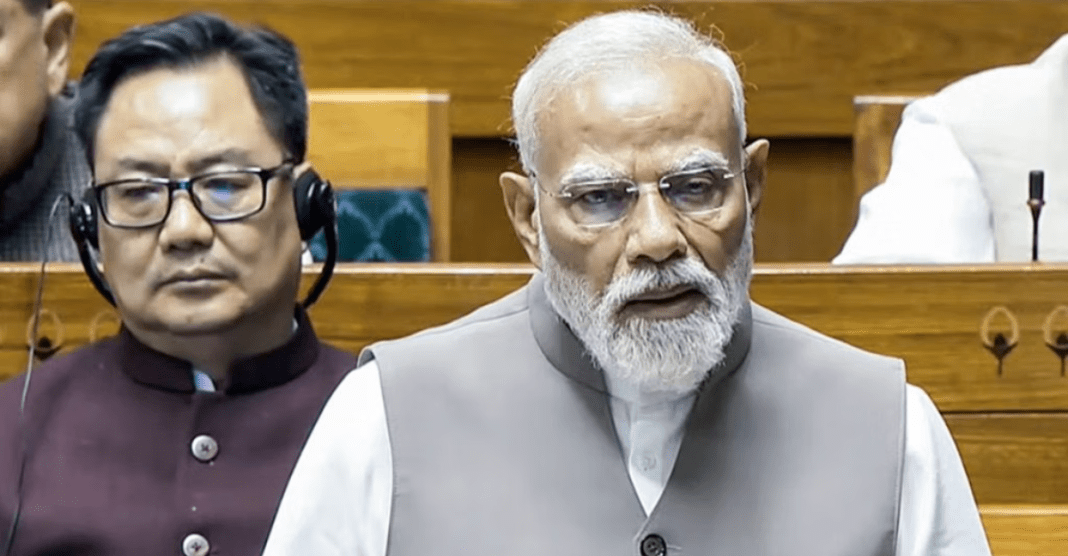

PM Modi in Lok Sabha: In a session charged with the gravity of a shifting global order, Prime Minister Narendra Modi addressed the Lok Sabha on March 23, 2026, delivering what many are calling the most significant foreign policy statement of his current term.
Standing before a packed House, the Prime Minister termed the escalating conflict in West Asia triggered by the February 28 strikes as “deeply worrisome,” warning that the crisis has now entered its fourth week with no signs of slowing down, and has moved beyond regional borders to pose “unprecedented challenges” to India’s economic stability and national security.
Let us understand What He Said, What He Meant, and Why Every Indian Should Pay Attention
“The Situation is Worrisome” What That Really Means
PM Modi in Lok Sabha: PM Modi did not beat around the bush. He called the West Asia conflict “deeply worrisome” and said it is “no longer a small, local problem.”
The war has been going on for more than three weeks and is already hitting the global economy hard.
He told Parliament: “This conflict has been ongoing for more than three weeks, having a very adverse impact on the global economy and on people’s lives.”
He then said something important he asked all MPs, from every party, to speak in one united voice.
He compared this moment to the COVID-19 pandemic. Just like India came together during Corona, he said, India must come together now.
His message was clear: “We must face every challenge with patience, restraint, and a calm mind.”
PM Modi in Lok Sabha: In simple words the Prime Minister is saying this crisis is big, it will last long, and India needs to stay calm and united rather than panic.
From 27 Countries to 41 India’s Smart Energy Plan
One of the most important things PM Modi revealed was about where India buys its oil and gas from.
Earlier, India imported crude oil, LNG, and LPG from only 27 countries. Today, that number has gone up to 41 countries.
this matter because the West Asia war has made a key sea route the Strait of Hormuz extremely dangerous for ships.
Almost all oil from the Gulf travels through this narrow water passage. If it is blocked or unsafe, oil tankers cannot pass.
But India now buys from 41 different countries instead of just 27, it can find other routes and other suppliers. No single country or route can hold India hostage.
The PM made it clear the government is working hard to ensure that the supply of petrol, diesel, and cooking gas is not severely affected, even as sea movement becomes “highly challenging.”
India’s Oil Emergency Reserve
PM Modi then spoke about something most ordinary citizens are unaware of India’s Strategic Petroleum Reserve, or SPR.
Think of it as a giant emergency oil locker. The government stores millions of tonnes of crude oil underground so that if supply from outside suddenly stops, India can use this stored oil and keep running.
PM Modi revealed that India currently has a strategic petroleum reserve of more than 53 lakh metric tonnes of crude oil. And work is already underway to increase this to 65 lakh metric tonnes.
He also pointed out that India’s refinery capacity has grown massively in the last 11 years.
This means India can now process crude oil arriving from many different countries and in different qualities making it even more flexible in a crisis.
The Ethanol Revolution: A 4.5 Crore Barrel Shield
The PM credited the “unprecedented work” in green energy for cushioning the impact of rising global oil prices.
“A decade ago, the country had a capacity of only one percent ethanol blending. Today, we are close to achieving 20 percent ethanol blending in petrol.”
This shift has had a massive fiscal impact: “Due to this, in the last year, we have had to import about 4.5 crore barrels less oil.”
By integrating the domestic agricultural sector into the fuel supply, the government has created a localized cushion that mitigates the current “War Premium.”
Will Farmers Suffer? What About Fertilizers and Food?
The war has disrupted fertilizer imports by as much as 40%. This is a serious concern for India’s massive farming population.
PM Modi addressed this directly. He assured farmers and the nation that the government has already identified alternate sources of fertilizer supply.
The Cabinet Committee on Security (CCS) the country’s highest security decision-making body has reviewed the situation and made adequate arrangements so that the upcoming Kharif sowing season is not disrupted.
On food security, the PM was confident: “The farmers of our country have filled our grain reserves… India has adequate food stocks.”
He also confirmed that coal stocks at power plants are sufficient to handle the rising electricity demand of summer.
So power cuts due to coal shortage are not expected.
One Crore Indians in the Gulf Their Safety Comes First
For many Indian families, the West Asia conflict is not just an economic issue it is deeply personal.
Nearly 1 crore (10 million) Indians live and work in Gulf countries like UAE, Saudi Arabia, Kuwait, Qatar, and Oman.
They send money home, support their families, and are the backbone of many households.
PM Modi said the safety of every Indian abroad is the government’s biggest priority.
He revealed that since February 28, over 3,75,000 Indians have been safely brought back home.
This includes 1,000 Indians from Iran, out of whom 700 are medical students who were pursuing their MBBS degrees there.
To protect students still abroad, the CBSE has cancelled board exams in Gulf-based schools.
This is so students do not have to risk their safety just to appear for an exam.
PM Modi also confirmed he has personally spoken twice with heads of government in the region, all of whom have given assurances that Indians living in their countries are safe.
Stern Warning to Black Marketers and Rumour Spreaders
In the final part of his speech, PM Modi’s tone became sharp and firm.
He warned that in times of crisis, two kinds of dangerous people become active those who spread misinformation and those who hoard essential goods to sell them at higher prices.
He had a direct message for both: “Beware of those who spread misinformation. I appeal to all state governments black marketers and hoarders must be dealt with strictly.”
He called for prompt action against anyone found hoarding petrol, gas cylinders, food, or fertilizers.
In simple words if anyone tries to profit from this crisis by creating false shortages, the government will come down hard on them.
The Big Picture What This Speech Really Tells Us
PM Modi’s Lok Sabha address today was historic for one reason it was not vague political talk.
It was a detailed, honest briefing to Parliament and to the nation. He acknowledged the danger.
He explained India’s preparations. He gave real numbers 41 countries, 53 lakh metric tonnes, 4.5 crore barrels, 3,75,000 Indians evacuated. And he ended with a message of hope:
“India’s economic fundamentals are strong. Dialogue and diplomacy are the only solutions. This war is not in the interest of humanity.”