


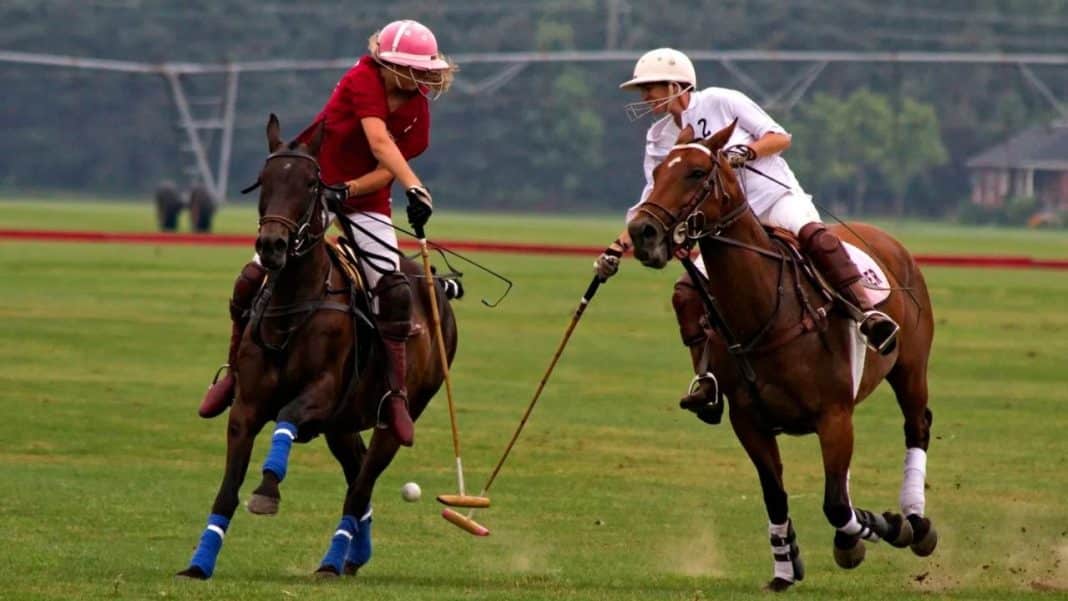

Polo is considered the world’s oldest and most prestigious team sport among games played on horseback.
This sport not only demands exceptional horsemanship but also requires strategy, balance, and discipline.
The origin of polo dates back to around the 6th century BCE in Iran, where it was known as Chaugan.
Played nearly 2,000 years ago in Persian civilization, this equestrian sport gradually reached the Western world and later developed further in India.
Because it was played by kings, rulers, and the noble class, polo is still referred to as “The Sport of Kings.”
What Is Polo?
Polo is an equestrian sport in which players ride horses and use a stick (mallet) and a ball to play.
Even today, the sport is largely driven by major sponsorships, and large numbers of spectators attend matches.
These spectators include equestrian sports enthusiasts as well as members of high society.
History and Early Development
Polo and its various forms existed as equestrian games from the 6th century BCE to the 1st century CE, primarily in Persia.
At that time, polo was not merely a form of entertainment but was also considered a means of military training and physical conditioning.
Over time, polo spread to many parts of the world and is now recognized globally.
Currently, around 100 countries are affiliated with the Federation of International Polo (FIP). Out of these, polo is played professionally in 16 countries.
Additionally, polo was part of the Olympic Games from 1900 to 1936.
Difficulty and Risks of the Game
Since polo is played at high speed on horseback, mastery of horse riding is absolutely essential.
There is always a risk of falling from the horse and sustaining injuries during the game. For this reason, polo players are required to be physically fit, strong, and highly active.
Origin of Polo
Polo was originally invented by the Iranians. An ancient and regional form of this game, known as Buzkashi or Kokpar, is still played in parts of Central Asia today.
In ancient Iran, Chaugan (polo) was played on a large scale as a national sport. Both men and women participated in the game.
It was also known as the “Persian Ball Game” and was played for entertainment in the royal courts of the Sassanian Empire.
India and British Influence
In India, Manipur is considered the most important center of polo. Here, it is known by the Tibetan name “Pulu” or “Polo.”
With the use of a wooden ball, the name gradually became popular and was widely adopted.
In 1859, a European polo club was established in Silchar, Assam, where the British learned the game from local Manipuri players. From here, the modern form of polo emerged before the world.
After this, polo spread from Manipuri traditions to other parts of India and eventually across the globe.
One of the most notable features of Manipuri polo was that it was fast-paced, thrilling, and entirely based on riding skills.
Unique Features of Manipuri Polo
In Manipur, polo was played—and is still played—with seven players on each side.
The horses used are relatively small in size, with a height of less than 13 hands (52 inches or 132 cm).
In this version, there are no goalposts. A player scores by hitting the ball out of either end of the field.
The ball is struck not with the tip of the mallet but with its longer side.
Players are not allowed to carry the ball, but stopping the ball with any part of the body except the open hand is permitted.
The sticks are usually made of cane, and the balls are crafted from bamboo roots. For safety, players used leather shields on saddles and straps to protect their legs from injury during the game.
Royal Polo Grounds and Tradition
Inside the Kangla Fort of Manipur’s kings, there was a royal polo ground where the king and courtiers played. It was called Manang Kangjei Bung, meaning “the inner polo ground.”
Separate polo grounds were built outside the fort for the general public, where regular public matches were held.
This clearly shows that polo in Manipur was not just a royal sport but was deeply connected to the common people as well.
The World’s Oldest Polo Ground
The Imphal Polo Ground in Manipur is considered the world’s oldest polo ground. It is mentioned in the royal chronicle Cheitharol Kumbaba as early as 33 CE.
In the 1850s, British officer Joseph Ford Sherer, regarded as the father of modern polo, played polo here.
Later, in 1901, the Viceroy of India, Lord Curzon, had the ground officially measured.
International Expansion of Polo
During the 19th century, several polo teams from Indian princely states gained international recognition.
During this period, India emerged as a strong force in the world of polo.
Gradually, the sport spread to Europe, America, and other countries. Today, polo is played in nearly 100 countries, and in many of them, it is recognized as a professional sport.
Polo in the Modern Era
Over time, polo has evolved. Match durations were shortened, fields were reduced in size, and greater emphasis was placed on spectator convenience.
With this vision, the World Champions Polo League was launched in Jaipur in 2016, inspired by cricket’s T20 format.
The aim of this new format was to make polo more spectator-friendly and exciting.
Rules of Polo
The rules of polo are designed to ensure the safety of both players and horses.
Matches are supervised by umpires, and penalties are awarded for rule violations.
The most important rule in polo is the “Line of the Ball,” which relates to the direction of the ball.
The player who hits the ball generally has the right of way, and other players are not allowed to cross this line dangerously.
In defense, players attempt to gain control of the ball using techniques such as ride-offs and hooking, but these must be performed safely. Unsafe play is considered a foul.
Polo is not just a sport—it is a unique blend of history, tradition, and equestrian skill.
From Iran to Manipur and then to the rest of the world, this game has preserved its royal identity and thrilling nature even today.
WRITTEN BY- NISHCHAY MALHOTRA