


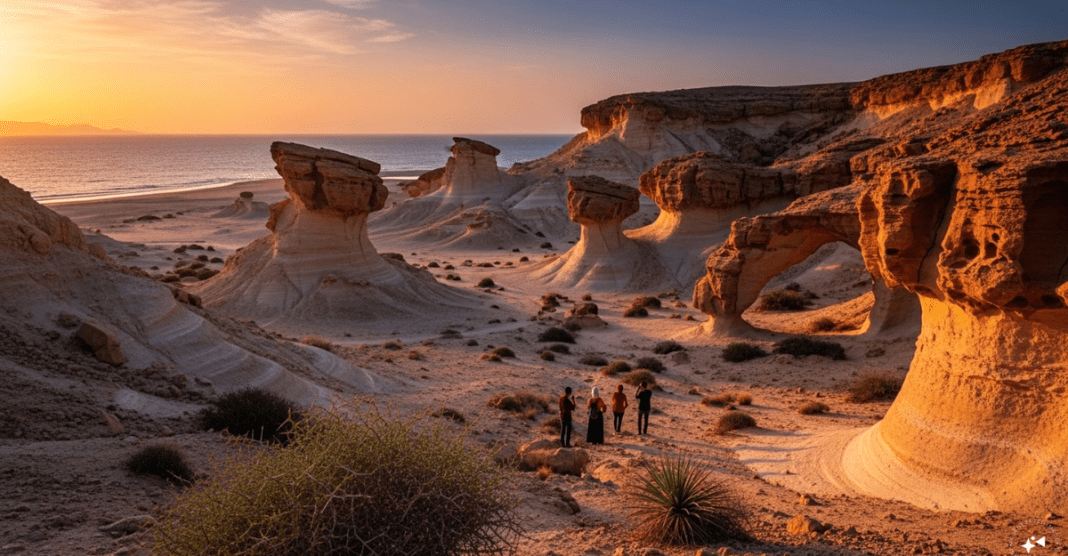

Qeshm Island: While the world watches the skies for fighter jets, the real war is being prepared hundreds of feet beneath the salt crust of Qeshm Island.
Home to Iran’s sophisticated ‘Missile Cities,’ Qeshm has evolved into an unsinkable aircraft carrier that even the most advanced US ‘Bunker Busters’ struggle to dent.
With the recent high-stakes strike on a desalination plant and the enforcement of a selective ‘Green Light’ shipping system, Qeshm is no longer just an island it is the frontline of a new era of asymmetric naval warfare.
The Incident That Put Qeshm in the Headlines
Qeshm Island: On March 7, 2026, a U.S. airstrike targeted an Iranian desalination facility, reportedly cutting water supply to approximately 30 villages by more than 70%.
The IRGC responded swiftly with a retaliatory action near Bahrain, dramatically raising the temperature across the Gulf.
The exchange immediately focused international attention on Qeshm Island Iran’s primary staging ground for maritime operations in the region.
As both sides calibrated their next moves, the island stood at the center of a dangerous escalation calculus, forcing the world to ask a question it had long deferred: what exactly is Qeshm, and why does it matter so much?
What Is Qeshm Island?
Qeshm is the largest island in the Middle East, stretching 135 kilometers in length off Iran’s southern coastline in the Hormozgan Province.
For decades it was known for fishing villages, mangrove forests, and salt caves. In 1990, Iran designated it a free trade zone.
But beneath that civilian surface, the Islamic Revolutionary Guard Corps (IRGC) has spent two decades quietly converting Qeshm into one of the most heavily fortified military installations in the region a transformation Western intelligence agencies now describe as Iran’s most consequential strategic asset in the Gulf.
Why Its Location Is Everything
Qeshm sits at the eastern mouth of the Strait of Hormuz the world’s single most critical maritime chokepoint.
At its narrowest, the strait is just 33 kilometers wide, yet through it flows nearly 20 percent of the world’s entire oil supply every day: roughly 17 to 21 million barrels.
Saudi Arabia, the UAE, Kuwait, Iraq, Iran, and Qatar all export through this passage.
There is no viable alternative route to absorb a full closure.
Qeshm does not merely sit near this chokepoint, it sits inside it. Weapons systems based on the island can reach vessels in transit without warning.
Iran does not need to send a fleet into open water.
Qeshm Island: It already occupies the high ground, making Qeshm more consequential for global energy stability than the Suez Canal, the Malacca Strait, or the Panama Canal combined.
How Iran Controls the Strait From Qeshm
Control is not exercised through a single dramatic act it is layered. Iranian radar and surveillance systems on Qeshm and surrounding islands track every vessel entering the strait in real time.
Friendly ships pass freely. Adversary vessels U.S. Navy ships, Israeli-linked tankers, or cargo bound for sanctioned destinations face surveillance, harassment, or interdiction.
Between 2019 and 2023, Iran seized or detained over a dozen commercial vessels using exactly this infrastructure.
Complementing surveillance is a swarm strategy: fast-attack boats armed with missiles, rockets, and torpedoes, capable of launching coordinated attacks from multiple angles simultaneously.
A simultaneous strike from 20 to 40 such vessels overwhelms even advanced point-defense systems.
Add to this one of the world’s largest naval mine stockpiles deployable within hours and Iran can impose crippling economic costs on global shipping without firing a single ballistic missile.
The “Missile City” Beneath the Island
The most extraordinary aspect of Qeshm is what lies underground.
Beginning in the early 2000s and accelerating after 2010, the IRGC excavated deep into the island’s hard sedimentary rock and salt formations terrain naturally resistant to airstrikes and bunker-busting munitions.
What emerged is a subterranean network of tunnels, launch facilities, storage depots, and command centers believed to extend for dozens of kilometers beneath the surface.
The IRGC itself has publicly used the term “missile cities” to describe these complexes, and Qeshm is considered the most significant.
The arsenal housed below is believed to include anti-ship cruise missiles such as the Noor, Qader, and Ghadr-380 capable of striking targets over 1,000 kilometers away alongside the upgraded HY-2 “Silkworm” for close-range tanker strikes.
Ballistic systems including the Qiam-1, the maneuvering Khaybar Shekan, and the Emad and Ghadr series provide regional deterrence, with ranges covering U.S. bases in the UAE, Qatar, and Bahrain.
Many of these have been upgraded with precision GPS guidance, capable of striking specific targets within meters.
The strategic logic is deliberate: above-ground installations can be destroyed in days by sustained airstrikes, as U.S. campaigns in 1991, 2003, and 2011 demonstrated.
Underground complexes require bunker-busting munitions in quantities even the U.S. possesses only in limited supply, combined with precise tunnel location intelligence and sustained airspace access none of which can be guaranteed. Iran has built a capability that survives the first strike and retaliates from beneath the earth.
Global Economic Consequences
A serious disruption to Hormuz traffic would cascade rapidly through the global economy.
Economists estimate even a two-week partial closure could push Brent crude past $130–$150 per barrel, with a full closure potentially driving prices toward $200.
China, Japan, South Korea, and India which receive the overwhelming majority of their Gulf oil through this strait would face acute supply shocks.
Transport costs, consumer prices, and supply chains worldwide would fracture in turn.
Critically, Iran need not act to wield this leverage.
The credible threat alone backed by the visible reality of Qeshm’s capabilities is sufficient to move insurance markets, reroute shipping, and shape the diplomatic calculations of every major power with an economic stake in stable energy supply.
Qeshm Island is a force multiplier built into the earth itself. Its geography gives Iran a veto over a fifth of the world’s oil supply.
Its underground missile city gives that veto teeth that survive an airstrike.
And its layered maritime control systems mean Iran can project global economic consequences without deploying a conventional force.
That is the reality of Qeshm in 2026 and it is a reality that no power in the world has yet found a reliable way to change.
BY: Namita Deora