


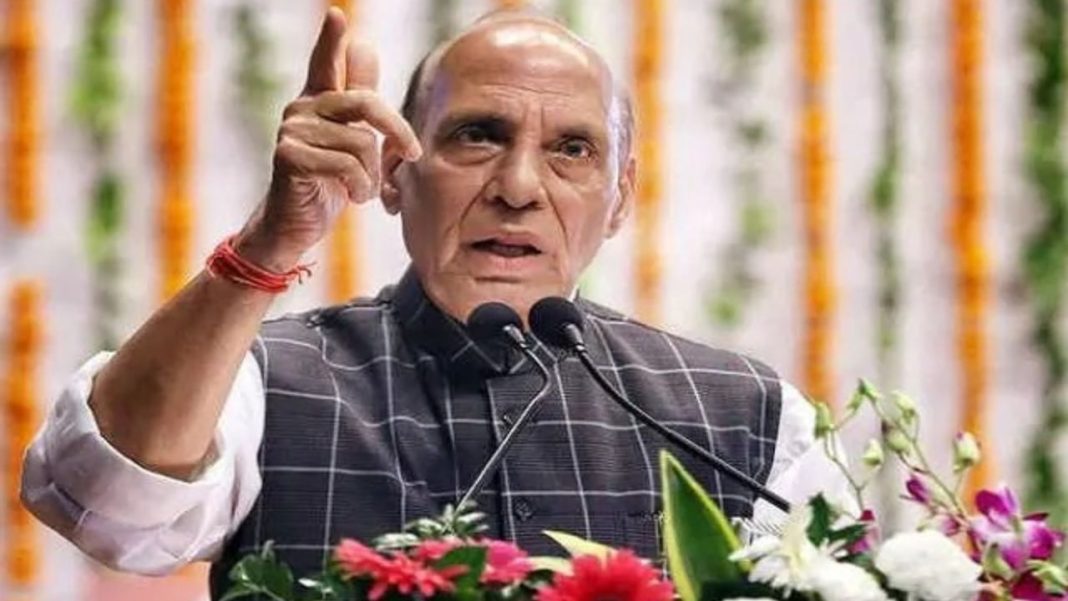

Rajnath Singh Puts Pakistan on Notice: The year 2026 has brought a major crisis to the Middle East. In February, the United States and Israel launched military strikes on Iran. Since then, the region has been burning.
Oil prices have jumped, important trade routes have been blocked, and governments around the world are worried about what comes next.
India is directly affected. The country depends heavily on the Middle East for its oil. But there is a second, equally serious concern that India’s leaders are watching very carefully the behaviour of Pakistan, its neighbour to the west.
In this moment of global chaos, India’s Defence Minister Rajnath Singh stood up and gave one of the most important speeches of recent times.
He spoke at an event called Veer Sainik Samman in Kerala an occasion to honour soldiers. But his words carried a much bigger message, aimed at Pakistan, at the world, and at the Indian public.
What Rajnath Singh Said
Singh’s speech was not a routine defence briefing. It was a carefully prepared warning, delivered at a time when India believes Pakistan might be tempted to cause trouble.
The most important thing he said was this: Operation Sindoor is not over. Operation Sindoor was the large military campaign India launched in May 2025, after a horrific terror attack in Pahalgam, Kashmir, killed dozens of innocent tourists.
India responded with force the Army, Air Force, and Navy all worked together to strike terror camps and military targets inside Pakistan.
Singh revealed a stunning detail during his speech. At the height of Operation Sindoor, Indian forces destroyed nearly 20% of Pakistan’s air force infrastructure in just 22 minutes.
He used this fact not to boast, but to remind Pakistan of exactly what India is capable of. He then made India’s current position crystal clear:
“Our mission to dismantle the ecosystem of terror is ongoing. We have the capability to escalate at a moment’s notice if provoked.”
This is not the language of a country that is done fighting. It is the language of a country that is keeping the door open and wants its enemy to know it.
The End of “Dossier Diplomacy”
Singh also took a direct shot at how India used to handle terror attacks in the past.
For years, after every major attack linked to Pakistan-based groups, India would collect evidence, bundle it into thick files called “dossiers,” and send them to Pakistan requesting action, hoping for justice, and rarely getting either.
Singh made it clear that era is finished. Under the current government’s policy of Zero Tolerance, India does not send files anymore. India sends a military response.
“The military speaks louder than the Ministry of External Affairs,” he said a blunt message that diplomacy has taken a back seat to direct action when it comes to cross-border terrorism.
Why Pakistan Might Be Tempted Right Now
To understand Singh’s warning fully, you need to understand why this moment is particularly dangerous.
When the world’s most powerful country the United States is busy fighting a war somewhere else, smaller countries sometimes see it as a chance to act without consequences.
Right now, the US military is deeply involved in the West Asia conflict. Its attention is locked on the Persian Gulf and the Mediterranean.
Pakistan may be calculating that this is the perfect time to quietly increase pressure on India in Kashmir through militant groups, border provocations, or other means knowing that Washington is too distracted to notice or care.
Singh’s response to this thinking was direct and public: “Our neighbour may think that the world is looking elsewhere, but India’s eyes are wide open.” That single line was the heart of the entire speech.
Pakistan’s Two Big Problems
India is not just worried about Pakistani ambition. It is also watching Pakistan’s desperation which can be even more dangerous. Pakistan is currently drowning in two serious crises at the same time.
The first crisis is military. Pakistan is fighting a bloody and expensive war against the Afghan Taliban on its northwestern border, called Operation Ghazab lil Haq. This conflict has drained soldiers, money, and public morale. There is no easy end in sight.
The second crisis is economic. The West Asia war has sent fuel prices through the roof. Pakistan’s economy already fragile is collapsing under the pressure.
Ordinary people are suffering, and the government is struggling to maintain control.
When a government is failing at home, it sometimes tries to manufacture a crisis with an outside enemy to distract its own people.
Starting a conflict with India is one of the oldest tricks in Pakistan’s military playbook a way to tell citizens, “forget your problems at home, we have a bigger enemy to fight.”
India sees this coming. And Singh’s speech was designed to make Pakistan think twice before trying it.
Pakistan’s Unexpected Diplomatic Card
There is one more reason India is on high alert. In March 2026, Pakistan quietly stepped into an unexpected role it became a back-channel peace negotiator between the United States and Iran, alongside Türkiye and Egypt.
This gave Pakistan a sudden boost of diplomatic importance in Washington’s eyes.
India is genuinely concerned that Pakistan might try to use this new influence as a trade. The deal could go something like this: “We are helping you make peace with Iran so look the other way when it comes to Kashmir.”
Singh’s speech was also a warning to Pakistan’s international partners: India will not allow peace in one region to be purchased at the cost of instability in another. No diplomatic deal gives Pakistan a free hand on the Line of Control.
Shift From Reacting to Warning
For a long time, India’s approach to Pakistan-backed terrorism was called “strategic restraint.”
The idea was to stay calm, avoid escalation, and let diplomacy do the work. It sounded responsible. It rarely worked. Operation Sindoor changed everything.
India’s new approach is called proactive deterrence which simply means making it so clear that the cost of attacking India is unbearable, that the enemy never attempts it in the first place. Instead of waiting to be hit and then responding, India now warns openly, acts swiftly, and leaves the consequences on record for everyone to see.
The 22-minute destruction of Pakistani air force assets was not just a military achievement. It was a message filed in history of what India can do when pushed.
By saying Operation Sindoor is still active, Singh is essentially telling Pakistan: the permission to act has not been withdrawn. If you move, we are already ready.
What This All Means
Singh’s speech achieved three things at once.
To Pakistan, it was a reminder we did it in 22 minutes before, and we can do it again, faster.
To the world, it was a signal India is not a passive bystander to global chaos. It is actively protecting its own interests and will use force if necessary.
To the Indian public, it was reassurance the country is alert, the borders are watched, and the government is not caught off guard.
The old India sent letters. The new India sends warnings it is prepared to back up. As Rajnath Singh put it plainly: if anyone mistakes this moment of global distraction for an opportunity against India, what follows will be “unprecedented and decisive.”
The world may be looking at West Asia. India is looking at its borders. And it is not blinking.
By- Namita Deora