


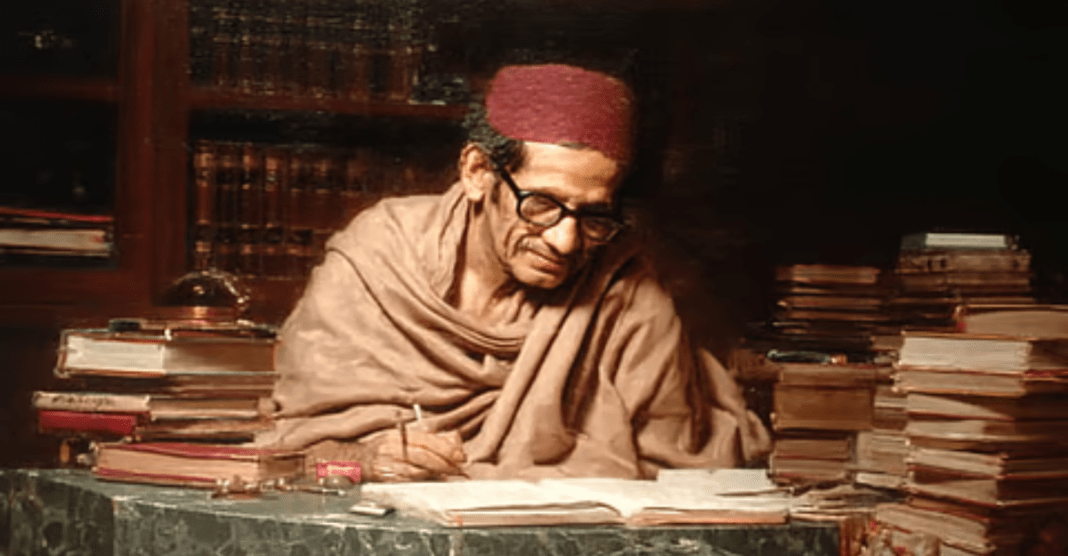

Sita Ram Goel Biography: A person completely abandon a lifelong belief and turn 180 degrees to become the greatest warrior for their culture?
Is it possible for an author to speak the absolute truth at a time when the entire country was swept away by a completely different wave?
Imagine an intellectual who spent years searching for answers in the books of Marx and Lenin.
But the moment he realized the hidden reality, he dedicated his entire life and his pen to protecting his roots, his religion, and his nation.
Even today, his writings create a storm in the world of historians and thinkers.
When he arrived in Delhi in 1957, he worked closely with leaders like Jayaprakash Narayan.
In his youth, he was a firm follower of Marxism, but as he studied deeper, he became its toughest critic. He realized that Marxist influence wasn’t just limited to politics , it was actually changing the way Indian history was being written.
To give a platform to his bold ideas, he founded the publishing house ‘Voice of India’ (Bharat-Bharati).
Sita Ram Goel Biography: Between 1951 and 1998, he wrote over thirty books and hundreds of articles. His arguments were so powerful that the famous Belgian scholar Koenraad Elst once remarked , “People rarely challenged Sita Ram Goel’s arguments; instead, they usually met them with a deep, uncomfortable silence.”
A symbol of a fearless journey, intellectual struggle, and absolute clarity of thought….
Yes, we are talking about Sita Ram Goel.
Personal Overview
| Field | Details |
|---|---|
| Full Name | Sita Ram Goel |
| Birth | 16 October 1921 |
| Birthplace | Punjab, British India |
| Death | 3 December 2003 |
| Nationality | Indian |
| Profession | Writer, Historian, Publisher, Political Thinker |
| Education | Master’s degree in History, University of Delhi |
| Early Ideology | Influenced by Marxism |
| Later Ideology | Associated with Hindu nationalist thought |
| Major Focus Areas | Indian history, Communism, Islam in India, Christian missionary activity, Secularism debate |
| Books Written | 30+ books and hundreds of articles (1951–1998) |
| Publishing House | Co-founded Voice of India (Bharat Bharati in Hindi) |
| Known For | Critique of Marxism and alternative interpretation of Indian history |
Early Life and Background
Sita Ram Goel’s early life is a fascinating story of a boy from a humble village who grew up to challenge the biggest intellectuals of his time.
- Humble Beginnings
Sita Ram Goel was born on 16 October 1921 in a small village in the Rohtak district of Haryana. He came from a modest family. Interestingly, his family environment was deeply rooted in traditional Hindu values, which would later play a massive role in his “homecoming” to his roots.
- A Brilliant Student
Sita Ram Goel Biography: He was a bright student from the very beginning. For his higher studies, he moved to Delhi and joined the prestigious St. Stephen’s College.
He earned his B.A. (Honours) in History.
Later, he completed his M.A. in History from Delhi University.
His deep dive into history during these years gave him the tools to later analyze and critique how Indian history was being taught.
- The Attraction to Marxism
Like many young students in the 1940s, Goel was deeply influenced by the global wave of Marxism and Communism.
He saw it as a “scientific” way to solve the world’s problems.
He spent a lot of time reading the works of Karl Marx and Lenin.
At one point, he was so involved that he was considered a rising intellectual star in Communist circles.
- The Turning Point
After moving to Calcutta (now Kolkata) for work, he began to see the practical side of Communist politics. He started noticing a gap between the “high ideals” written in books and the “harsh reality” of how the movement functioned.
He began to feel that these Western ideologies were alien to the soul of India.
He realized that the Marxist approach often looked down upon Indian culture and traditions.
- Working with Great Minds
Before he became a full-time writer, he gained experience in different fields:
He worked in various business firms in Calcutta.
In 1957, he moved back to Delhi and worked briefly with the famous socialist leader Jayaprakash Narayan.
Educational Journey
The academic background of Sita Ram Goel played a massive role in shaping him into one of India’s most feared and respected historians. His journey from a small village to the top colleges of Delhi is a story of brilliance and deep study.
- Schooling and Early Roots
Sita Ram Goel was born in 1921 in the Rohtak district of Haryana. He completed his primary education in his village, where he was raised in a traditional Hindu family. This early exposure to Indian values remained a core part of his identity throughout his life.
- Graduation from St. Stephen’s College
For his higher education, Goel moved to Delhi. He joined the world-famous St. Stephen’s College, known for producing India’s top intellectuals.
Degree: B.A. (Honours) in History.
Impact: It was here that he mastered the art of historical research and critical thinking.
- Master’s Degree (M.A. in History)
He continued his academic excellence at Delhi University, where he earned his Master’s degree in History.
During his university days, he was a top-tier student.
His deep understanding of world history allowed him to compare Western ideologies with Indian traditions later in his career.
- Intellectual Influence: The Marxist Phase
While studying in the 1940s, like many brilliant students of that era, Goel was deeply attracted to Marxism.
He studied the works of Karl Marx and Lenin extensively.
This phase was crucial because it gave him an “insider’s view” of Communist ideology, which he would later critique with great detail in his books.
- Beyond Formal Education: A Lifelong Scholar
Sita Ram Goel’s education didn’t stop with a degree. He was a polyglot (someone who knows many languages) and a voracious reader. He spent decades studying:
Sanskrit and ancient Indian texts.
Islamic history and theology.
Western philosophy and political science.
Intellectual Development
The intellectual development of Sita Ram Goel is often described as a “spiritual and mental homecoming.” It wasn’t just a change of mind; it was a complete transformation from a Western-influenced radical to a defender of Indian heritage.
- The Marxist Phase (The Search for Equality)
In his early years, Goel was deeply attracted to Communism. Like many young intellectuals of the 1940s, he believed that:
Marxism was “scientific” and could solve poverty.
Religion was an “opium” that held society back.
The Soviet Union was a model for the future of the world.
During this time, he was a brilliant advocate for Communist ideas, writing and thinking within that framework.
- The Crisis of Faith (The Turning Point)
The shift didn’t happen overnight. It came through deep observation and a “crisis of conscience.”
The Gap in Reality: While working in Calcutta, he saw that Communist leaders often behaved differently from what they preached in books.
Political Disillusionment: He began to feel that the Communist movement in India was more loyal to foreign powers (like the USSR or China) than to India itself.
Reading the Critics: He started reading thinkers who criticized Communism, which opened his eyes to the “totalitarian” nature of the ideology.
- The Influence of Ram Swarup
The most important turning point in his intellectual life was his friendship with Ram Swarup, another great thinker.
Ram Swarup helped Goel see that the “answers” he was looking for in Western books were already present in ancient Indian philosophy.
Together, they began to analyze Indian history not through a British or Marxist lens, but through a Vedic perspective.
- Rediscovering the “Hindu Identity”
Goel’s development reached its peak when he embraced Sanatana Dharma. He realized that:
Indian civilization was unique and had survived for thousands of years because of its spiritual roots.
The history of India had been “distorted” by colonial and Marxist historians to make Indians feel inferior.
Intellectual Kshatriya: He decided to become a “warrior of the mind,” using facts and research to challenge these distortions.
Career and Professional Life
Sita Ram Goel’s career was not a typical 9-to-5 journey. It was a mix of business, social activism, and a lifelong mission to change how India views its own history.
- The Calcutta Years (Business and Observation)
After completing his studies in Delhi, Goel moved to Calcutta (Kolkata), which was the intellectual capital of India at the time.
Corporate Work: He worked for several private business firms.
The Witness: Living in Calcutta during the 1940s and 50s allowed him to see the rise of Communism firsthand. This experience was the “laboratory” where he studied political movements.
- Association with Jayaprakash Narayan (1950s)
In 1957, Goel returned to Delhi. For a period, he worked closely with the famous socialist leader Jayaprakash Narayan (JP).
He was part of the Society for the Protection of Cultural Freedom.
During this time, he helped research and write reports on political issues, gaining a reputation as a sharp and logical thinker.
- Founding ‘Voice of India’ (The Turning Point)
The most significant part of his career began when he decided to stop working for others and start his own mission. Along with his friend and mentor Ram Swarup, he founded the publishing house ‘Voice of India’ (known in Hindi as Bharat-Bharati).
The Mission: To publish books that challenged the “official” version of Indian history.
The Risk: He spent his own money and faced a lot of criticism from the government and famous historians, but he never stopped.
- A Fearless Historian and Writer
From 1951 to 1998, Goel’s “office” was his writing desk. He was incredibly productive:
Prolific Output: He wrote over 30 books and hundreds of articles in both Hindi and English.
Major Works: His books like “Heroic Hindu Resistance to Muslim Invaders” and “The Calcutta Quran Petition” became famous for their deep research and bold claims.
Intellectual Activism: He didn’t just write for money; he wrote to “wake up” the Indian public. He believed that true freedom only comes when a nation knows its true history.
- The “Silent” Legacy
Goel’s professional life was unique because, although he was a top-tier scholar, he was often ignored by mainstream media and universities because his views were “too bold.”
The Elst Remark: As the scholar Koenraad Elst noted, Goel’s career was defined by the fact that his opponents couldn’t prove him wrong, so they tried to ignore him instead.
Major Works
| Year | Book Title | Description |
|---|---|---|
| 1979 | Hindu Temples: What Happened to Them | Analysis of historical destruction of Hindu temples and cultural impact |
| 1982 | The Story of Islamic Imperialism in India | Historical account of Islamic rule in India and its consequences |
| 1982 | History of Hindu–Christian Encounters, AD 304–1996 | Examines missionary activity in India and its effects on Hindu society |
| 1988 | How I Became a Hindu | Personal journey and defense of Hindu faith and philosophy |
| 1989 | The Calcutta Quran Petition | Critique of controversial religious and legal petitions and defense of free speech |
| 1990 | Communism and Peasantry | Critical study of Marxism and communism in Indian context |
| 1991 | The Communist Party in India: Facts & Fallacies | Analysis of Indian Communist Party’s ideology and political influence |
| 1994 | Vindicated by Time: The Ninetieth Anniversary Volume of Voice of India | Collection of essays highlighting Hindu civilization and historical narratives |
| 1998 | Muslims in Indian History: A Forgotten Heritage | Revisits historical contributions of Muslims while critically examining Islamic invasions |
Historical Perspective and Ideology
Sita Ram Goel’s perspective was revolutionary because he looked at India through Indian eyes, rather than through the lenses of British colonists or Soviet Marxists.
- Rejection of the “Narrative of Defeat
Most history books during his time suggested that India was a weak nation that was easily conquered by every invader. Goel strongly disagreed.
His View: He argued that India put up a “Heroic Resistance” for over 800 years.
The Difference: While other countries fell to invaders in a few decades, India’s culture and religion survived because the people never stopped fighting.
- Intellectual Decolonization
Goel believed that even though the British had left India in 1947, the Indian Mind was still colonized.
The Problem: He felt that the Indian elite were “imitating” the West and felt ashamed of their own traditions.
The Solution: He wanted Indians to take pride in their heritage and study their past with honesty and courage.
- Critique of Marxism (Communism)
Having been a Marxist himself, he knew the ideology inside out.
The Conflict: He argued that Marxism was a foreign “materialist” ideology that didn’t understand the spiritual soul of India.
Historical Distortion: He accused Marxist historians of intentionally hiding facts about the destruction of temples and Indian culture to serve their political goals.
- Sanatana Dharma as the Foundation
For Goel, “Hinduism” was not just a religion, but the very foundation of Indian civilization.
Universality: He saw Sanatana Dharma as a scientific and spiritual tradition that belonged to all of humanity.
The “Intellectual Kshatriya”: He believed that thinkers must act like “Warriors” (Kshatriyas) to protect this knowledge using facts, logic, and research.
The Main Ideological Questions of Sitaram Goel
Historian and thinker Sitaram Goel was known for his boldness and clear ideas.
Through his famous book “Hindu Temples What Happened to Them” and other writings, he raised many tough questions about Indian history and politics.
Although he asked many questions over time, his most famous 10 questions (or main points) were often directed at historians and intellectuals who tried to hide the ‘darker sides’ of Indian history.
The Main Ideological Questions of Sitaram Goel
- Why the Silence on Temple Destruction?
He raised the question: Is it not true that thousands of Hindu temples were broken down to build mosques or other buildings there? He even provided a list of more than 2,000 such places.
- Why Tamper with History?
He asked why the cruelties committed by invaders are shown in a ‘softened’ way. Shouldn’t history be shown exactly as it was?
- What is the Definition of Secularism?
His question was: Why has the meaning of secularism in India become only ‘anti-Hindu’?
- Aryan Invasion Theory
He challenged whether there is any solid proof of the ‘Aryan Invasion’ or if it was just a lie spread by the British to divide Indians.
- The Nature of Islamic Invasions
He asked: Were the Islamic invasions only for looting, or was there a deep religious ideology behind them?
- The Role of Leftist Historians
He questioned why India’s educational institutions are dominated by a specific ideology (Leftism) that looks down upon Indian culture.
- Why was Hindu Resistance Underestimated?
He asked: Why is it taught in history books that India was always losing? Why was no place given to the bravery of the kings and warriors who struggled for centuries?
- The Crisis of Cultural Identity
His question was: Why does independent India feel ashamed to embrace its ancient identity?
- The Reality of Sufi Saints
He raised the question: Were all Sufi saints only preachers of love and peace, or did some of them also help the invaders?
- The Lie of Buddhist and Hindu Conflict
He questioned the claims which said that Hindu kings destroyed Buddhism. He asked: Where is the evidence behind this?
Debates and Controversies
Because Sita Ram Goel spoke about topics that most people were afraid to mention, his life was full of heated debates and intense controversies. He was often a “lonely voice” standing against the mainstream academic world.
- The “Silence” of Mainstream Scholars
The biggest controversy wasn’t a loud argument, but rather a “wall of silence.”
The Debate: Goel challenged famous historians from top universities (like JNU). He used their own sources to prove them wrong.
The Reaction: Instead of debating him with facts, many famous scholars chose to ignore him completely. They labeled him a “communalist” to avoid answering his difficult questions.
The Famous Quote: As scholar Koenraad Elst pointed out, “His critics couldn’t find mistakes in his facts, so they tried to kill his ideas with silence.”
- The Temple vs. Mosque Debate
Long before the Ayodhya issue became a national headline, Goel was researching the history of religious structures.
The Controversy: He published a list of nearly 2,000 sites where he claimed temples had been destroyed to build other structures.
The Clash: Many historians argued that temples were destroyed only for “political wealth.” Goel argued it was driven by religious ideology. This remains one of the most debated topics in Indian history today.
- The Calcutta Quran Petition
In the mid-1980s, Goel became involved in a very sensitive legal case.
The Incident: A petition was filed in court regarding certain verses in a religious text.
The Backlash: This led to massive protests and international news coverage. Goel didn’t file the petition, but he wrote a book documenting the whole event and analyzed the theology behind it.
The Result: The book was highly controversial and faced various attempts to be banned, as it touched upon the most sensitive parts of religious harmony in India.
- Critique of “Nehruism
Goel was a harsh critic of India’s first Prime Minister, Jawaharlal Nehru, and his followers.
The Argument: Goel believed that the “Nehruvian” style of government was trying to turn India into a copy of the West or the Soviet Union.
The Conflict: He argued that this policy was making Indians feel ashamed of their own Hindu identity. This put him directly at odds with the entire political and intellectual establishment of that time.
Legacy and Influence
Sita Ram Goel passed away in 2003, but his influence is much stronger today than it was during his lifetime. He is often called the “Intellectual Father” of the modern movement to reclaim Indian history.
- The Concept of the Intellectual Kshatriya
Goel’s biggest legacy is the idea that you don’t need a sword to protect your culture; you need a pen and facts.
He taught a new generation of Indians how to research, debate, and stand up for their heritage using logic instead of emotion.
He inspired many young writers to become “Warriors of the Mind.
- The “Voice of India” Impact
The publishing house he started, Voice of India, became a treasure chest for researchers.
Many famous scholars today (like Koenraad Elst, David Frawley, and Meenakshi Jain) were either published by him or deeply influenced by his fearless style of writing.
He made “banned” or “hidden” historical facts available to the common public.
- Decolonizing the Indian Mind
Goel was one of the first thinkers to argue that India’s education system was still teaching history from a British or Marxist perspective.
He started the conversation about “Decolonization” , the process of looking at India through its own ancient traditions and values rather than foreign theories.
- From “Outcast” to “Mainstream”
During his life, Goel was often ignored or pushed to the margins by the government and top universities.
The Shift: Today, the topics he wrote about , such as the destruction of temples, the reality of the Aryan Invasion Theory, and the bravery of Indian kings , are now being discussed in mainstream news, movies, and school textbooks.
Personal Traits and Philosophy
Sita Ram Goel was not just a writer; he was a man of intense discipline and deep principles. His personal life was a reflection of his philosophy , simple, honest, and fearless.
- Fearless Honesty (The Truth-Seeker)
The most defining trait of Sita Ram Goel was his courage to speak the truth, even if it meant being completely alone.
No Compromise: He never changed his facts to please the government or powerful people.
Plain Speaking: He believed that “sugar-coating” history was a disservice to the nation. If a historical event was dark, he wrote about it exactly as it was.
- Intellectual Discipline
Goel was a “worker” in the truest sense. He didn’t wait for inspiration; he treated research like a daily duty.
Master of Sources: He wouldn’t write a single line unless he had a primary document (like an old Persian record or an archaeological report) to prove it.
Hard Work: He spent decades in libraries and archives, often working in a simple, small office without any luxuries.
- The “Intellectual Kshatriya” Philosophy
Goel believed that every era requires a different kind of warrior. In ancient times, warriors fought with swords; in the modern world, he believed they must fight with knowledge.
Mental Defense: He felt that if a nation loses its “intellectual defense,” its culture will eventually die.
The Mission: His philosophy was that every Indian should be an “Intellectual Kshatriya” , someone who uses logic and history to protect their identity.
- Simplicity and Humility
Despite being a brilliant scholar who could have lived a wealthy life in the corporate world, he chose a very simple lifestyle.
Focus on Work: He lived a quiet life, focused entirely on his family, his friends (like Ram Swarup), and his books.
No Fame-Seeking: He never ran after awards or media attention. For him, the survival of his books and ideas was the only reward he needed.
- Spiritual Rooting (Sanatana Dharma)
His philosophy was deeply rooted in the Vedas and the Upanishads.
Universal Truth: He didn’t see Hinduism as a narrow “belief system” but as a vast, scientific tradition of seeking the truth.
Self-Realization: He believed that knowing one’s history is the first step toward knowing oneself.
Death and Remembrance
The final chapter of Sita Ram Goel’s life was as quiet as his intellectual work was loud. Even after his passing, he remains a “living force” in the world of Indian history.
- His Death (December 2003)
Sita Ram Goel passed away on December 3, 2003, in New Delhi. He was 82 years old.
A Quiet Departure: He died peacefully, leaving behind a massive library of research and a legacy of over 30 influential books.
End of an Era: His death marked the end of a legendary partnership with his friend Ram Swarup (who had passed away in 1998). Together, they had spent 50 years changing the way India thinks.
- How He is Remembered Today
During his life, the “mainstream” media and government ignored him. However, after his death, his popularity exploded.
The “Goel Wave”: Today, young historians and social media influencers frequently quote his books. He is seen as a “prophet” who predicted the cultural shifts happening in India today.
The Father of “New History”: He is remembered as the person who gave Indians the courage to question colonial and Marxist history.
- The Survival of ‘Voice of India’
The publishing house he founded continues to be his living memorial.
It still prints his books, which are now sold globally.
Many people consider these books “must-reads” for anyone who wants to understand the true history of Indian temples and ancient resistance.
- 4. A Tribute to the “Intellectual Kshatriya”
On his death anniversaries, scholars and thinkers across the world pay tribute to him. He is remembered not as a politician, but as a Satyaveer (a hero of truth).
Famous Tribute: “Sita Ram Goel did not just write history; he cleared the path for others to see the truth that had been buried under piles of lies for decades.”
Intresting Facts about Sitaram Goel
- The “Ex-Marxist” Insight
Sita Ram Goel didn’t just study Communism; he lived it. In his early years, he was a dedicated Marxist intellectual.
This gave him a “secret weapon”: he knew exactly how Marxist historians worked.
When he later turned against the ideology, he could dismantle their arguments from the inside out, making him their most dangerous critic.
- Mastering “Invader” Languages
To ensure his research was 100% accurate, Goel refused to rely on English translations of history.
He learned Persian and Arabic specifically to read the original diaries and court records of medieval invaders.
By doing this, he proved that many “peaceful” historical events were actually described as violent conquests in the original texts.
- The “Silent” Scholarly War
He is famous for causing a “conspiracy of silence.” Because his research was backed by such solid evidence, mainstream historians often found it impossible to prove him wrong.
Instead of debating him, they chose to ignore him entirely and kept his books out of universities to prevent students from reading his findings.
- A One-Man Publishing Revolution
When mainstream publishers were too scared to print his bold research, he didn’t give up. He founded his own publishing house, Voice of India, and funded it himself.
He acted as the author, editor, and distributor, proving that a single person with a pen could challenge the entire intellectual establishment of a country.
- The “Intellectual Kshatriya” Concept
Goel changed the definition of a “warrior.” He argued that in the modern world, India didn’t just need soldiers on the border; it needed “Intellectual Kshatriyas” , scholars who would use logic, facts, and historical research to defend the nation’s cultural identity from being erased or distorted.
BY: Aarushi Sharma