


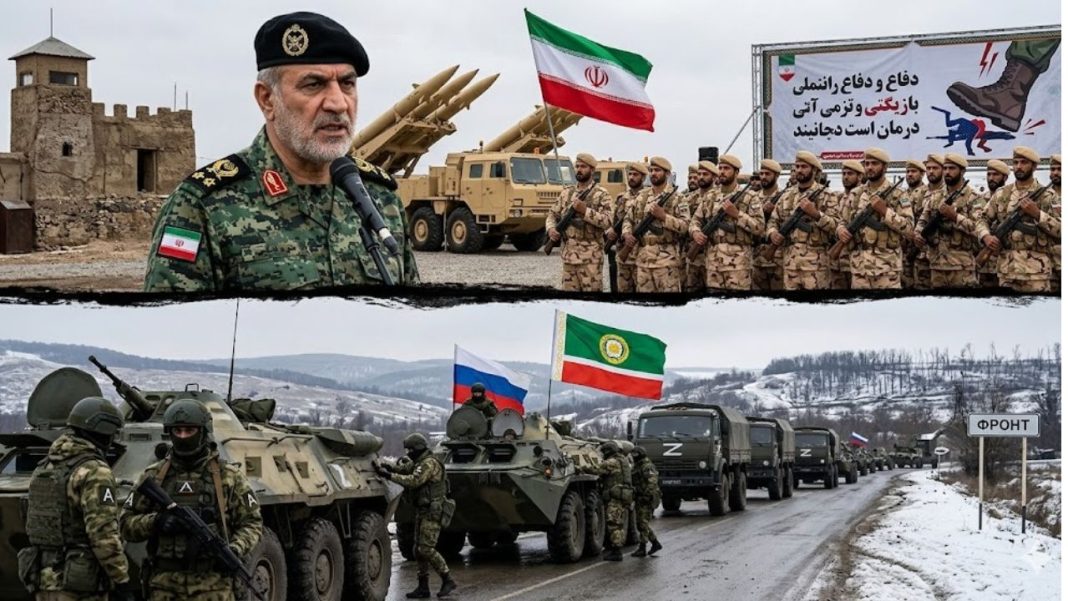

The Desert on Fire: “We will not just defend; we will cut off the legs of any aggressor who dares to set foot on our soil.”
This chilling warning, issued this morning by Ebrahim Zolfaghari, a spokesperson for Iran’s military command, wasn’t just rhetoric.
It was a signal that the month-long war between the United States, Israel, and Iran-backed forces has reached its most dangerous inflection point yet.
As the sun sets over a smoke-filled Middle East, the world is no longer just watching a regional skirmish; it is witnessing a high-stakes chess match where the board is made of oil and the pieces are millions of human lives.
From the high-pressure situation in the Oval Office to the elite Russian-backed units waiting in the Iranian shadows, here is the full, deep-dive story of the crisis that has defined the start of 2026.
- The Trump Ultimatum: A Six-Week Race Against Time :
In Washington, President Donald Trump is operating on a famously tight schedule. According to a bombshell report from The Wall Street Journal, citing high-level U.S. officials, the President has told his inner circle that he wants the military phase of this war over in four to six weeks.
Trump, known for his “deal-making” approach, is reportedly tired of “forever wars.” However, his strategy to end this one is a massive gamble that has left global economists trembling.
The “Hormuz Gamble”
The biggest surprise in the Trump strategy involves the Strait of Hormuz. This tiny strip of water is the throat of the global oil trade. Usually, the U.S. would fight for years to keep it open.
However, Trump has reportedly told aides he is prepared to end the war even if the Strait remains mostly closed.
His team has concluded that a “protracted maritime clearance mission”, which involves clearing thousands of Iranian mines and sunken ships, would drag the U.S. into a conflict lasting years.
Instead, Trump plans to batter Iran’s missile sites and navy, declare victory on his core goals, and leave the opening of the water to later diplomatic pressure.
The Infrastructure Threat
The President’s final warning to Tehran was blunt: if no deal is reached “shortly,” the U.S. will move to “obliterate” Iran’s civilian backbone. This includes:
Energy Infrastructure: Targeting oil refineries to collapse the regime’s primary source of income.
Civilian Power Grids: Leaving major cities like Tehran and Isfahan in total darkness.
Water Desalination Plants: A move that human rights groups warn could lead to a massive humanitarian catastrophe for millions of civilians.
- The Russian Shadow: Enter the Chechen Units
While the U.S. weighs the possibility of a ground invasion to force a surrender, Tehran has found a powerful, if unofficial, ally.
Reports from Iranian state media indicate that Russia’s elite Chechen units, highly trained, brutal urban fighters, are “ready and waiting” to deploy to Iran if American boots hit the ground.
The Kremlin sees this as a golden opportunity. By providing Iran with satellite imagery of U.S. warships and potentially deploying “volunteer” Chechen troops, Russia is turning this into a dangerous proxy war.
For the Chechen units, this is framed as a “religious defense,” making the battlefield even more volatile.
If American soldiers meet Russian-backed fighters on Iranian soil, we are no longer looking at a regional conflict, we are looking at the potential start of World War III.
- Southern Lebanon: Tragedy and the “Blue Helmets”
While the world watches the skies over Iran, a brutal ground war is being fought in the mud and hills of southern Lebanon. Israel’s military (the IDF) has pushed deep into territory held by Hezbollah, but the victory has come at a staggering cost.
The UN Peacekeeper Crisis
In a development that has sparked global outrage, Israel’s actions in southern Lebanon have killed three UN peacekeepers (the “Blue Helmets”). These international soldiers were meant to be a neutral buffer, but they have been caught in the crossfire of heavy artillery and drone strikes. The UN has called for an immediate investigation, but with the fighting intensifying, access to the sites remains blocked.
The Human Toll
The statistics of the month-long invasion are grim:
Civilian Casualties: Over 1,240 Lebanese civilians have died since the start of the month.
Israeli Losses: The war is not one-sided. In the last 48 hours alone, four Israeli soldiers were killed in a fierce ambush in a southern Lebanese village, proving that Hezbollah’s underground tunnel network remains a deadly threat.
- Why This Matters to You: The Economic “Toll”
Even if you live thousands of miles away from the Middle East, this war is sitting in your driveway and on your dinner table.
The Global Energy Shock
With the Strait of Hormuz blocked, oil cannot flow freely. This has sent gasoline prices in the U.S. and Europe soaring. In a sign of how desperate the situation has become, the Czech Republic recently announced plans to release 100,000 metric tons of oil from its emergency reserves just to keep its national transport system from collapsing.
Tehran in the Dark
Inside Iran, the civilian impact is devastating. Residents in Tehran are living under
Strict Security: Revolutionary Guard patrols are on every corner to prevent anti-war protests. Thousands have marched in the city of Karaj in support of the government, but the atmosphere remains tense.
Power Outages: Electricity is only available for a few hours a day.
Internet Blackouts: The government has cut off the web to prevent “foreign interference,” leaving millions of families unable to communicate with the outside world.
- The “Tanker War” 2.0: Terror off Dubai
The war at sea reached a new peak shortly after midnight. A Kuwaiti oil tanker was struck by a suicide drone near the coast of Dubai.
While all crew members miraculously survived, the attack sent a clear message: no ship in the Persian Gulf is safe. Shortly after the attack, NATO and regional air defenses were forced to intercept a flurry of missiles fired from Iran targeting Turkey and Saudi Arabia. The conflict is no longer contained; it is spilling over borders.
- The Diplomatic Deadlock: Who is Lying?
One of the most confusing aspects of this war is the “war of words” regarding negotiations.
The Trump Claim: The U.S. President claims he has had “very productive” talks with the Speaker of Iran’s Parliament.
The Iran Denial: Tehran has flatly denied that any negotiations are taking place, calling Trump’s claims “pure fiction” designed to weaken Iranian resolve.
Meanwhile, Gulf Allies (like Saudi Arabia and the UAE) are playing a complex game. Privately, some are urging the U.S. to maintain maximum military pressure, with a few even pushing for a full-scale ground invasion to remove the Iranian government once and for all.
The Verdict: A Cold Peace or a Hot War?
As we close out March 2026, the situation remains “fluid”, the diplomatic word for “unpredictable.”
Trump’s six-week deadline is ticking. If a deal isn’t reached, he may feel forced to follow through on his threat to “obliterate” Iran’s civilian infrastructure. If that happens, and Russia’s Chechen units enter the fray, the “fire in the desert” will become a global conflagration that no one, not even the President of the United States, can easily put out.
The next 14 days will be the most critical in modern history.
Key Data Summary (As of March 31, 2026)
Category Status / Impact
U.S. Strategy 4-6 week timeline; willing to leave Hormuz closed.
Iran’s Stance Denying talks; threatening to “cut off legs” of invaders.
Lebanon War 1,240+ civilians dead; 3 UN peacekeepers killed.
Russia’s Role Chechen units on standby for ground war.
Global Economy Oil prices spiking; Czech Republic releasing reserves.
Military Action NATO intercepting missiles over Turkey and Saudi Arabia.
Written By – Arushi Sharma