


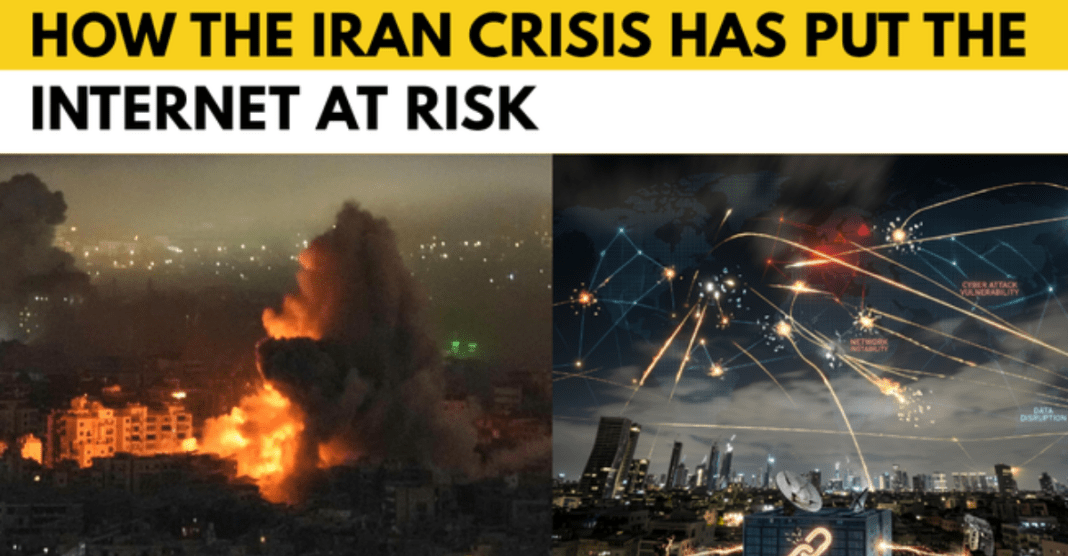

The Great Digital Chokepoint: Imagine a world where your UPI payment fails, your Netflix buffer never ends, and global stock markets freeze in a split second.
This isn’t a sci-fi movie plot; it is a looming reality. As tensions boil over in the Middle East, the Red Sea and the Strait of Hormuz, the two most critical arteries of the global internet have become frontline war zones.
For the first time in history, the world’s “digital highways” are under direct threat of physical sabotage, putting billions of lives and trillions of dollars at risk.
What are Red Sea Internet Cables and What is at Stake?
The Great Digital Chokepoint: Underneath the waves of the Red Sea lies a dense bundle of fiber-optic glass strands, no thicker than a garden hose, known as Submarine Cables.
These cables carry 97% of all intercontinental data traffic.
The Red Sea is the ultimate global chokepoint.
Because of the geography of the Suez Canal, almost all data flowing between Europe and Asia must pass through this narrow, shallow corridor.
The Volume: Over 17 major cable systems transit the Red Sea
The Stake: Approximately 30% of the world’s total internet traffic depends on this single path.
If these are cut, the world doesn’t just lose social media; it loses the ability to conduct international banking, cloud computing, and military communications.
The Iran Factor: From Oil to Data Warfare
The Great Digital Chokepoint: Historically, Iran’s leverage was its ability to block oil through the Strait of Hormuz.
In 2026, that leverage has shifted to Data.
Iranian officials and state-aligned groups have explicitly identified these cables as “strategic targets.”
In the Strait of Hormuz, where the water is as shallow as 200 feet, damaging a cable d
oesn’t require a sophisticated submarine; a heavy ship anchor or a simple depth charge is enough to sever the connection.
What it Means for India: The 33% Vulnerability
The Great Digital Chokepoint: India is one of the most “digitally exposed” nations in this crisis.
The “Westbound” Risk: Roughly one-third (33%) of India’s data traffic to Europe and the US flows through the Red Sea and the Strait of Hormuz.
Economic Impact: India’s IT and Global Capability Centers (GCCs), which serve the world’s biggest Fortune 500 companies, rely on low-latency (high-speed) connections.
A break in these cables would force traffic to reroute via the Pacific or around the tip of Africa, increasing “lag” to a point where real-time financial trading and AI operations become impossible.
Government Alert: The Indian Department of Telecommunications (DoT) has already issued “Emergency Fallback” directives to major telcos like Reliance Jio, Airtel, and Tata Communications to prepare for a “prolonged disruption.”
Key Risks: The “Double Chokepoint” Trap
In a normal year, a cable break is a routine fix. In 2026, it is a catastrophe due to two main risks:
The Repair Vacuum (Force Majeure): Specialized cable-repair ships are refusing to enter the Red Sea.
Insurance companies have canceled coverage for these vessels in “active war zones.” If a cable is cut today, it might stay broken for months.
Simultaneous Degradation: Usually, if the Red Sea is blocked, traffic moves through the Persian Gulf.
Now, both routes are threatened simultaneously, leaving no “Plan B” with enough capacity to handle the load.
Key Projects Impacted
The crisis has halted some of the most ambitious digital infrastructure projects in history:
Meta’s 2Africa Pearls: The world’s longest subsea cable project has suspended work on its Persian Gulf segment.
India-Europe-Express (IEX): This massive project, intended to quadruple India’s connectivity to Europe, is facing delays as installation vessels remain stranded due to safety concerns.
Blue-Raman Cable: A Google-backed project designed to bypass traditional routes by going through Israel and Jordan is now caught in the crossfire of the regional conflict.
Data Center Vulnerability: The New Frontline
It’s not just the cables. In March 2026, physical strikes on Data Centers have begun.
Recent drone strikes on AWS (Amazon Web Services) facilities in the UAE and Bahrain have shown that the “Cloud” is actually a very physical and vulnerable building on the ground.
When a data center is hit, the services it hosts (banking apps, government portals, corporate databases) go dark instantly for that entire region.
Why This is a “Perfect Storm”
The world’s internet was built for efficiency, not resilience.
Geographic Concentration: We have too many cables in the same narrow strips of water.
Lack of Alternatives: Terrestrial (land-based) cables through Russia or Central Asia are politically blocked, and satellite internet (like Starlink) currently lacks the massive bandwidth needed to replace subsea fibers.
As we navigate the final days of March 2026, the threat to our global connectivity is no longer theoretical.
For India and the international community, protecting these undersea glass fibers is now as important as protecting national borders.
The digital world is hanging by a thread literally.
By: Snigdha
Also Read: Rupee at 93.27: How the Historic Fall Will Hike Your LPG and Smartphone Prices