


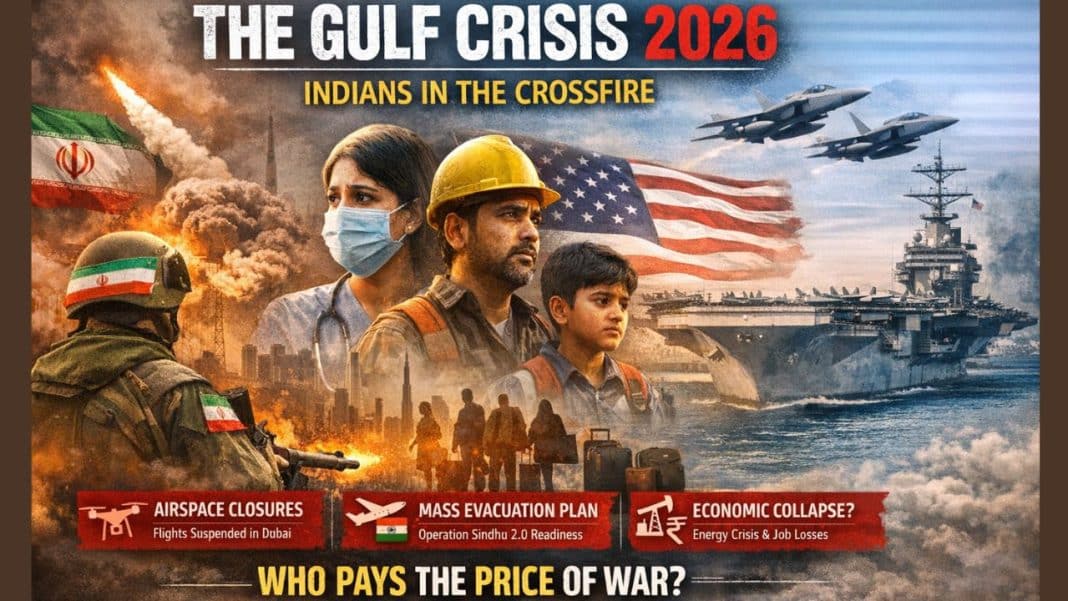

The Gulf Crisis 2026: The Gulf Cooperation Council (GCC) region, home to the world’s most ambitious architectural marvels and its busiest trade veins, is currently shivering under the shadow of a potential “Great War.”
What was once a beacon of stability and luxury has transformed into a high-alert zone as the military standoff between Iran and the United States reaches a breaking point.
The Geopolitical Spark: Why the Gulf is Trembling
The current instability stems from a direct military confrontation between Iran and the U.S.
Following strikes on February 28, 2026, Tehran issued a definitive warning: any nation hosting American military assets or supporting U.S. interests is a legitimate target.
Strategic Vulnerability: Countries like the UAE, Qatar, and Kuwait host critical U.S. airbases (such as Al Udeid and Al Dhafra). Iran’s rhetoric has turned these business hubs into potential frontlines.
The “Early Spring Break” Phenomenon: To prevent civilian casualties and manage panic, the UAE Ministry of Education announced an early spring break from March 9 to March 22, 2026.
Schools and universities are operating remotely where possible, while others remain shut to ensure student safety.
Airspace Paralysis: On March 16, 2026, Dubai International (DXB) temporarily suspended flights after drone-related incidents near the airport.
Major carriers like Emirates and flydubai have urged passengers not to travel to the airport without confirmed re-bookings.
The Human Crisis: 8.8 Million Indian Lives in the Crossfire
The most heart-wrenching aspect of this crisis is the impact on the Indian expatriate community.
For decades, the Gulf has been the “Land of Opportunity.” Today, it feels like a gilded cage.
The Demographic Breakdown (Latest Data):
| Nation | Indian Population (Approx.) | Economic Role |
|---|
| United Arab Emirates | 3.4 Million | Tech, Construction, Hospitality |
| Saudi Arabia | 2.5 Million | Oil & Gas, Healthcare, Infrastructure |
| Kuwait | 1.0 Million | Logistics, Finance, Retail |
| Qatar | 0.8 Million | Energy, FIFA Legacy Projects |
| Oman | 0.7 Million | Trade, Agriculture, Services |
| Bahrain | 0.3 Million | Banking, Telecommunications |
The Agony of Choice: These millions face a brutal dilemma. Leaving means abandoning life’s savings and career stability. Staying means living under the threat of sirens.
Recent reports from Human Rights Watch (March 17) indicate that migrant workers have unfortunately been among the victims of falling debris from intercepted projectiles.
Economic Fallout: A Global Heart Attack
The GCC isn’t just a place where people live; it is the Energy Reservoir of the world.
Energy Security: Industrial plants belonging to Saudi Aramco and ADNOC are on maximum alert.
With threats to the Strait of Hormuz, global crude prices are volatile, threatening a global recession.
The Remittance Factor: India receives nearly 28.6% of its total foreign remittances from the GCC.
A prolonged conflict threatens the financial lifeline of millions of households in Kerala, UP, Bihar, and Punjab.
What You Need to Know (The “Safety Blueprint”)
Operation Sindhu 2.0: While the 2025 operation focused on Iran, the Indian government is now coordinating with GCC authorities for a potential mass-repatriation plan if the situation escalates further.
Visa & Legal Protection: Several GCC governments are considering automated visa extensions for those stuck due to flight cancellations, so you don’t need to worry about “Overstay Fines” during this active conflict.
The Power of Community: Indian expat groups in Dubai, Sharjah, and Riyadh have started “Home-Stay” initiatives, opening their doors to fellow citizens stranded at airports or transit points.
Government Response & Safety Protocols
The Indian Ministry of External Affairs (MEA) has activated its emergency protocols:
Movement Restrictions: Stay indoors after 9:00 PM in major cities. Avoid government buildings and military zones.
MADAD Portal: It is mandatory to register your current location on the MADAD portal for evacuation priority.
Emergency Helpline: * UAE: 800-46342
KSA: +966-542126748 (WhatsApp)
The Moral Question
As the world watches the missiles and the rhetoric, we must ask: Who pays the price? The war isn’t fought by those who start it; it is lived by the common man the nurse in a Riyadh hospital, the engineer in Abu Dhabi, and the student in Dubai. They are the resilient, silent observers of a history they hope never unfolds.
“Disclaimer: The situation in the Gulf is evolving rapidly. Readers are advised to follow official updates from the Indian Embassy and local Gulf authorities for real-time safety instructions.”
By: Snigdha