


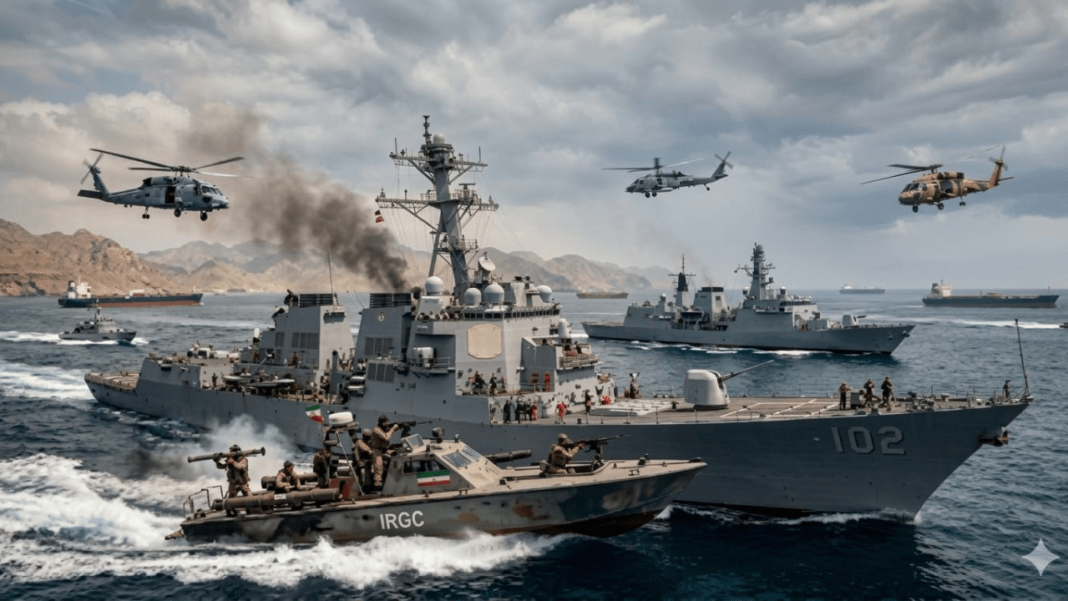

The Hormuz Standoff: This morning will be recorded as a dark chapter in the pages of history.
The waves of the Persian Gulf are not calm today; they are witnessing a storm that is ready to engulf not only the Middle East but the entire global economy.
The Strait of Hormuz, often called the world’s “economic jugular vein,” is now held in the iron grip of Iran’s Revolutionary Guards (IRGC).
Iran’s declaration, “Any movement will face a harsh response”, is not merely a military threat.
It is a direct challenge to the international order that the U.S. and its allies have claimed to maintain for decades.
Turning back three massive cargo ships at gunpoint is proof that the diplomacy table is burning, and the smell of gunpowder has dissolved into the air.
The Battlefield of ‘Hormuz’: A Strategic Analysis
The Hormuz Standoff: The Strait of Hormuz is the world’s most sensitive ‘choke point.’
Imagine a narrow passage only 21 miles wide, yet 20% of the world’s crude oil and massive amounts of LNG (Liquefied Natural Gas) pass through here.
The three ships Iran stopped today were not just structures of iron; they were symbols of global trust.
The IRGC has made it clear: from now on, only those with Tehran’s permission will pass
This isn’t just “maritime bullying”; it is the desperation of Iran arising after four weeks of intense war.
When a country feels it has nothing left to lose, it puts its hand on the world’s most precious nerve. Iran did exactly that today.
That Night in February
The roots of this crisis lie in the night of February 28, 2026.
Under ‘Operation Lionheart,’ American and Israeli fighter jets tore through the skies of Tehran.
That attack was not ordinary. According to reports, the compound of Iran’s Supreme Leader Ayatollah Ali Khamenei was targeted that night.
This ‘decapitation’ of leadership created a vacuum within Iran, which was filled by the hardline generals of the IRGC.
Control of Iran is no longer in the hands of politicians or religious scholars, but in the hands of generals who believe that “an honorable death is better than living on one’s knees.”
In the last 28 days, the U.S. has fired over 850 Tomahawk missiles at Iran, but this new military leadership has become more aggressive instead of bowing down.
- Trump’s 15-Point ‘Peace Gamble’
In Washington, President Donald Trump faces a dual challenge.
On one hand, he must bring Iran to its knees, and on the other, he must manage falling ratings at home and rising oil prices.
A 15-point peace proposal sent through Pakistan is being seen as Trump’s last-ditch effort. The main points include:
Ceasefire on Infrastructure: No attacks on Iran’s energy infrastructure until April 6.
Sanctions Relief: Economic concessions in exchange for humanitarian aid.
The Condition: Iran must completely end its nuclear ambitions and proxy networks (Hezbollah, Houthis).
But for Tehran, this proposal is not ‘peace’, it is a ‘document of surrender.’
Iran’s demand is clear: first, the U.S. must remove its military from the Gulf and pay compensation for the destruction caused over the past month.
The Dark Shadow Over the Global Economy
If you are reading this news from any major city in the world, you might think this is a war in a distant land. It is not. A small move by Iran in Hormuz directly affects your pocket.
Sector Description of Impact
Oil Prices The level of $120 per barrel has been crossed. Experts believe it could hit $200 if the blockade continues.
Shipping Maritime insurance rates have jumped 600%. Shipping companies are now forced to go around Africa,
increasing both cost and time.
Food Security Food grain shortages have begun in Gulf countries, as most of their supply depends on this sea route.
Regional Equations: The Changing Face of Friend and Foe
This war has put Middle Eastern countries in a dilemma.
UAE and Saudi Arabia: These countries are directly within the range of Iranian missiles.
Recent attacks on Kuwait’s ports proved that Iran is now following a policy of “If we go down, we’re taking you with us.”
Israel: For Israel, this is a fight for existence. Benjamin Netanyahu’s government believes this is a ‘now or never’ opportunity to end Iran’s nuclear program.
Russia and China: Beijing’s silence is mysterious. China depends on Iran for its energy needs but is avoiding a direct clash with the U.S. Meanwhile, Russia sees this conflict as an opportunity to distract the world from Ukraine.
Human Tragedy: The Truth Behind the Headlines
War is not just about missiles and barrels; it is about human beings. More than 1,900 deaths have occurred in Iran.
There are long queues for food on the streets of Tehran.
A shortage of medicine has turned hospitals into graveyards. Despite this, the spirit of Iranian nationalism is at its peak.
In Israel and Gulf cities, the sound of sirens has become common.
People are sleeping in bunkers. This is the bitter reality of 2026 that the world never imagined.
April 6…The Day of Decision
Iran stopping three ships is not just a military action; it is a ‘trigger.’ it is a test of American endurance.
If the Trump administration ignores this challenge, their dominance will end. If they retaliate, the Strait of Hormuz will turn into a massive powder keg.
The April 6 deadline is approaching. The world hopes that back-channel diplomacy will succeed, but the ground reality tells a different story.
When swords are drawn and ships are being turned back, talk of peace feels like mere imagination.
We must understand that modern war is not just fought at borders; it has reached our economies, our internet, and our kitchens.
The Hormuz crisis is a reminder that we live in a global order that is like a house of cards, one card falls, and everything can collapse.
BY – ARUSHI SHARMA
Also Read: Rupee at 93.27: How the Historic Fall Will Hike Your LPG and Smartphone Prices