


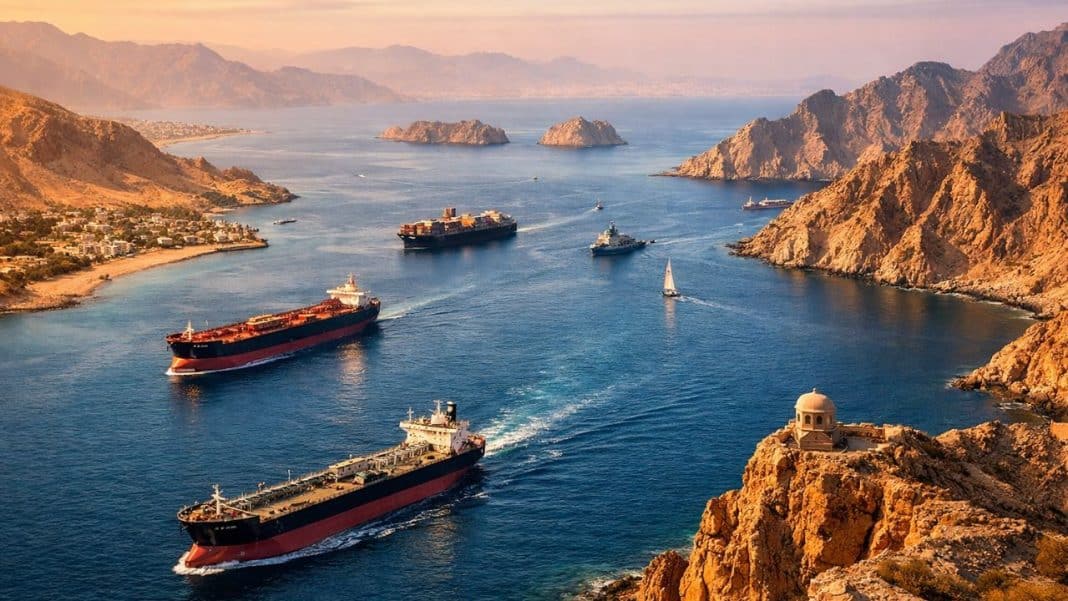

The Strait of Hormuz is one of the most important maritime chokepoints in the world. It connects the Persian Gulf with the Gulf of Oman and then to the Arabian Sea.
A large portion of the world’s oil supply passes through this narrow waterway, making it extremely important for global energy security and international trade.
Because of its strategic importance, any tension or disruption in the Strait of Hormuz can affect oil prices, global economies, and geopolitical relations.
Geographical Blueprint: Where and How?
The Strait is a curved body of water shaped like an inverted “V.”
Location: It separates Iran (to the north) from the Oman (specifically the Musandam Peninsula) and the United Arab Emirates (to the south).
Dimensions: It is approximately 96 miles (154 km) long. At its narrowest point, the width is only 21 miles (33 km).
The Shipping Lanes: Despite the width, the actual “navigable” water for massive oil tankers is very limited. There is a Traffic Separation Scheme (TSS) consisting of:
A 2-mile wide lane for inbound ships.
A 2-mile wide lane for outbound ships.
A 2-mile wide “buffer zone” in the middle to prevent collisions.
The Economic Powerhouse: Why the World Depends on It
The importance of the Strait is defined by the sheer volume of energy that flows through it every single day.
Oil Volume: On average, 20 to 21 million barrels of oil pass through the Strait daily. This accounts for roughly 25-30% of all seaborne-traded oil in the world.
Liquefied Natural Gas (LNG): Qatar, the world’s leading exporter of LNG, sends almost all of its gas through this Strait. Any blockage would literally “turn off the lights” for many countries in Europe and Asia that depend on gas for electricity.
Revenue Source: For the “Oil Giants” Saudi Arabia, Iraq, Kuwait, the UAE, and Iran this is their primary source of national income.
The Geopolitical Chessboard: Who Controls What?
The Strait is a flashpoint for international conflict because of the countries involved:
Iran’s Leverage: Iran has the longest coastline along the Strait. Because the shipping lanes fall within the “territorial waters” of Iran and Oman (under the UN Convention on the Law of the Sea), Iran frequently uses the threat of closing the Strait as a political tool against Western sanctions.
The U.S. and International Role: The U.S. Fifth Fleet, based in Bahrain, constantly patrols these waters.
Their mission is “Freedom of Navigation” ensuring that the Strait remains open for all nations, regardless of political disputes.
Oman’s Neutrality: Oman plays a silent but vital role in monitoring the traffic and often acts as a mediator between Iran and the West.
What Happens if the Strait is Closed? (The “Doomsday” Scenario)
If a war or a blockade were to occur, the effects would be catastrophic and immediate.
A. Global Market Collapse
Oil Prices: Experts predict oil could jump from current levels to $150 or $200 per barrel within days.
Supply Chain Crisis: Since oil is required for shipping, the cost of transporting everything (food, electronics, clothes) would skyrocket, causing global hyper-inflation.
B. Impact on India: A Crisis of Survival
India is one of the top three consumers of oil in the world and gets over 60-70% of its energy imports from the Persian Gulf.
Fuel Inflation: If the Strait closes, petrol and diesel prices in India could double or triple, leading to massive increases in the cost of fruits, vegetables, and transport.
Strategic Reserves: India has “Strategic Petroleum Reserves” (underground oil storage), but these can typically only sustain the country for about 9 to 14 days.
The “Gulf Connection”: Over 8 million Indians live and work in the Gulf countries. A blockade usually implies a military conflict, which would lead to a massive humanitarian crisis and the need for a “mega-evacuation” of Indian citizens.
Are there any Alternatives?
Countries have tried to build “bypass” routes to reduce their dependence on the Strait:
Saudi Arabia: Has the Petroline (East-West Pipeline) that can move oil to the Red Sea.
UAE: Has the Abu Dhabi Crude Oil Pipeline that goes to Fujairah on the Indian Ocean.
The Problem: These pipelines combined can only handle about 6.5 million barrels per day, which is less than 35% of what usually goes through the Strait. Most of the world is still “stuck” using the water route.
Current Status: Is it Safe Right Now?
Currently, the Strait is Open and Functional, but the tension is at a “high-boil.”
Recent Events: Over the last few years, there have been incidents of “tanker wars” where ships were attacked by drones or seized by naval forces.
Monitoring: Every ship passing through is monitored by radar and often escorted by military warships to prevent piracy or state-sponsored seizure.
India’s Oil & Gas Connection: The “Hormuz Factor”
India is the world’s third-largest energy consumer. While we have diversified our sources recently, the Strait of Hormuz remains our most sensitive security link.
- India’s Crude Oil Basket (By Country)
Historically, India received nearly 60% of its oil through the Strait. However, as of 2025-2026, India has strategically shifted its “basket” to reduce risk:
Supplier Country % Share in India’s Imports Route to India
Russia ~35-38% Safe (Black Sea/Baltic Sea)
Iraq ~18-20% Vulnerable (Via Strait of Hormuz)
Saudi Arabia ~15-17% “Mixed (Some via Strait, some via Red Sea)”
UAE ~8-10% Vulnerable (Via Strait of Hormuz)
USA ~6-8% Safe (Atlantic/Pacific Route)
Key Change: To protect against the current 2026 crisis, India has surged its Russian oil imports by 50% in the last month alone to bypass the troubled Gulf waters.
- The Cooking Gas (LPG) & LNG Crisis
While we can bring oil from Russia, LPG (Liquid Petroleum Gas) is a much bigger problem.
LPG Dependency: India imports about 60% of its total LPG.
The Chokepoint: Roughly 91% of India’s LPG imports come from the West Asia region (Qatar, Saudi, UAE), and almost all of it passes through the Strait of Hormuz.
Current Status: In March 2026, LPG prices in India were hiked by ₹60 per cylinder due to supply disruptions in the Strait.
Current Reality (March 2026): Is the Strait Closed?
The situation has escalated significantly.
The “Trickle” Effect: Following the outbreak of hostilities between Iran and the US/Israel in late February 2026, Iran has effectively blocked or heavily restricted movement. The International Energy Agency (IEA) reports that shipping has slowed to a “trickle.”
Force Majeure: Major suppliers like Qatar have invoked “Force Majeure” (a legal clause for unavoidable accidents), meaning they cannot guarantee their usual delivery schedules to India.
How is India Surviving This? (Government’s “Action Plan”)
The Indian government has activated an emergency energy shield to prevent a total blackout or fuel famine:
Operation Sankalp: The Indian Navy has deployed warships in the region to protect Indian-flagged vessels and negotiate safe passage for “neutral” cargo.
The “70% Shift”: As of March 11, 2026, the Ministry of Petroleum announced that India has successfully rerouted/sourced 70% of its crude oil from sources outside the Strait of Hormuz (mostly Russia and Africa).
Essential Commodities Act: The government has invoked this law to prioritize gas for households.
100% supply is being given to Domestic LPG and CNG (for cars).
35% cut has been imposed on industries and petrochemical plants to save gas for your kitchen.
Strategic Reserves: India has roughly 9–10 days of oil stored in underground “caverns” (Visakhapatnam, Mangaluru, and Padur) and another 25 days in refinery tanks to use in case of a total cutoff.
Conclusion: The Global energy Heartbeat
The Strait of Hormuz is more than just a waterway; it is the “jugular vein” of the global economy.
For a country like India, any blockage here is not just a trade issue it is a national emergency that can spike petrol prices and disrupt kitchens overnight.
While India is smartly diversifying its oil sources from Russia and the US, the sheer volume of energy passing through this 21-mile stretch makes it irreplaceable.
As long as the world runs on fossil fuels, global stability will continue to depend on the peace and “Freedom of Navigation” in this narrow strip of water.
By:Snigdha