


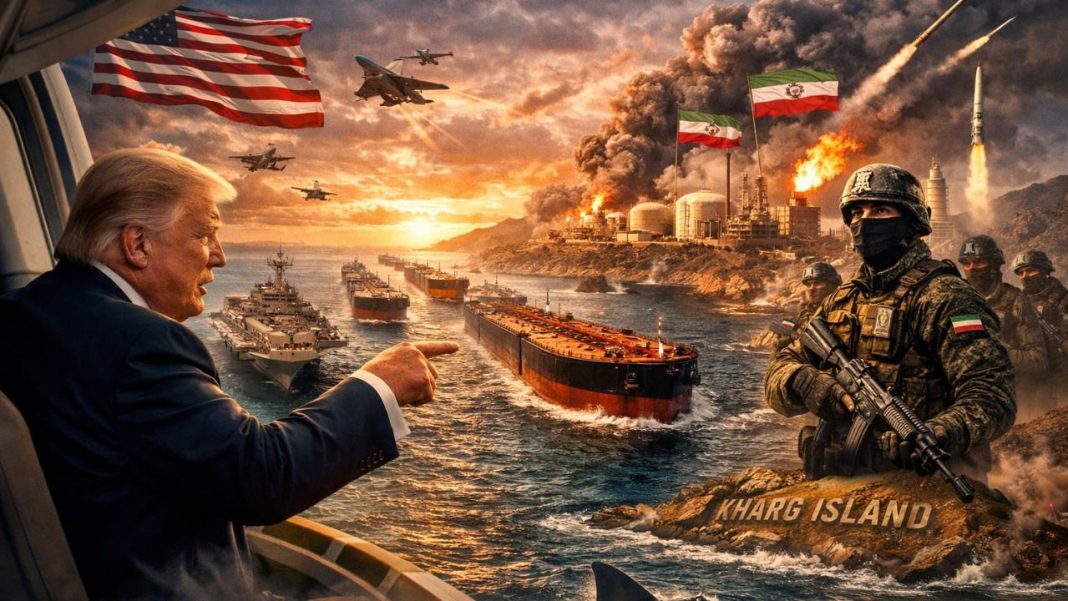

Trump’s Bold Gambit: In a move that has left geopolitical analysts stunned, Donald Trump claims that Iran one of America’s fiercest adversaries is currently sending 20 massive oil tankers directly to the United States as a “sign of respect.”
But don’t let the talk of “respect” fool you; the velvet glove covers an iron fist, as Trump simultaneously threatened to seize Iran’s primary oil hub, Kharg Island, warning that the nation could cease to exist if it doesn’t surrender its nuclear ambitions.
A Sudden Shift in the Strait of Hormuz
The Strait of Hormuz is widely considered the world’s most important oil transit chokepoint. While the region has been a literal powder keg of tension, Donald Trump revealed aboard Air Force One that the tide might be turning or at least, that Iran is flinching.
According to Trump, Iran initially agreed to send 10 tankers, a number that has now doubled to 20.
All these vessels are reportedly laden with crude oil and are navigating the treacherous waters of the Strait of Hormuz bound for American shores.
Trump interpreted this unprecedented move not as a routine trade, but as a symbolic gesture of submission.
“It’s a sign of respect,” Trump stated, suggesting that Tehran is finally feeling the heat of U.S. pressure and is looking for a way to de-escalate.
The Ultimatum: Kharg Island and the “Nuclear Dust”
While the news of the tankers suggests a diplomatic opening, Trump’s rhetoric regarding Iran’s infrastructure remains incredibly aggressive.
He turned his sights toward Kharg Island, the facility responsible for roughly 90% of Iran’s oil exports.
Trump signaled that the U.S. is seriously considering a military takeover of the island. He noted:
Military Presence: Any seizure would require a long-term U.S. military occupation to secure global oil flow.
The Nuclear Demand: Trump claimed Iran is now so weakened that they are ready to hand over even their “nuclear dust.”
The Existential Threat: In classic Trump fashion, he issued a dire warning: if Iran does not meet U.S. conditions and abandon its nuclear program entirely, “Iran will no longer be a country.”
This isn’t just empty talk; it follows a confirmed U.S. airstrike on Iranian positions on March 13, 2026, proving that the administration is willing to use kinetic force to back up its demands.
Iran’s Fierce Response: “Food for Sharks”
Tehran has not taken these threats sitting down. While there are reports of back-channel negotiations, the Iranian military leadership has responded with scorched-earth rhetoric.
Brigadier General Ibrahim Zolfaghari issued a chilling warning to American troops, stating that any U.S. soldier attempting to set foot on Iranian territory or seize Kharg Island would become “food for the sharks.” The Iranian leadership maintains that while they are open to mediation, they will not be bullied into a total surrender of their sovereignty.
The 15-Point Peace Plan: Fact or Friction?
One of the most surprising claims from the Air Force One briefing was the existence of a 15-point peace plan.
Trump revealed that the U.S. sent a list of 15 “hard” conditions to Tehran, delivered via intermediaries in Pakistan.
The Progress: Trump claims Iran has already agreed to “most” of these points.
The Discrepancy: While Trump is optimistic, officials in Tehran have been more cautious.
Last week, the Iranian government did not immediately sign off on the plan, and the Iranian Foreign Minister expressed deep skepticism regarding Washington’s true intentions.
Despite the skepticism, the fact that both sides acknowledge a 15-point framework exists suggests that the most intense period of the Middle East war might be moving toward a diplomatic crossroads even if that path is paved with threats of total destruction.
What this mean to the World
If Trump’s claims are accurate, we are witnessing a historic “Maximum Pressure” 2.0 campaign.
By squeezing Iran’s oil economy while simultaneously offering a path to “respectful” trade, the U.S. is attempting to rewrite the map of the Middle East without a full-scale ground war.
However, the risk of a “black swan” event remains high. With 20 tankers in the water and the threat of an island seizure hanging in the air, a single miscalculation in the Strait of Hormuz could send global oil prices into the stratosphere and ignite a regional conflagration.
By: Snigdha