


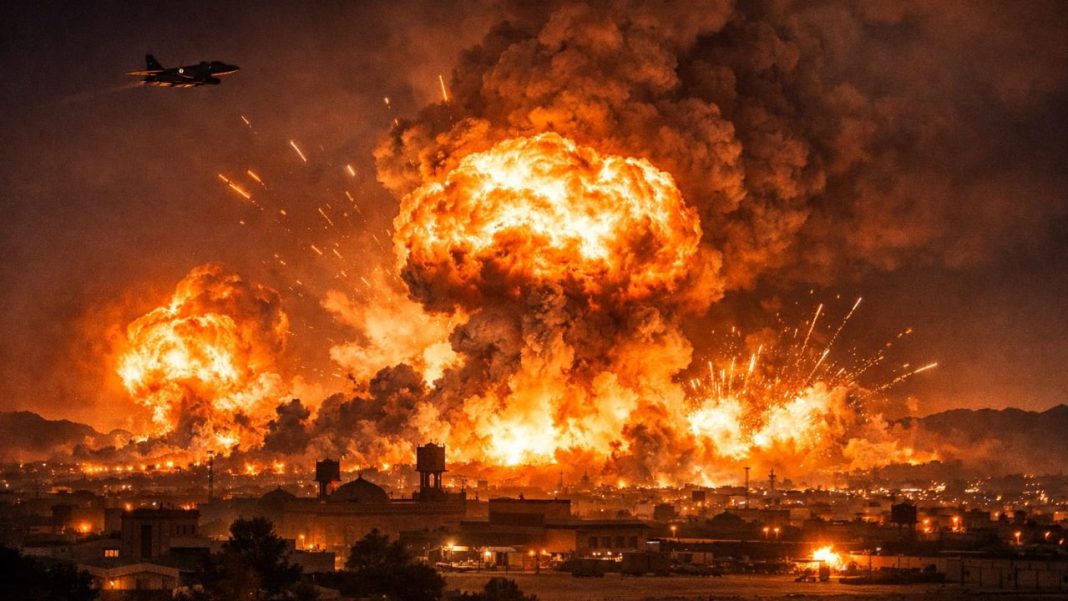

Isfahan is Shaking: In a massive escalation that has sent shockwaves across the globe, the United States has launched its most devastating strike yet on Iran’s military heartland.
Using 2,000-pound ‘Bunker Buster’ bombs, US forces targeted a high-security ammunition depot in Isfahan, a city central to Iran’s nuclear and military operations.
President Donald Trump personally took to social media to share a video of the massive explosions, where the night sky turned a haunting orange as secondary blasts tore through the facility.
The Strike: Precision Meets Power
According to US officials and reports from the Wall Street Journal, the operation utilized a heavy barrage of ‘penetrator munitions’.
These specialized bombs are designed to drill deep into reinforced concrete or underground bunkers before detonating.
The primary target was a massive ammunition depot, but the scale of the secondary explosions suggests that the “payload” hit something much larger than just standard artillery.
Isfahan is not just a military city; it is the suspected hiding place for Iran’s 540 kg of highly enriched uranium enough material to potentially fuel 11 nuclear weapons.
Trump’s warning become reality
The attack followed a clear ultimatum from President Trump. He had warned Tehran that if a deal wasn’t reached and the Strait of Hormuz (a vital global oil artery) wasn’t fully reopened, Iran’s energy and nuclear infrastructure would be “wiped out.”
By sharing the video on Truth Social, Trump sent a loud message to the world: the era of “strategic patience” is over.
The footage, though not yet independently verified by third parties, shows a series of rapid-fire detonations followed by massive plumes of smoke, indicating that the facility’s own stored explosives contributed to its destruction.
What happens next? The Impact & Future of the War
- The military impact: A broken Spine
Isfahan was the “safe room” for Iran’s most prized military assets. By proving that underground bunkers are no longer safe from US ‘Bunker Busters,’ the US has stripped away Iran’s sense of security.
Without its primary ammunition hub and with its nuclear material potentially buried under rubble, Iran’s ability to sustain a long-term conventional war has been severely crippled.
- The economic fallout
The threat to the Strait of Hormuz remains the biggest wild card. If Iran tries to block the Strait in retaliation, global oil prices could skyrocket.
However, with the US now targeting internal infrastructure directly, Iran risks losing its own refineries and power plants if it pushes too hard.
- How long will the war last?
Geopolitical analysts suggest we are entering a “Peak Pressure” phase. Trump’s strategy appears to be a “Short and Sharp” conflict hitting targets so hard and so fast that the Iranian regime is forced to the negotiating table to avoid total collapse.
-Will Iran give up? Hardliners in Tehran are under immense pressure. While they rarely “surrender” publicly, the loss of their nuclear leverage (the 540kg uranium) might leave them with no choice but to accept a ceasefire.
-The Timeline: If strikes of this magnitude continue, experts believe the active “hot war” phase could see a resolution or a forced truce within the next few months, as the Iranian military’s supply lines are being cut off one by one.
The Isfahan strike is a game-changer. It wasn’t just a move to destroy weapons; it was a move to destroy Iran’s nuclear clock. As the dust settles over Isfahan, the world watches to see if Tehran will take the “off-ramp” or if this “orange sky” was just the beginning of a much larger fire.
BY: Snigdha